
Disney Dollars: Disney’s Magical Money System
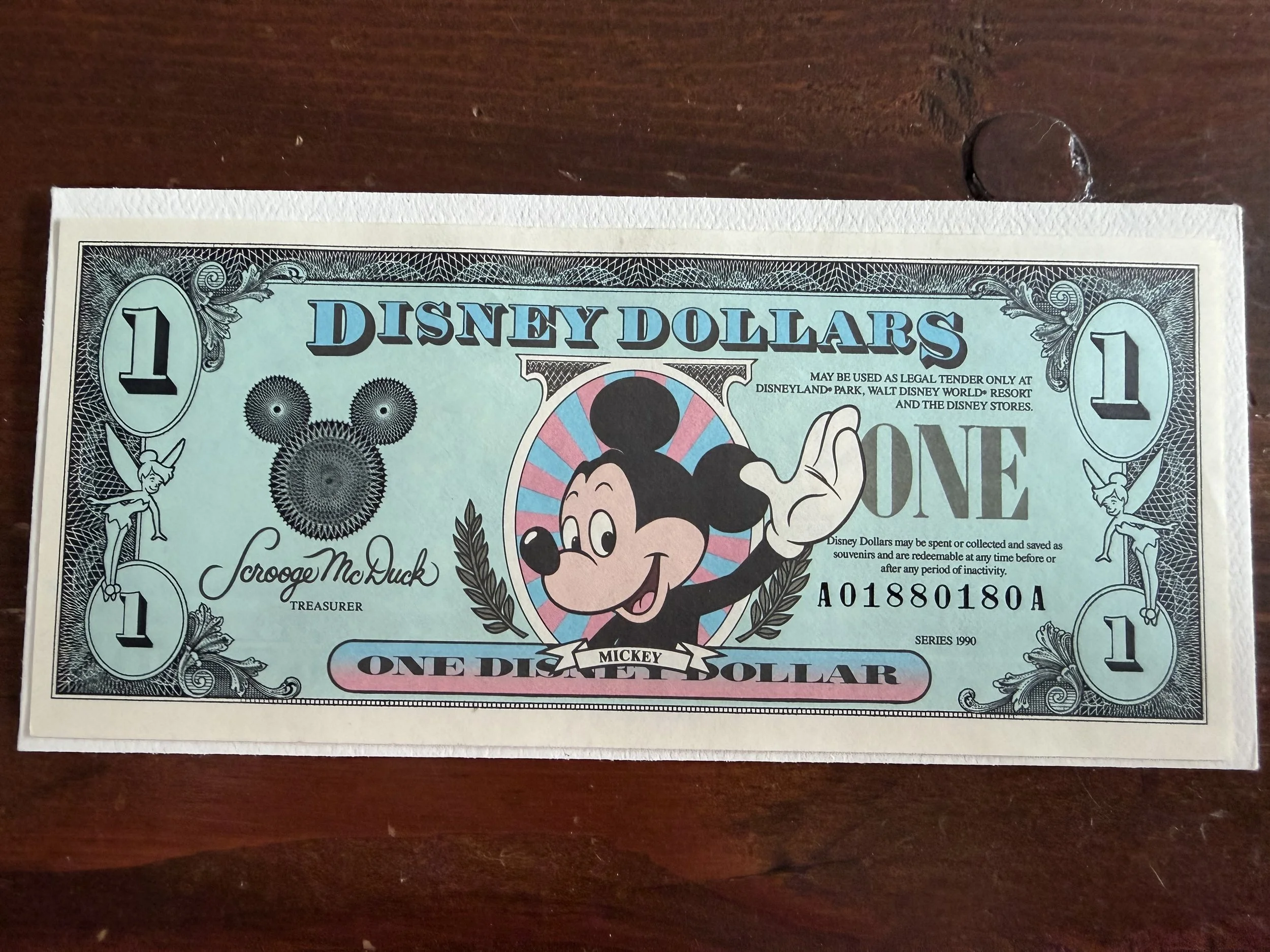
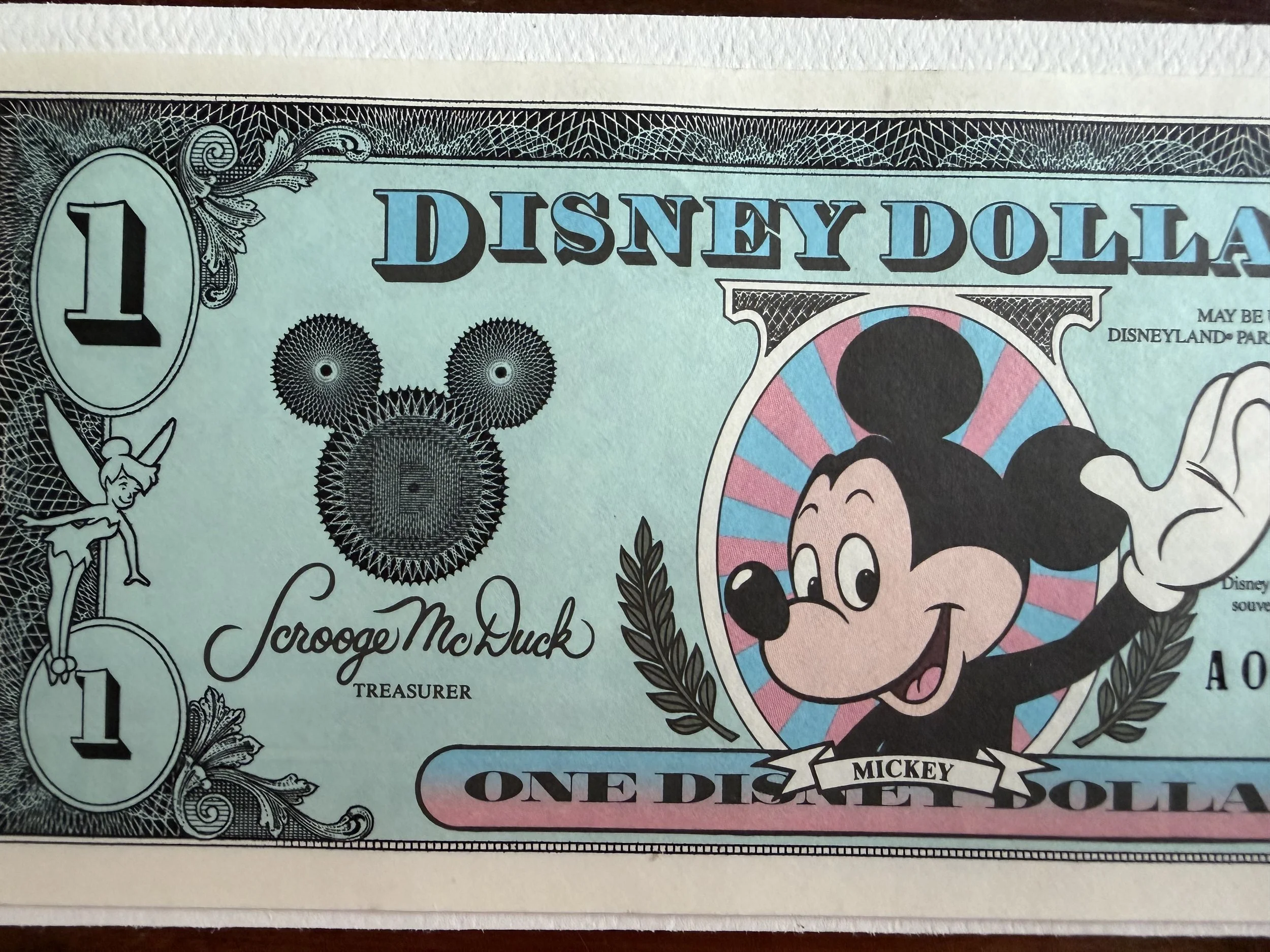
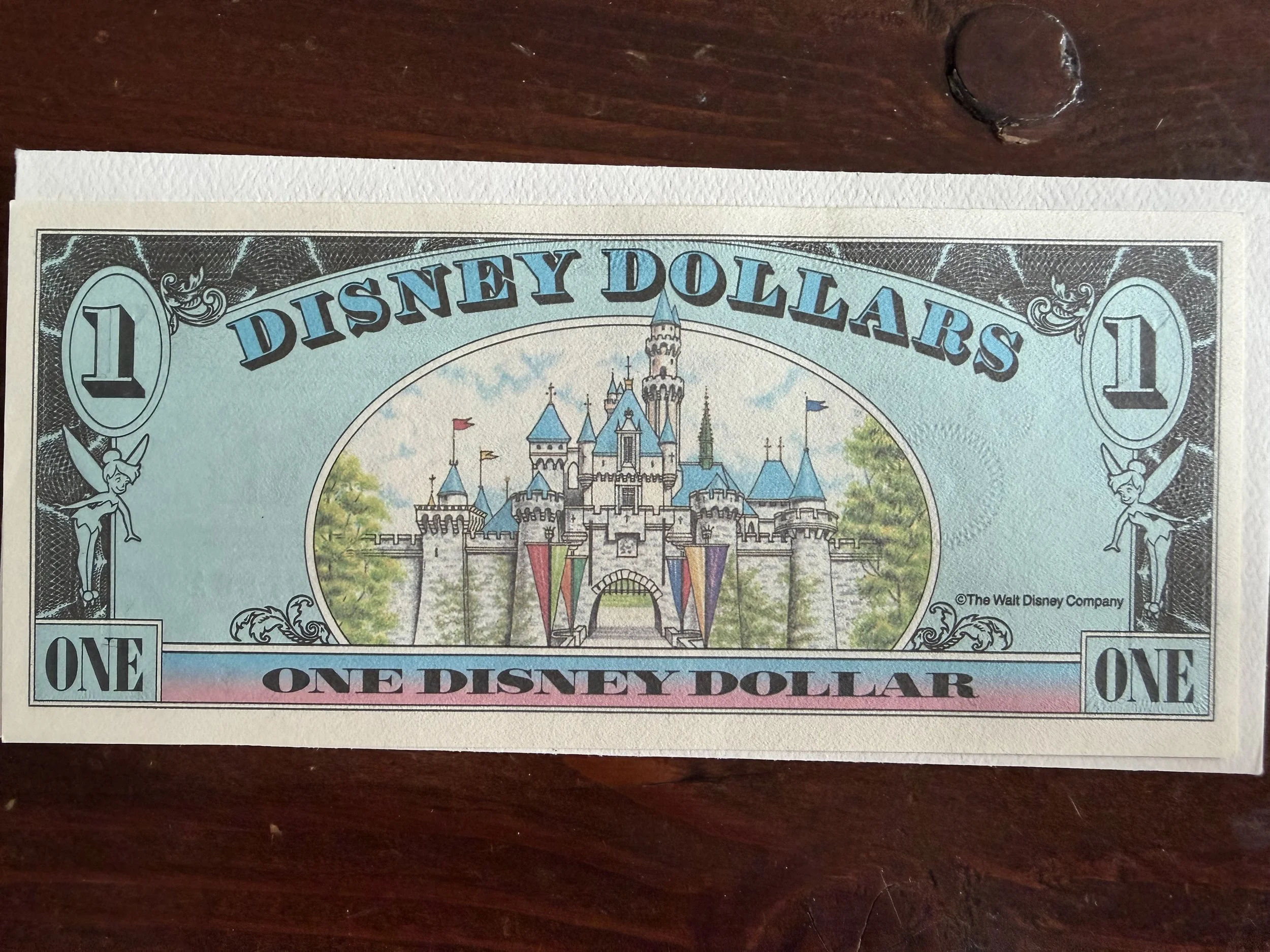
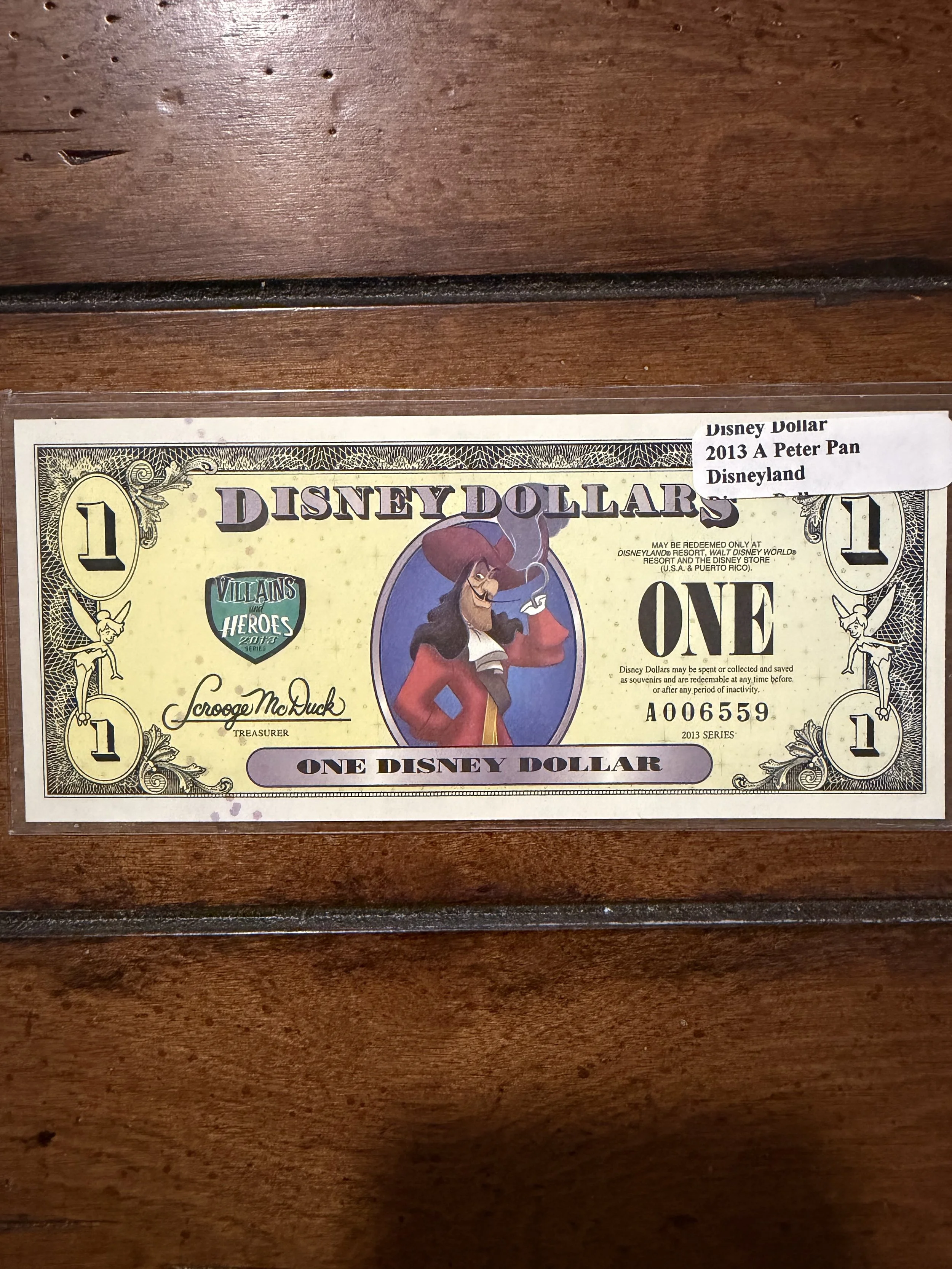
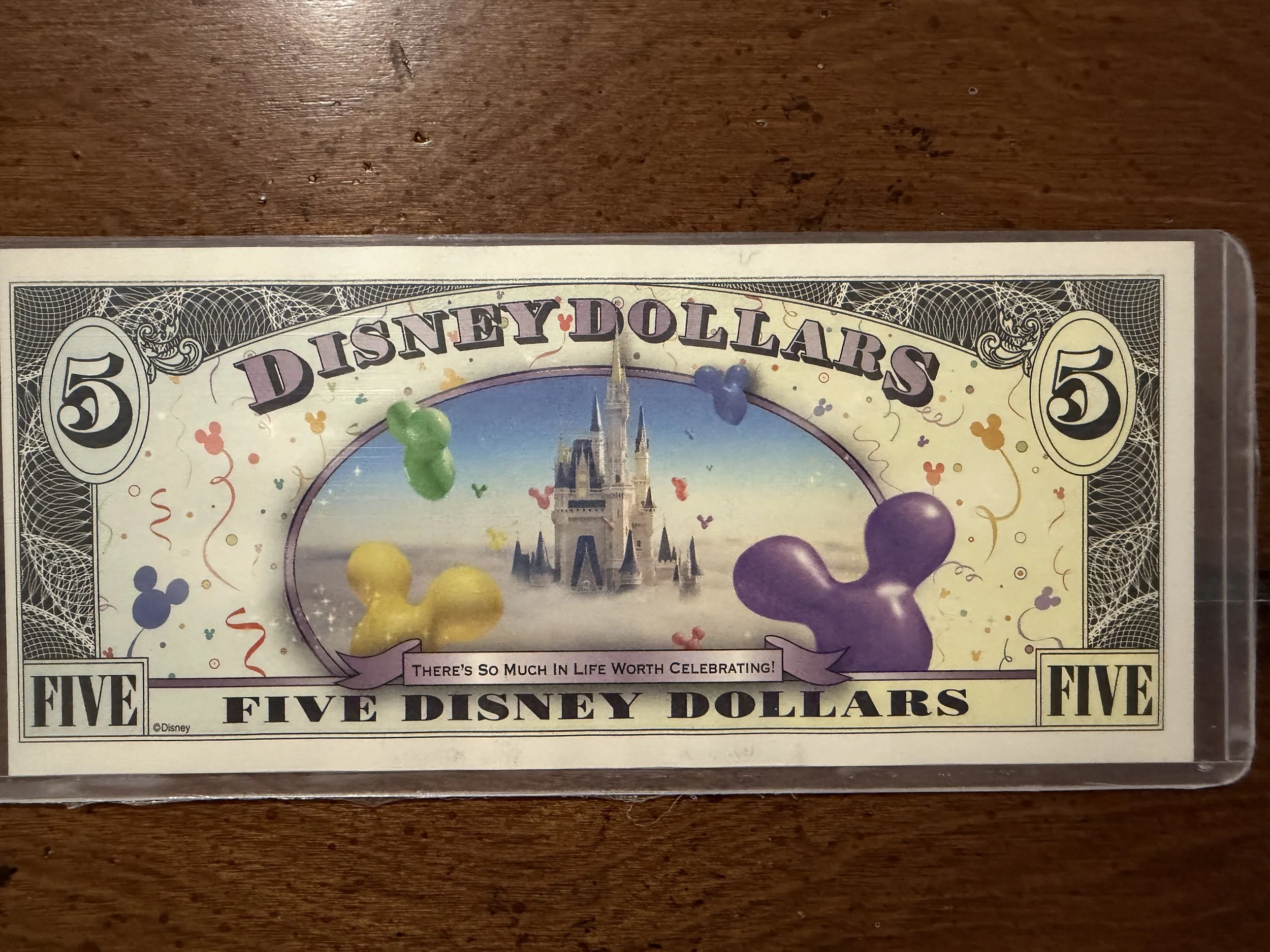
Imagine walking down Main Street U.S.A. in Walt Disney World, the scent of freshly popped popcorn wafts through the air, your child is staring lustfully at a huge, plush Mickey Mouse stuffed animal, and you fish a dollar bill out of your pocket... except this dollar bill has an enormous image of Mickey himself smiling on its face, with the iconic Sleeping Beauty Castle depicted on its reverse side!
That was the Disney Dollar! And if you've never seen a Disney Dollar before, then you've missed one of the most ingeniously clever, highly collectible, and emotionally rich pieces of currency the Disney Company has ever produced!
The one common pitfall shared by most writing on Disney Dollars is that it tends to focus solely on the historical or collector aspects. Disney Dollars aren't simply a form of currency no longer in circulation – they are artifacts of pop culture history, family traditions, childhood memories, and for the die-hard Disney enthusiast, a genuine asset stored safely away in a protective case in some climate-controlled suburb in America!
So why does Disney Dollars even matter? First of all, because Disney Dollars weren't merely printed as part of the currency system. Disney actually printed its very own currency for 29 years! Yes, you read that right, and here's your chance to find out more! Welcome to the world of Disney Dollars!
What Are Disney Dollars, Exactly?
Corporate Scrip is any privately issued currency that can be utilized to acquire goods and services offered by a particular corporation. Think of it as the world's most exquisite gift card; however, the Corporate Scrip looks and feels like regular US money except for its unique design!
On May 5, 1987, The Walt Disney Company first issued Disney Dollars, which were officially printed, designed, and circulated by Disney for use in its theme parks, resorts, cruise ships, Disney stores, and Castaway Cay (Disney's own Bahamian Island). Disney Dollars may not have been legal tender in the traditional sense of the term, but for all intents and purposes, they were just as valuable as any US dollar while in use within the Disney universe!
The idea of using Corporate Scrip is not unique to Disney. Mining companies in the nineteenth century used corporate scrip to pay their employees who worked in far-off locations. However, Disney made something more out of it. They created something that not only serves as a souvenir but could also be spent as currency!
Over the years, Disney Dollars were printed in the following denominations:
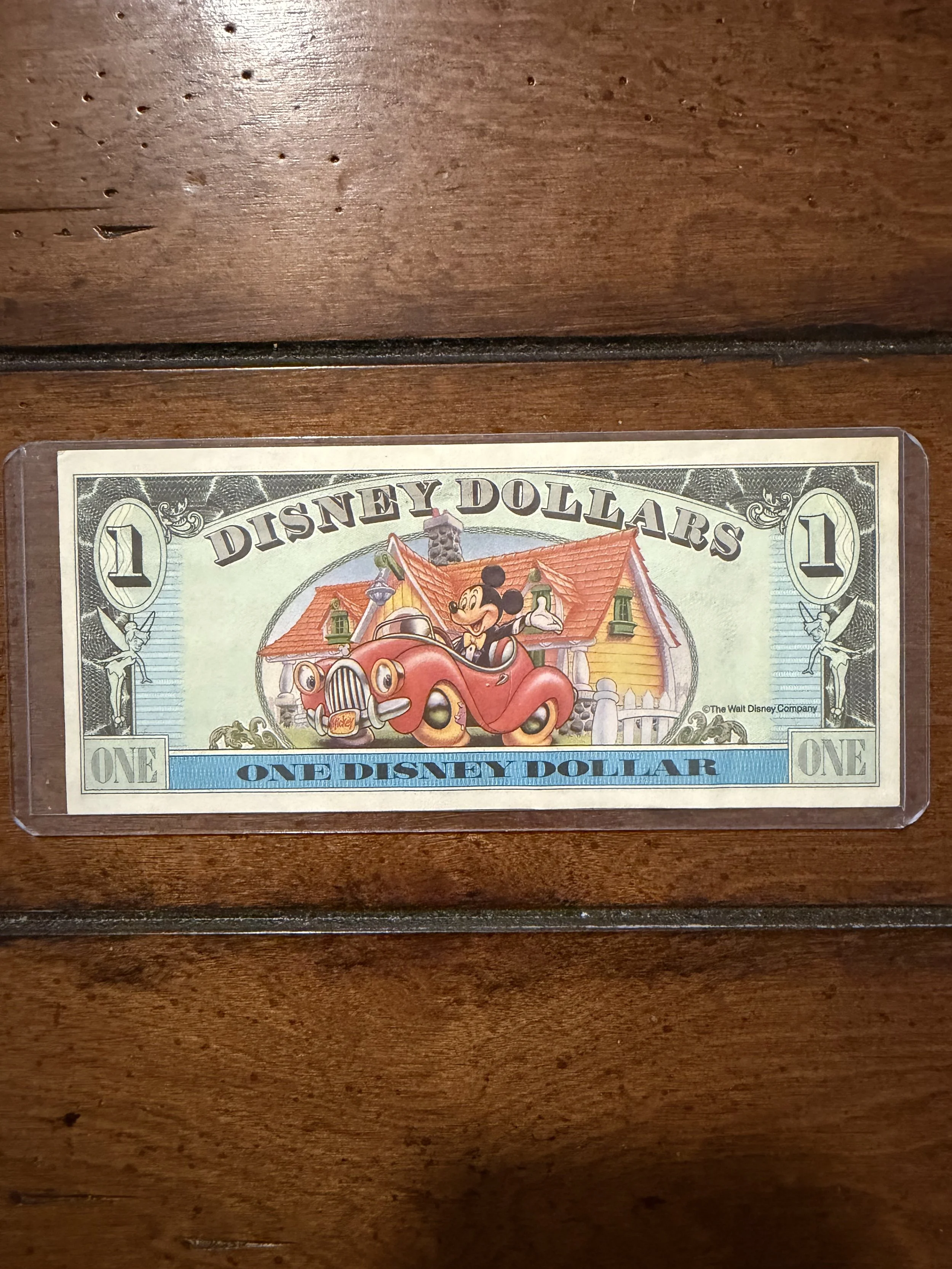
$1 bill (first released in 1987)
$5 bill (first released in 1987)
$10 bill (introduced in 1990)
$50 bill (launched in 2005 in celebration of the fiftieth anniversary of Disneyland)
$20 bills were also rumored to have been printed in limited amounts. However, among the four mentioned above, the $1, $5, $10, and $50 bills are considered the most sought-after and recognizable Disney Dollar denominations. To date, Disney Dollars have produced an impressive one hundred seventy-two varieties in nearly thirty years of production! Crazy right? Some are easy to find while others are almost impossible!
Do you love everything Disney? You should think about becoming a travel agent and get paid to book Disney trips and enjoy discounted trips to the Parks! Here at MainStreet it only costs $99 to join! We have a high 70/30 commission split and no required working hours or bookings! You can start working from home and enjoy more travel by joining today!
The Disney Dollar Origin Story
Great ideas are sometimes created in unusual situations. Disney Dollars did not have their inception in the board of directors' room but rather at Disneyland when Harry Brice, who worked there cutting the silhouettes on Disneyland Main Street, participated in the Disney memorabilia collectors convention. He came up with an excellent idea to issue special souvenir that could be used as a currency while visiting Disneyland!
Management at Disney was eager to implement this idea. The bills were printed in EPI of Battle Creek, Michigan, and one unique thing about them is that they became the first colored notes issued in the United States. It was not only a souvenir, but a technical innovation as well because this bill represented a real technological challenge to make paper money.
Walt Disney World Epcot became a participant of this program on October 5, 1987, just a few months after the inauguration of Disneyland. From 1992 Disney Stores accepted this money. Therefore, this project covered the whole company.
One funny thing deserves mentioning here. Some sources mention that the concept was thought up by Jack Lindquist, the first president of Disneyland, while others insist that Harry Brice had come up with it. Whichever it was, it is probable that both of them played a crucial role in developing the idea into a program!
The Series System: A, D, and T
Disney Dollars weren't just one big batch of bills. They came in distinct series, and understanding this is crucial if you're a collector (or want to become one)!
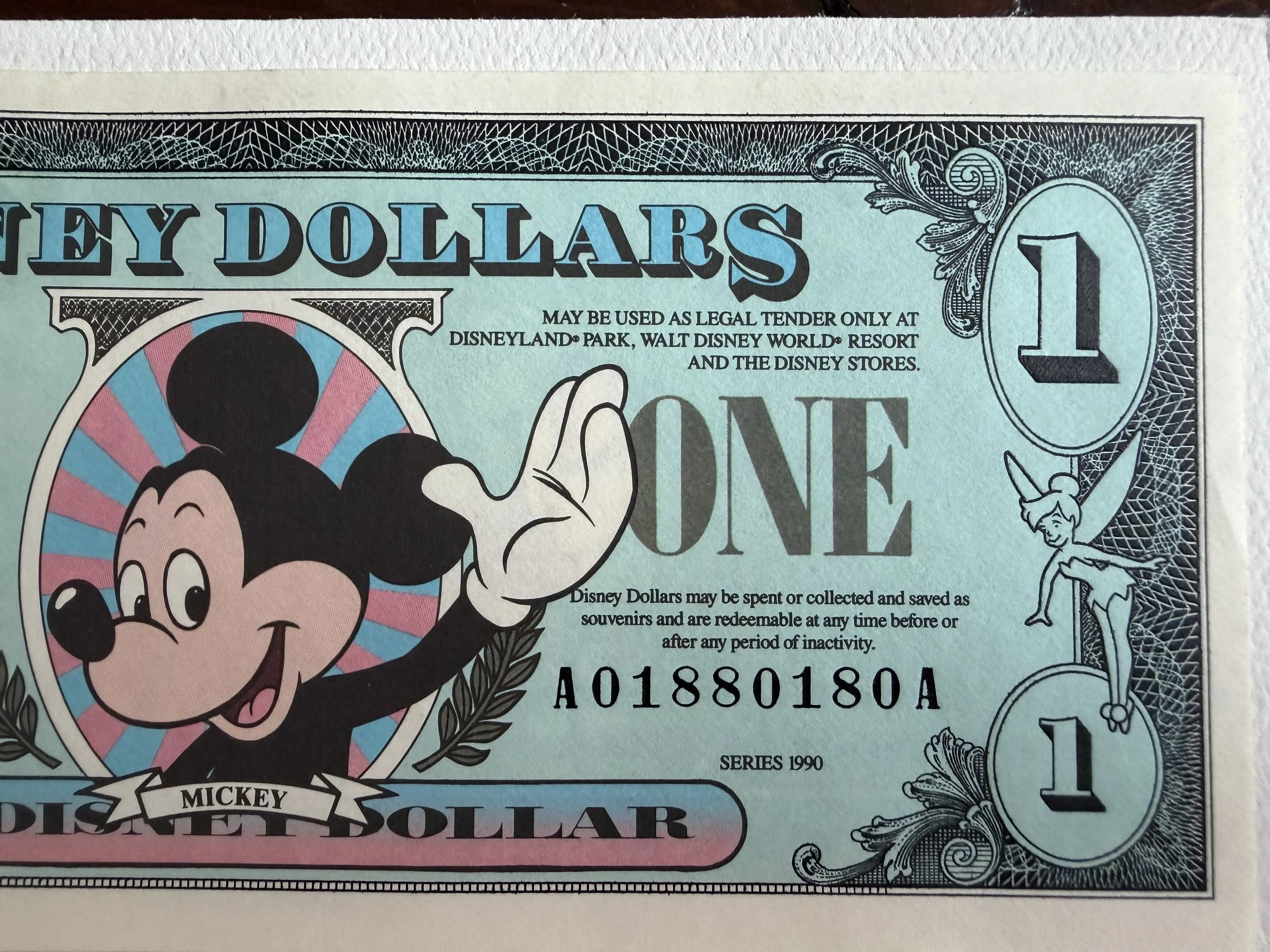
Series A — Issued for Disneyland Resort in Anaheim, California. Serial numbers begin with the letter A.
Series D — Issued for Walt Disney World Resort in Orlando, Florida. Serial numbers begin with D.
Series T — Issued for Disney Stores starting around 2004-2005. Disney Stores stopped selling Disney Dollars in October 2009.
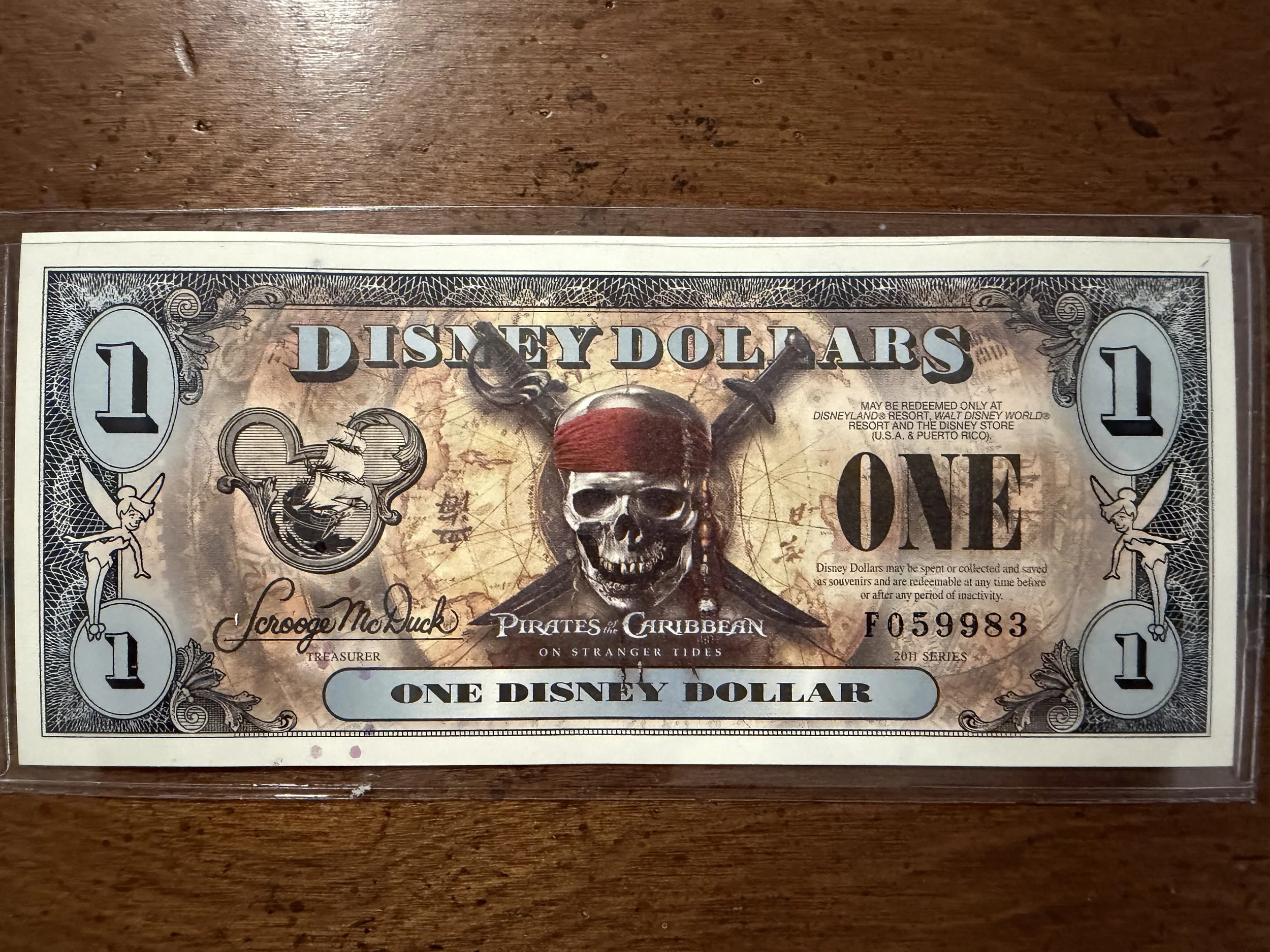
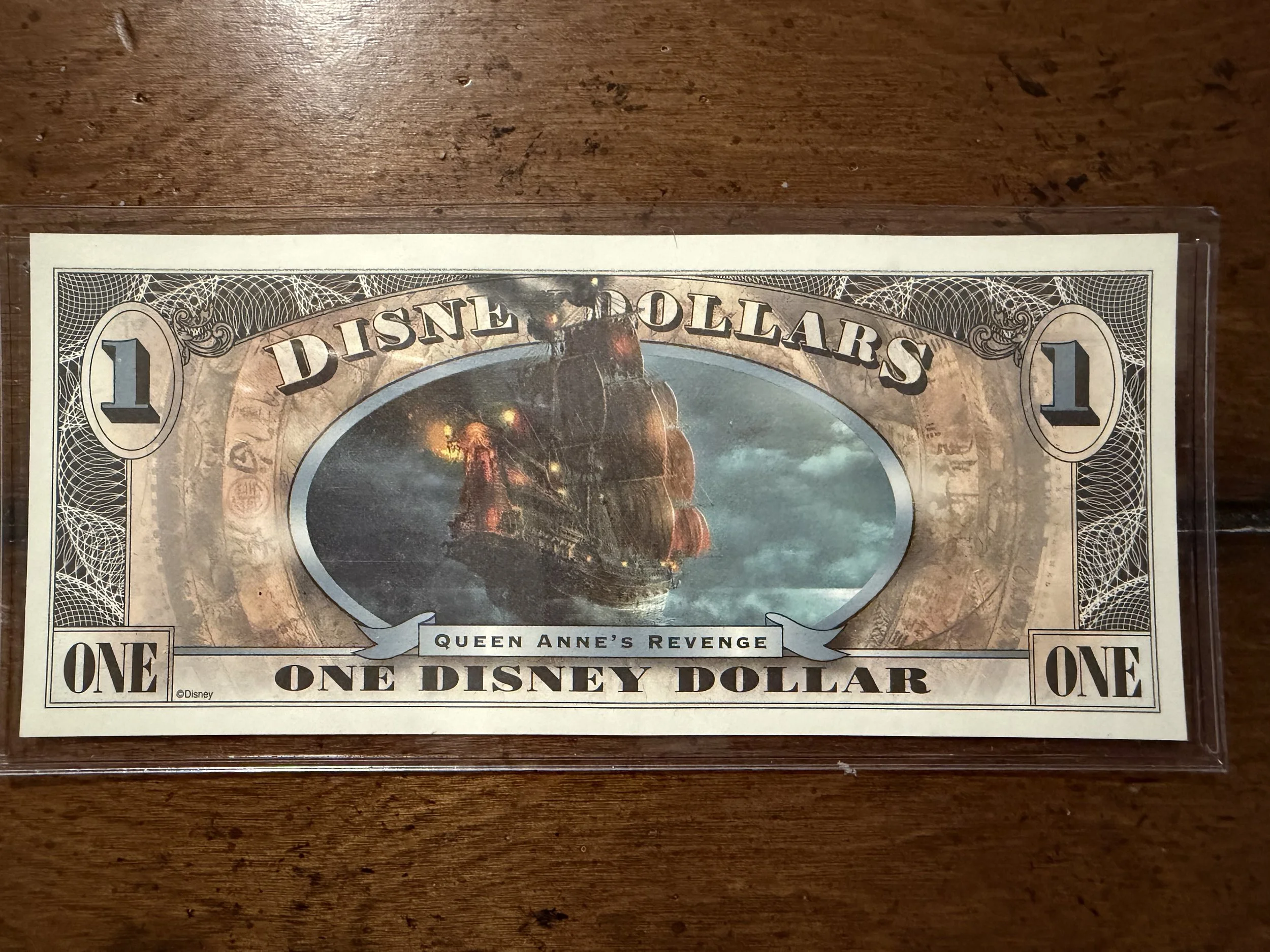
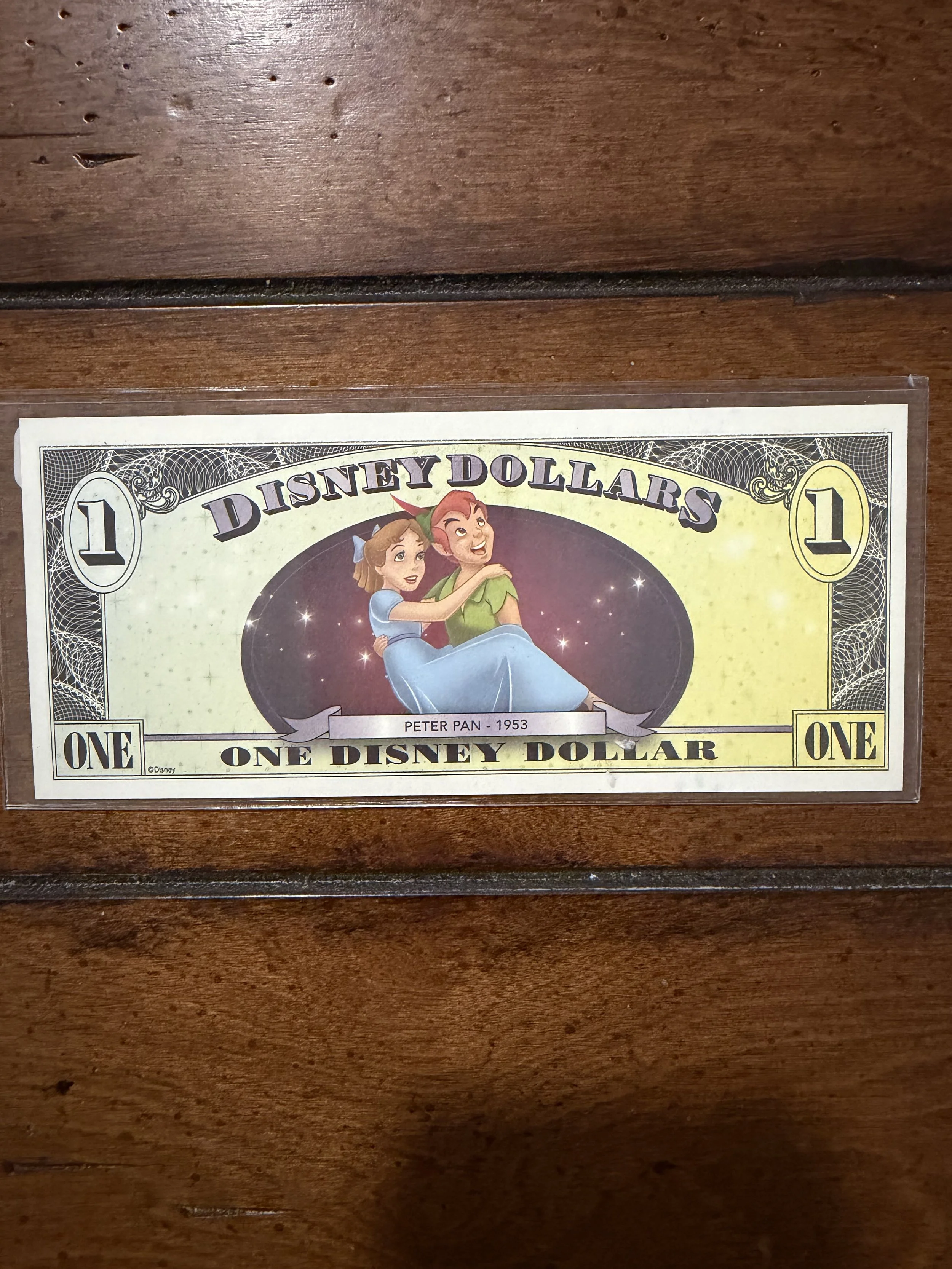
Each series was further divided by year, since the designs changed annually. This annual rotation of characters and themes is a big part of what made collecting Disney Dollars so addictive, every year brought a fresh set to hunt down! Featured characters over the years included Mickey Mouse, Minnie Mouse, Donald Duck, Goofy, Pluto, Dumbo, Snow White, Ariel, Sleeping Beauty, and many more, with Disney park landmarks often gracing the reverse side.
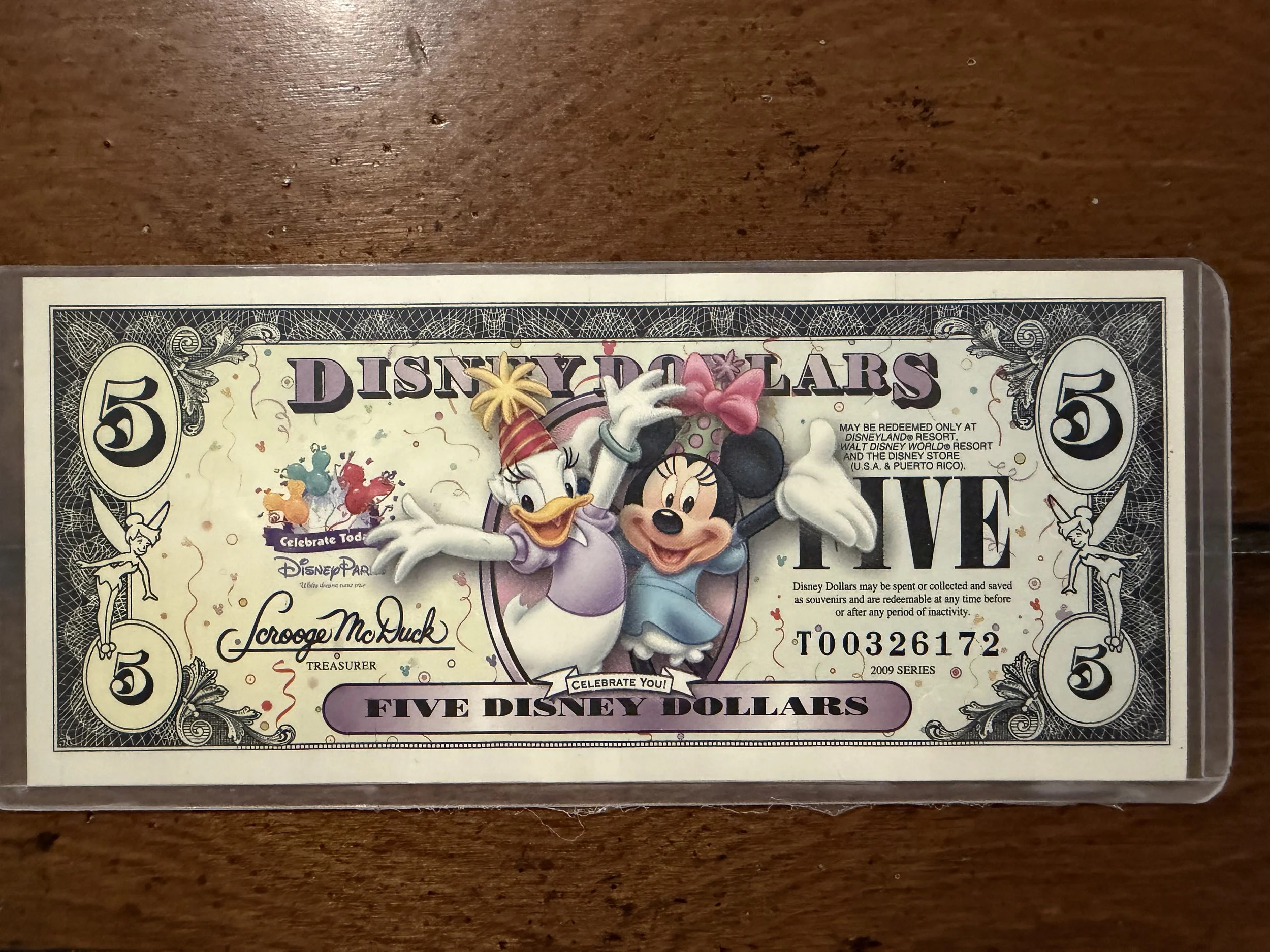
One delightful detail that remained consistent across every single Disney Dollar ever printed: Scrooge McDuck's signature appears as the Treasurer on every bill! Because obviously, who better to manage Disney's money than the richest duck in the world?
The Disney Dollar Security Features
One thing you probably didn’t know about Disney dollars is that they were made using authentic anti-counterfeiting technology similar to that used on actual currencies.
These notes had the following:
Microprinting – Very tiny text that cannot be seen without magnification; microprinting appeared on the front of the $10 bills issued from 1990 onward
Reflective Ink – Very hard-to-scan and hard-to-reproduce ink used to print Disney Dollars' faces; this "pixie dust" ink was used from 1996
100% Cotton Paper – The same paper as used in making US dollars, giving these bills a very authentic look and feel
Unique Serial Numbers – Every Disney dollar bill had its own unique serial number between 00000001 and 99999999. The serial letter would show what value and issuing place was for each individual bill
Intaglio Printing – Raised ink printing that would give Disney dollars the same look as US currency
Glitter (Pixie Dust) – Tiny pieces of glitter randomly spread over all subsequent bills released. Apart from creating a more magical look, this glitter also worked as anti-counterfeiting technology
Barcodes – In 2005 and onwards, a barcode was added to the back of each dollar note; this barcode contained information such as the serial number, year, and denomination of the bill. Disney could have tracked the date and point of purchase for every individual bill; this technology was dropped from 2007
The bills were so well-made that they're still accepted in Disney's U.S. theme parks today! That’s years after they stopped being printed and that's not by accident. Disney built these things to last!
Why Disney Stopped Making the Disney Dollar
On May 14, 2016, Disney announced that the printing and circulation of Disney Dollars would be terminated. This announcement shocked the Disney collector community!
According to the official statement, the popularity of gift cards and other means of electronic payments made the use of printed money unfeasible. As mentioned above, Disney Gift Cards were a good substitute for the pre-paid tickets issued before and served the same purpose as Disney Dollars.
There is another aspect of the matter that lies behind the statement. As mentioned earlier, the printing and circulation of Disney Dollars were not profitable in any way, and Disney did not earn on the production of bills. What was actually beneficial to the company was the money it earned from its clients but never received, which is known as the "float".
It is worth noting, however, that at the moment of terminating the printing and circulation of Disney Dollars, the Disney collecting community was still strong. PCGS Currency had graded about 20,000 Disney Dollars prior to 2016, and Disney Dollars formed one of the most competitive categories within the PCGS Currency Set Registry program. The vice president of PCGS Currency stated that he could not understand the decision of Disney since, from the point of view of profit from float, uncirculated Disney Dollars were purely profitable for the company!
The good news for holders is that Disney Dollars do not expire and are still accepted at face value at all U.S. Disney parks, Disney cruise ships, and select Disney Store locations! They just can't be purchased new anymore. So sad!
Disney Dollars as Collectibles
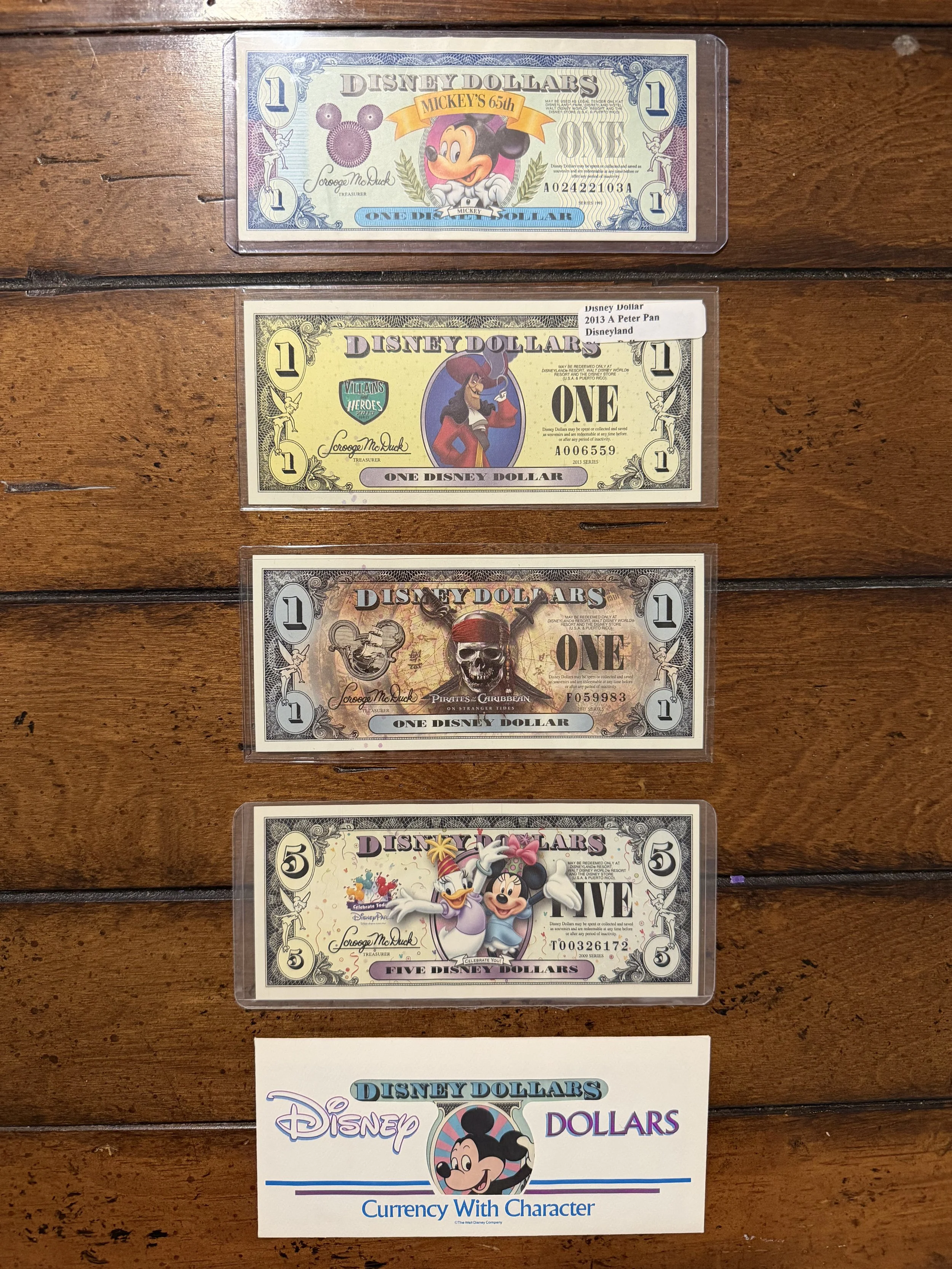
If you found a Disney Dollar in a box of old vacation stuff and thought, oh neat, free money for my next trip — stop! Put the bill down gently and check the date. Because you might be holding something worth significantly more than its face value!
The collectibles market for Disney Dollars has exploded since the 2016 discontinuation, exactly as experts predicted. Here's a breakdown of what drives their value:
What Makes a Disney Dollar Valuable?
1. Condition (Grade)
This is the single biggest value driver. A crisp, uncirculated, never-folded Disney Dollar is worth dramatically more than one that's been crinkled in a wallet. Collectors use third-party grading services, specifically PMG (Paper Money Guaranty) and PCGS Currency, to certify the condition of their notes on a 70-point scale. A grade of 70 (perfect, Supreme Gem Uncirculated) represents a flawless note! Once graded, notes are sealed in tamper-evident holders with holograms and UV watermarks.
2. Year and Rarity
The 1987 issues are the most prized because they were the first. Low-print-run editions, special anniversary releases, and cast-member-exclusive notes carry a premium! The general rule: the fewer printed, the more valuable.
3. Denomination
The $50 bill (issued only in 2005 for Disneyland's 50th anniversary) is the rarest denomination and arguably the most sought-after piece of Disney currency! A signed, uncirculated example sold at Heritage Auctions in April 2024 for $10,800!
4. Uncut Sheets
Uncut proof sheets (multiple bills printed together before being cut) are among the most coveted Disney Dollar collectibles! Only 400 of the original 1987 five-dollar Goofy uncut sheets were produced. One such sheet, hand-signed by Disney artist Matt Mew and numbered 137 of 400, sold at Heritage Auctions in November 2025 for $1,320. Another uncut sheet sold at Heritage in 2021 for $2,040!
5. Artist Signatures
Disney Dollars signed by the original artists who designed them fetch major premiums! If you come across a signed bill, treat it with extreme care!
6. Low Serial Numbers
Bills with serial numbers like A00000001A (the very first of a series) are extraordinarily rare and valuable!
What’s Your Disney Dollar Worth Right Now?
Here's a real-time value snapshot based on the latest market data:
🟢 Everyday Finds
$1 bill from 1987 — Circulated: Worth roughly $10–$30. Even a well-loved bill with a few folds is worth 10–30x its face value. Don't toss it!
$10 bill from any year — Circulated: Expect $20–$70 depending on the character and condition. Common but still collectible.
🟡 Mid Tier Collectibles
$1 bill from 1987 — Uncirculated & Graded: A crisp, never-folded, professionally graded example bumps up to $50–$150+. Grading makes a huge difference.
$5 bill from 1987 — Uncirculated: The first-ever $5 Disney Dollar, in mint condition, can fetch $200–$500. That's up to 100x face value.
$5 Snow White from 2002 — Uncirculated: A fan-favorite design that commands $279–$475 in top condition!
🔴 Rare Disney Dollars
$50 Anniversary Bill from 2005 — Uncirculated: The rarest denomination ever made! Values range from $200 on the low end all the way to $10,800+ for signed, high-grade examples auctioned at Heritage Auctions. This is the crown jewel of Disney Dollar collecting!
1987 Uncut Sheets — Uncirculated & Signed: These were produced in batches of only 400. A signed example recently sold for $1,000–$2,000+ at auction. The real-deal collector's trophy!
🔑 The Golden Rule of Disney Dollar Values
Condition is everything! The difference between a folded bill and a professionally graded uncirculated one can be hundreds of dollars! If you think you have something special, store it flat in a protective sleeve immediately and look into getting it graded by PMG or PCGS before handling it any further!
The "Still Accepted" Loophole Most People Don't Know About
As I mentioned above, you can still use Disney Dollars at the parks today. Like, right now…on your next trip! It’s pretty awesome that Disney still accepts Disney Dollars (though most of us wouldn’t think about getting rid of them)!
Disney Dollars are still accepted at:
All Walt Disney World Resort ticketing locations, food venues, merchandise shops, and resort hotel front desks
All Disneyland Resort locations
Disney cruise ships
Select Disney Store locations in the United States
Parts of Castaway Cay, Disney's private island
There's one catch worth knowing, if you pay with a Disney Dollar and you're owed change, the change will be given back in U.S. currency, not Disney Dollars! Also, they don't work in coin-operated machines.
Now, here's the real question, should you even use them? Honestly, probably not. I certainly wouldn’t recommend it! Most Disney Dollars, even common circulated ones, are worth more than their face value on the secondary market. Using a $1 Disney Dollar to buy a bottle of water at Magic Kingdom when that bill might fetch $15–$30 from a collector is like burning a baseball card to light a campfire! Technically possible. Not the best idea!
The exception? If you genuinely have no interest in collecting and just want to enjoy a little piece of Disney nostalgia at the park, go for it. Disney will honor them with a smile!
Disney Dollars as a Family Trip Tradition
Before the extinction of Disney Dollars, there were many families in which children earned their Disneyland spending money by doing well in school or by following their parents' guidelines and instructions. This is one of the best examples of how people should manage money, and the concept behind it is just brilliant!
Disney Dollars are earned long before the trip, which means they are associated with the upcoming vacation, making children excited
Disney Dollars can be earned by completing various tasks, such as helping at home or achieving good grades at school
The money earned cannot be used anywhere else but during the Disneyland visit, teaching children valuable lessons about saving and managing resources.
Many parents love Disney Dollars because:
They make children watch how their savings decrease, which is not the case with gift cards
They allow parents to teach their kids how to budget
They create expectations long before the visit starts
Children tend to make wiser purchases when they feel they have worked hard to earn it
There will be no tantrums because everyone knows how much the child has left
Although there are no Disney Dollars anymore, parents use Disney Gift Cards as an alternative, or simply create their own fun money to build expectations!
Disney Dollars vs. Disney Gift Cards
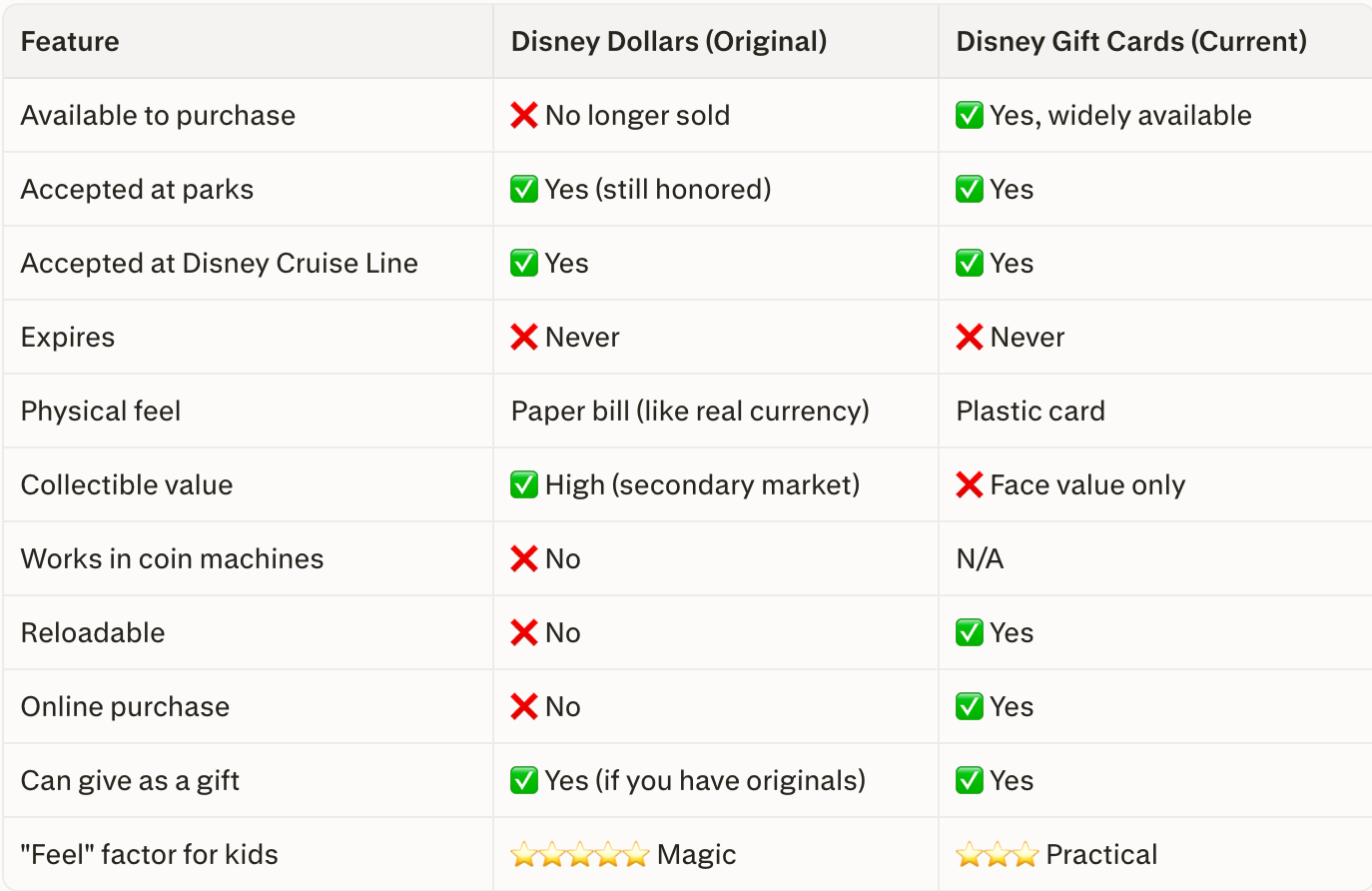
Since 2016, Disney Gift Cards have functionally replaced Disney Dollars as the primary prepaid payment option at Disney parks. Here's how the two compare:
Disney Dollar vs Disney Gift Card
When it comes to real-life use in the parks, the Disney gift cards are always more practical! However, when you want that nostalgic thrill of handing down something that is so unique and precious, you simply cannot beat the original Disney money cards!
How to Start Your Disney Dollar Collection
Whether you're a total beginner or you've been collecting for years and want to go deeper, here's a roadmap you can follow!
For Beginners
Step 1: Inventory what you have.
Dig through old vacation memorabilia, check grandma's junk drawer, post in Facebook groups for Disney collectors. You might already own something worth real money!
Step 2: Handle with care.
Never fold, crease, or expose your Disney Dollars to direct sunlight or moisture. Store them flat in protective sleeves immediately. The difference between a graded 65 and a graded 55 can be hundreds of dollars, and a single careless fold can be the difference!
Step 3: Identify your notes.
Use the series letter (A, D, or T) and year to identify exactly which note you have. Reference lists like the full Disney Dollar catalog at Kath's Disney Dollars or the comprehensive guides at Our Departure Board to understand your note's rarity.
Step 4: Buy from reputable sources.
When purchasing Disney Dollars on the secondary market, look for sellers on Heritage Auctions, PCGS/PMG-verified dealers, and established Disney collector communities. Be cautious of eBay listings without grading certification, fakes and washed/ironed bills exist!
For Intermediate and Advanced Collectors
Get Your Notes Graded: PMG and PCGS Currency are the two most respected grading companies for Disney Dollars. PMG grading is generally considered slightly more affordable for initial submissions. Submit your notes as U.S. currency items through their standard submission process.
Build A Set: Serious collectors aim to complete a full series, all denominations from a single year, or all notes from a single location series. The thrill of completing a set is hard to replicate!
Hunt for Key Dates: The 1987 series, the 2002 "100 Years of Magic" series, and the 2005 $50 anniversary bill are among the most valuable. Low serial numbers, consecutive serial number pairs, and uncut sheets are the trophies of Disney Dollar collecting.
Watch Heritage Auctions: Heritage Auctions is the premier venue for high-end Disney Dollar sales. Monitoring their upcoming auctions and past results is the best way to track real market values.
Where to Buy Disney Dollars Today
Since Disney stopped selling them directly, the secondary market is your only option for acquiring Disney Dollars. Here are the best places to look:
Heritage Auctions (ha.com) — Best for premium, high-grade, and signed examples
eBay — Widest selection, but exercise caution and look for graded notes when possible
Specialized Disney Dollar websites like Kath's Disney Dollars and DizDollars
Coin and currency shows — Look for dealers who specialize in notaphily (paper money collecting)
Elite Coinage and similar certified dealers
Disney fan communities on Facebook, Reddit (r/papermoney), and the DIS Boards
Always ask for provenance, look for original packaging or holders when available, and remember, a graded note from PMG or PCGS is worth far more in terms of buyer confidence than an ungraded one!
Fun Disney Dollar Facts
Disney Dollars were the first four-color notes ever issued in the United States. Before Mickey, American currency was notoriously monochromatic.
The notes were printed on the same 100% cotton paper as real U.S. currency, which is why they feel so much like the real thing.
Tinker Bell appears on every single Disney Dollar ever printed — on at least one side of every bill from 1987 onward. She's the constant, the through-line, the pixie dust that ties it all together.
Disney issued special cast member exclusive editions as incentives for employees. These are rarely seen on the public market and command significant premiums.
The 2005 $50 bill — released for Disneyland's 50th anniversary — was designed by Disney Legend Charles Boyer, who passed away in 2021. Signed examples of this bill are particularly prized collector's items.
Disney Dollars are still technically convertible back to U.S. currency at Disney resort front desks and Guest Relations. So if you found a stack and genuinely need the cash, you have options — though a collector would likely pay you more.
By the time Disney stopped printing them in 2016, Disney had produced 172 distinct varieties across all denominations, years, and series.
Frequently Asked Questions About Disney Dollars
Q: Are Disney Dollars still accepted at Disney parks?
Yes! Disney Dollars are still honored at all U.S. Disney theme parks, Disney cruise ships, Disney resort hotels, and select Disney Store locations. They have no expiration date and Disney will continue to accept them indefinitely!
Q: Can I still buy Disney Dollars from Disney?
No. Disney stopped selling Disney Dollars on May 14, 2016. The only way to acquire them now is through the secondary market, other collectors, dealers, auction houses, and resale platforms like eBay.
Q: Why did Disney stop making Disney Dollars?
Disney cited the growing popularity of gift cards and the shift toward digital payments as the primary reason. Gift cards are cheaper to produce, easier to reload, and don't require the complexity of paper currency infrastructure.
Q: How much is my Disney Dollar worth?
It depends heavily on the year, denomination, condition, and series. Common circulated $1 bills from the 1990s might fetch $10–$30. Uncirculated 1987 bills can run $50–$500 depending on denomination. The rarest examples (uncut sheets and the 2005 $50 anniversary bill) can reach into the thousands or even tens of thousands of dollars!
Q: Should I use my Disney Dollars at the park or save them?
Unless the bill is heavily circulated and has minimal collector value, you're almost certainly better off holding it. Even common Disney Dollars are worth more than face value on the secondary market, and using them at the park for face value is leaving money on the table.
Q: What denominations were Disney Dollars made in?
Disney Dollars were issued in $1, $5, $10, and $50 denominations. The $1 and $5 were introduced in 1987, the $10 in 1990, and the $50 in 2005.
Q: What's the difference between Series A and Series D Disney Dollars?
Series A bills were printed specifically for Disneyland Resort in California and have serial numbers beginning with the letter A. Series D bills were printed for Walt Disney World in Florida and have serial numbers beginning with D. Series T was created for Disney Stores, starting around 2004. The series distinction matters significantly for collectors because some designs and years were unique to one location.
Q: Are there any Disney Dollar errors or rarities I should know about?
Yes — error notes (misprints, off-center cuts, serial number anomalies) exist in the Disney Dollar world just like in regular currency and are highly sought after by advanced collectors. Additionally, bills with extremely low serial numbers (like #00000001 or #00000002 of a series) represent the "first off the press" and carry major premiums.
Q: How do I get a Disney Dollar professionally graded?
Submit your notes to either PMG (Paper Money Guaranty) or PCGS Currency — the two most reputable grading services for Disney Dollars. PMG suggests submitting Disney Dollars as U.S. notes through any qualifying submission tier at their Sarasota office. The process involves sending your notes securely, having them examined under UV light and magnification for authenticity and condition, and receiving them back encapsulated in tamper-proof holders with certification numbers.
Q: Were any Disney Dollars made exclusively for cast members?
Yes. Disney issued special edition Disney Dollars exclusively to cast members as incentives and rewards. These are extremely rare in the public market since they were never sold commercially and were only distributed internally. If you encounter one, it's worth having professionally authenticated.
Q: Is collecting Disney Dollars a good investment?
The collectibles market as a whole is projected to grow at a 6.2% compound annual growth rate, potentially surpassing $512 billion by the end of 2025. Disney collectibles specifically have seen strong appreciation, with park ephemera and paper items regularly selling for two to four times their pre-2020 values. That said, like all collectibles, Disney Dollars should be purchased for the love of the hobby first and the investment potential second. Market conditions fluctuate, grades matter enormously, and condition is everything.
Q: What's the single rarest Disney Dollar to own?
Opinion varies among serious collectors, but the 1987 uncut proof sheets are generally considered the holy grail — with only 400 produced and many signed by the original artist. The signed and framed 2005 $50 anniversary bill designed by Charles Boyer is the single most valuable individual note, with authenticated examples selling for over $10,000. Both represent the pinnacle of the Disney Dollar collecting world!

More Than Money, More Than a Souvenir
Disney Dollars have never been really about money. Instead, they have been about how money could be transformed with the help of Disney!
They have been about that joy and thrill felt by the family, who saved up for the vacation and offered their child an envelope filled with Disney-inspired bills before the departure for the holiday adventure! They have been about the feeling experienced by the tourist, who put the well-pressed one-dollar bill in the keepsake box rather than spend it somewhere else. They have been about the experience felt by that collector, who managed to find all 172 Disney Dollar bills after decades-long search.
In the history of the American business, only one company managed to create a money system so desired that nobody wanted to use them anymore. This isn't a disaster; on the contrary, it's the highest brand success that can be achieved!
There have been 172 Disney Dollar varieties issued over a 29-year period (1987–2016), creating a cult of devoted collectors and traditions of whole families. Today, all Disney Dollars continue to be traded, collected, graded, and cherished, even though they ceased to be sold at Disney parks!
Become a Travel Professional for Only $99
Turn your love of travel into extra income from home!
Join Now