
The Travel Agent Training and Education Guide 2026
The travel industry is absolutely booming right now! If you've ever dreamed about turning your passion for travel into a real career, 2026 is your year to make it happen. But here's the thing—becoming a successful travel agent isn't just about loving vacation planning (though that definitely helps). You need solid training, the right credentials, and a clear roadmap to navigate this exciting but competitive field!
Our guide walks you through everything you need to know about travel agent training and education in 2026! Whether you're completely new to the industry or looking to upgrade your skills, you'll discover proven pathways, insider tips, and real-world strategies that actually work!
Join us here at MainStreet Travel today for only $99! That’s the cost of our Starter Membership! Our Travel Plus Membership is $199 and offers even more helpful tools! We have no minimum booking requirements, a high 70/30 commission split, and a great training program! Start your new career from home today!

Why Travel Agent Training Matters More Than Ever in 2026
Let's be honest. With AI trip-planning tools popping up everywhere and online booking sites dominating search results, you might wonder if travel agents are even relevant anymore.
Here's the exciting truth: travelers are craving the human touch more than ever! While technology can spit out generic itineraries, only a trained travel advisor can truly understand what makes your dream vacation tick. The industry is experiencing remarkable growth, with 88% of tour operators anticipating sales increases in 2026.
But here's the catch—clients expect expertise. They want specialists who know their stuff, not order-takers who just punch buttons. That's where proper training becomes your competitive edge!

Understanding Travel Agent Business Models
Before diving into certifications and courses, you need to understand how this business actually works. There are two main paths, and picking the right one shapes your entire training journey!
Host Agency Model (Best for Beginners)
Think of a host agency as your launchpad into the travel world. You work as an independent contractor under their established umbrella, which means:
Lower startup costs: Just $99-$500 to get started instead of $10,000-$30,000
Built-in training and support: They teach you the ropes
Commission splits: You'll keep 70-90% of commissions while the host takes their cut
Legal protection: You're covered by their insurance and licenses
Booking system access: No need to negotiate with suppliers yourself
Most new agents start here, and honestly? It's smart! You get to learn the business without drowning in overhead costs or complex legal requirements.
Independent Agent Model
Going independent means running your own show completely. You keep 100% of commissions, but you're also responsible for:
Higher startup costs ($10,000-$30,000+)
Your own supplier relationships
Business insurance and licenses
Technology and booking systems
Marketing and client acquisition
The independent route works best for experienced agents who've built a client base or those with significant business capital to invest upfront.

Essential Travel Agent Certifications in 2026
Now let's talk credentials! While you technically don't need a license to call yourself a travel agent in most U.S. states, certifications make you stand out and prove you know your stuff.
TAP Test: Your Entry Point
The Travel Agent Proficiency (TAP) test from The Travel Institute is your foundation.
What it is: A 100-question exam covering travel industry basics, geography, booking procedures, and customer service
Cost: $95 (often included with training courses)
Pass rate: 70% or higher required
Time limit: 2 hours
Why it matters: Passing with 80%+ lets you enroll in CTA programs without meeting experience requirements
Many online courses bundle TAP test prep with their training, so you're studying and preparing for certification simultaneously.
CTA: Certified Travel Associate
The Certified Travel Associate designation is your next step up and the industry standard for serious professionals.
Provider: The Travel Institute
Cost: $699 (includes study materials)
Timeline: Self-paced, typically 3-6 months
Coverage: 15 areas of study including sales techniques, destination knowledge, industry operations, and travel insurance
Requirements: TAP certification OR 1 year of industry experience
Maintenance: Earn 10 Continuing Education Units (CEUs) annually
Agents with CTA certification consistently report higher earnings and more credibility with clients. It's worth every penny!
CTC: Certified Travel Counselor
The Certified Travel Counselor is the advanced credential for seasoned professionals.
Cost: $1,295
Requirements: 5 years of verified industry experience
What it covers: Advanced business management, leadership skills, strategic planning
Why pursue it: Maximum credibility, higher earning potential, recognition as an expert
Think of the CTC as your master's degree in travel advising. It positions you as a true industry leader.
CLIA Cruise Certifications
If cruises are your thing (and they should be—cruises are super profitable!), CLIA offers a progression of certifications:
CCC (Certified Cruise Counsellor): Entry-level, covering basics
ACC (Accredited Cruise Counsellor): Intermediate level
MCC (Master Cruise Counsellor): Advanced certification
ECC (Elite Cruise Counsellor): Top-tier expertise
What's cool about CLIA membership? You get 4 free online courses per year, access to bonus commissions, and the chance to participate in ship inspections and FAM trips!
Destination Specialist Programs
Want to become the go-to expert for Alaska, the Caribbean, or Europe? Destination specialist certifications help you stand out!
Many are offered completely free by tourism boards eager to promote their destinations. Others cost $0-$500 from providers like The Travel Institute. You'll learn:
Regional geography and culture
Essential attractions and hidden gems
Sample itineraries
Travel tips for clients
Local customs and etiquette
Specializing in 2-3 destinations makes you memorable and marketable!

Top Travel Agent Training Programs for 2026
Choosing the right training program can literally make or break your success. Here are the standout options for 2026:
MainStreet Travel Agency
Perfect for absolute beginners who want comprehensive, hands-on training.
Features:
In-depth curriculum from basics to advanced selling
Mentorship from experienced agents
Flexible online learning
Supportive environment for newcomers
MainStreet Travel has built its reputation on turning complete newbies into confident, booking agents quickly!
The Travel Institute
The gold standard in travel education for decades.
What they offer:
TAP test preparation
CTA and CTC certification programs
Destination specialist courses
Niche market training
CEU-approved continuing education
The Travel Institute is respected industry-wide. Having their credentials on your resume opens doors.
Yeti Travel
A modern host agency with exceptional training!
Highlights:
Comprehensive online certification program
No sales minimums or quotas
Strong community support and mentorship
Ability to maintain your own brand
Access to Disney's travel agent portal
Base Camp Membership ($99)
Yeti has exploded in popularity because they combine solid training with flexibility and community!
IATA Training
Specializes in air travel and airline relationships.
Best for: Agents focusing on airfare, airline negotiations, and complex flight itineraries
Benefit: Global recognition and airline industry connections
Courses: GDS systems, fares, ticketing, regulations
CLIA Cruise Training
The Cruise Lines International Association offers some of the best free training available!
Access: Free once you qualify for membership
Benefits: Globally recognized, higher commission rates, exclusive partnerships
Courses: Cruise sales, ship inspections, niche cruise markets
Universal Academy of Travel
Dynamic and interactive learning designed for modern agents.
Features:
Hands-on practical exercises
Live webinars with travel professionals
Curriculum that adapts to industry changes
Real-world scenario training
Host Agency Training Programs
Many top host agencies offer their own comprehensive training:
Outside Agents: Learning Management System, mentors, 5-day intensive
Travel Planners International: Full onboarding and ongoing education
Brownell Mentoring: Year-long luxury travel advisor intensive (highly competitive)
SmartFlyer Takeoff: Annual mentorship with bi-monthly roundtables

How Long Does It Take to Become a Travel Agent?
One of the most common questions! The answer depends on your chosen path.
Fast Track: 3-4 Months
Programs like Careers on Vacation offer the quickest route to certification. You'll complete:
Basic industry training
TAP test preparation
Foundational booking skills
Sales techniques
Pros: Get to market quickly, start earning sooner
Cons: May need additional specialized training later
Standard Timeline: 4-6 Months
Most people complete basic certification in this timeframe. This includes:
Comprehensive course materials
Practice bookings
Supplier training
TAP certification
The beauty of modern training? You can start booking clients immediately with a host agency while you're learning!
CTA Certification: 12 Months
The Travel Institute's CTA requires a 12-month timeline because they mandate 1 year of practical experience. Even if you finish coursework earlier, you can't claim the certification until you hit that experience benchmark.
Pro tip: Use that year to build your client base, complete destination courses, and rack up bookings!
Ongoing Education: Forever
Here's the reality—your education never really stops in this industry! Destinations change, suppliers update policies, and new travel trends emerge constantly. Successful agents commit to:
Annual CEU requirements (10+ units for CTA/CTC holders)
Regular supplier webinars
FAM trip participation
Industry conference attendance
Niche specialty training
Think of it like continuing education for doctors or lawyers. It's just part of the profession! Keep in mind, the harder you work the faster the outcome! Remember to take breaks every couple of hours to let you brain relax and soak up all this new information.

Breaking Down Startup Costs for 2026
Let's talk money! Understanding the financial investment helps you plan realistically.
Host Agency Route: Budget-Friendly
Initial investment: $99-$500
Monthly fees: $25-$100
Commission split: Keep 70-90% of earnings
First 18-24 months working capital: $5,000-$10,000 recommended
Independent Route: Significant Investment
Initial setup: $10,000-$30,000
Includes:
Business registration and legal fees
Website and branding
Booking software and GDS access
Insurance (E&O, liability)
Marketing budget
Office equipment
Monthly overhead: $1,500-$4,000
Additional Training Costs
GDS training (Sabre, Amadeus): $149-$300
CTA certification: $699
CTC certification: $1,295
E&O insurance: $150-$2,150+ annually
IATAN ID card: Varies by qualification
Professional memberships (ASTA, CLIA): $100-$500+ annually

Income Expectations
Let's get real about the money side because this matters!
Year 1: Building Your Foundation
Gross commission income: $0-$10,000
Net income: -$5,000 to $5,000
Yes, you might actually lose money in year one! But don't let that discourage you. You're building relationships, learning systems, and establishing your reputation.
Years 2-3: Growth Phase
Gross commission income: $15,000-$40,000+
Net income: $10,000-$35,000+
This is where things get exciting! Repeat clients start rebooking, referrals flow in, and your efficiency improves dramatically.
Years 3-5+: Hitting Your Stride
Gross commission income: $50,000-$150,000+
Net income: $40,000-$120,000+
Full-time advisors with 3-5 years experience average $44,127, while mid-experience agents earn $66,000-$79,000.
Elite Performance: Sky's the Limit
Top-performing agents earn $250,000+! These are agents who:
Specialize in luxury or high-margin niches
Build strong repeat client bases
Master relationship building
Operate efficiently with systems and automation
Commission Structures by Product
Understanding how you get paid is crucial:
Travel Product Commission Rate:
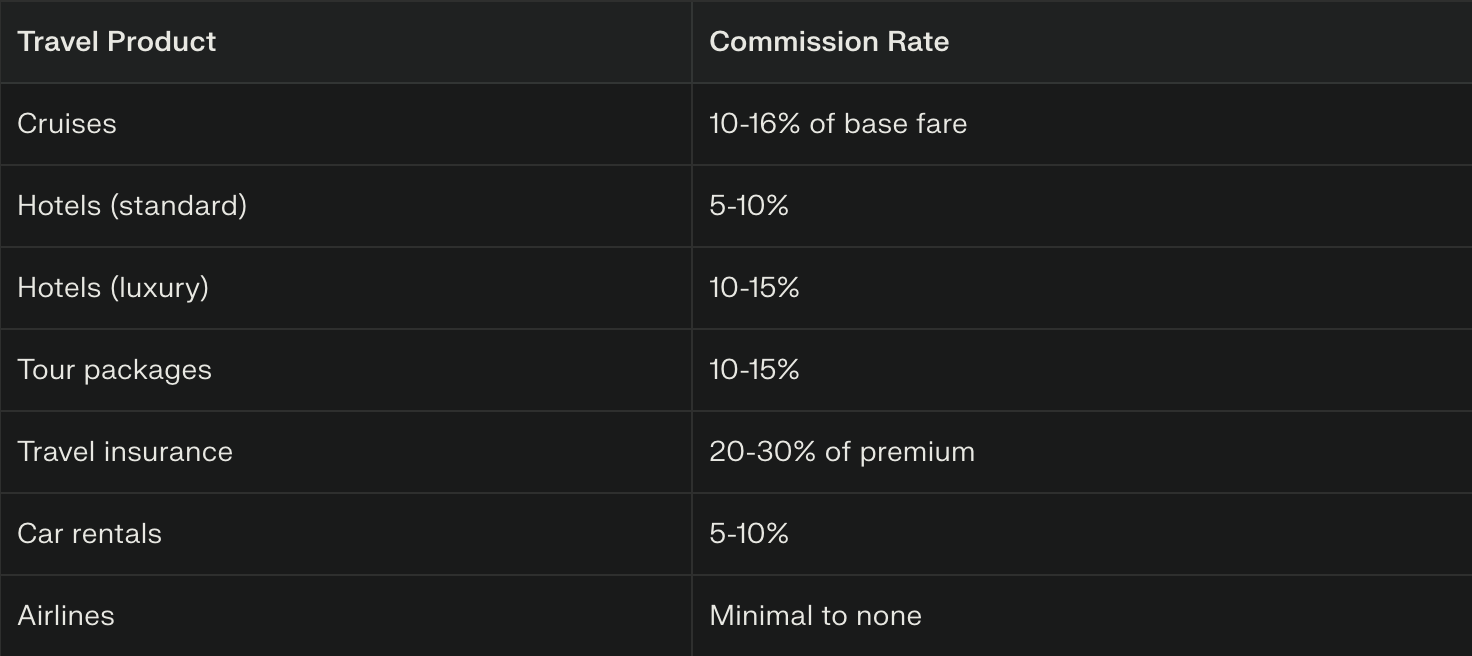
Key insight: This is why smart agents focus on cruises, luxury hotels, tour packages, and travel insurance. The commissions are significantly higher!
Remember, earnings come from the amount of time and effort you put into everything! Even first-years can earn more than $50,000 if they work hard enough!

Finding Your Niche: Specialization Wins in 2026
Here's something crucial: generalists struggle while specialists thrive! Studies show agents who specialize earn up to 80% more than those who try to book everything for everyone!
Top Profitable Travel Niches for 2026
Luxury Travel
Consistently profitable across all markets
Higher commissions and fees
Clients value expertise over price
Includes aspirational luxury to ultra-high-net-worth segments
Honeymoons and Romance Travel
$30 billion global industry
Emotional purchases (less price-sensitive)
High referral rates
Repeat clients for anniversaries
Disney Travel
Massive, loyal customer base
Complex planning requires expertise
Free training through Disney College of Knowledge
Annual free park tickets for certified agents
Wellness Travel
Projected to grow significantly
Aligns with self-care trends
Premium pricing
Experiential focus
Group Travel
One trip, multiple clients
Rinse-and-repeat efficiency
Higher total commissions
Includes destination weddings, reunions, corporate retreats
Adventure Travel
Active, engaged clientele
Complex itineraries command higher fees
Growing market
Sustainable and authentic experiences
LGBTQ+ Travel
$218 billion global market
Underserved by mainstream agents
Strong community loyalty
Inclusive travel expertise valued
Family Multi-Generational Travel
Complex logistics = higher value
Multiple bookings per trip
Repeat business (annual family trips)

Essential Technology and Tools You'll Need
The right tech stack makes everything easier!
Must-Have Equipment
Reliable laptop: Updated, fast processor for multiple tabs and booking platforms
High-speed internet: Non-negotiable for real-time bookings
Professional phone system: Dedicated business line with good headset
Quality printer/scanner: For documents, contracts, itineraries
External monitor: Boost productivity with dual-screen setup
Ergonomic workspace: Comfortable chair, proper desk height
Software and Platforms
Global Distribution Systems (GDS)
Sabre, Amadeus, or Galileo
Self-paced training available ($149+)
Access to real-time flight, hotel, car rental inventory
Industry-standard booking tools
CRM (Customer Relationship Management)
Zoho Travel CRM
Kapture Travel CRM
Built-in tools from host agencies
Itinerary and Proposal Builders
Travefy (most popular)
TravelJoy
Tern (all-in-one platform)
Professional presentation matters!
Accounting and Commission Tracking
TravelWorks
iBOS (Traveltek)
Host agency back-office systems
Marketing Tools
Social media scheduling (Later, Planoly)
Email marketing (Mailchimp, ConvertKit)
Website builder (Squarespace, WordPress, Kadence)
Design tools (Canva)

Industry Credentials That Boost Your Credibility
IATAN/IATA ID Card
The internationally-recognized travel professional credential.
Benefits:
Concessionary rates on flights and hotels (up to 30% off)
Savings at 100,000+ hotels worldwide
Gift card discounts (up to 10%)
Travel accident insurance ($35,000 coverage)
Professional verification globally
Daily retail discounts
Requirements: Your affiliated agency must have IATAN accreditation
CLIA Membership
Individual Agent Membership (IAM) offers:
4 free online courses annually
Access to bonus commissions
Ship inspection opportunities
FAM trip invitations
Cruise sales credibility
Recommendation: Generate $5,000 in cruise commissions over 12 months before applying. We can’t recommend getting this one enough!
ASTA Membership
The American Society of Travel Advisors provides:
Professional benefits:
Industry credibility and networking
Advocacy at government levels
Verified Travel Advisor certification
Business insurance options (health, dental, vision, disability)
Consumer leads program
Discounts on business products and services
For clients:
Peace of mind working with ethical professionals
Access to expert, trained advisors
Consumer protection advocacy
Many host agencies, like Signature Travel Network, now subsidize ASTA membership for their independent contractors!

High Success Strategies for 2026
Ready for the insider tips that separate thriving agents from struggling ones?
Do Your Research BEFORE Jumping In
The #1 mistake new agents make? Diving in without proper vetting!
Avoid:
MLM schemes disguised as travel agencies
Agencies with hidden fees and minimal support
Unrealistic "get rich quick" promises
Poor training programs with no real curriculum
Do instead:
Research multiple host agencies thoroughly
Read reviews on Host Agency Reviews
Interview current agents about their experience
Understand commission splits and fee structures completely
Check licensing and credentials
Invest in Education and Mentorship
Trying to DIY everything might save money short-term, but it costs you massively in lost time and opportunities!
Smart investments:
Quality training programs with proven track records
Mentorship programs (Brownell Mentoring, host agency mentors)
Continuing education courses
Industry conferences and networking events
Supplier FAM trips
Mentorship benefits:
Avoid years of costly mistakes
Learn efficient systems and workflows
Get emotional support during challenges
Access proven marketing templates
Fast-track your learning curve
Master Client Acquisition and Marketing
You can be the best planner in the world, but without clients, you have no business!
Effective strategies for 2026:
SEO-optimized website and blog: Create valuable content targeting specific travel searches
Social media presence: 80% valuable content, 20% sales
Email marketing and nurturing: Build your list, provide consistent value
Partnerships: Hotels, tour operators, travel bloggers, local businesses
Referral program: Incentivize past clients ($50 gift cards, discounts)
Google PPC ads: Target high-intent keywords when you have budget
Local networking: Join business groups, sponsor community events
Content marketing: Travel guides, destination videos, planning tips
Develop Deep Product Knowledge
Clients hire you for expertise they can't get from Google!
Stay ahead:
Experience destinations firsthand (FAM trips!)
Complete supplier training programs
Follow travel trends and emerging destinations
Understand visa requirements and travel regulations
Master 2-3 destinations deeply rather than knowing a little about everything
Keep current on policy changes
Build Systems and Efficiency
Successful agents work ON their business, not just IN it!
Create:
Client onboarding workflows
Booking processes and checklists
Communication templates
Follow-up systems
Post-trip feedback collection
Referral request protocols
Automation tools:
Automated email sequences
CRM reminders and tasks
Social media scheduling
Invoice and payment processing
Focus on the Client Experience
Your job isn't just booking trips—it's creating transformational experiences!
Consultative approach:
Ask deeper questions about motivations and desires
Listen more than you talk
Customize every itinerary to the specific client
Follow up before, during, and after travel
Solve problems proactively
Create "wow" moments clients remember
Build relationships, not just transactions. That's where repeat bookings and referrals come from!

Understanding Legal Requirements and Insurance
Let's talk about protecting yourself and your business!
Errors & Omissions (E&O) Insurance
What it is: Professional liability coverage for travel agents
What it covers:
Legal defense fees if you're sued
Major booking errors and omissions that don't benefit you or the traveler
Claims up to policy limits ($1M-$2M typical)
What it DOESN'T cover:
Small mistakes under your deductible
"Moral hazard" situations where you or client benefited from the error
Bookings made outside your host agency's accreditation
Liability/slip-and-fall (that's separate insurance)
Cost: $150-$2,150+ annually depending on sales volume
Do you need it? Not legally required, but industry standard and often required by host agencies, IATA, and suppliers.
Important: If you work with a host agency, their E&O policy covers bookings made under their accreditation number only!
Business Structure and Licensing
Business registration:
Register LLC or corporation for legal protection
Obtain Federal EIN from IRS
Open dedicated business bank account
Consider professional liability coverage if operating as LLC
Seller of Travel licenses:
Required in several states including:
California: Check California Seller of Travel database
Florida: FDACS registration, $25,000 bond
Washington, Hawaii, Iowa: Various requirements
Your host agency's license typically covers you, but verify your specific state's requirements!
Swerve Around These Common Mistakes
Learn from others' errors so you don't repeat them!
Setup and Business Mistakes
Jumping into first opportunity without research
Choosing wrong business model for your goals
Not understanding commission splits and fees
Failing to read contracts thoroughly
Mixing business and personal finances
Not having professional email and phone
Skills and Knowledge Gaps
Starting without proper training
Confusing similar destination names (Fiji Islands vs. Mount Fuji!)
Not understanding booking systems before helping clients
Lacking legal and contract knowledge
Missing documentation requirements (visas, passports)
Poor geography and destination knowledge
Marketing and Client Acquisition Failures
No clear marketing strategy beyond "posting on Facebook"
Trying to be everything to everyone
Not having clear contact information visible
Inconsistent social media presence
No email list building
Giving up on marketing too quickly
Not investing in paid marketing when appropriate
Operational Issues
Poor communication and typos in emails
Not following up with leads promptly
Lacking confidence in client interactions
DIY-ing everything instead of getting help
No systems or processes in place
Inadequate record-keeping
Not using CRM effectively
Professional Development Neglect
Skipping continuing education
Not attending supplier trainings
Avoiding FAM trips and industry events
Refusing to invest in professional growth
Not seeking mentorship or guidance

2026 Travel Industry Trends You Should Know
Stay ahead by understanding where the industry is heading!
AI and Technology Integration
AI trip planning tools doubling in usage
Travel agents must adapt, not resist technology
Human connection remains competitive advantage
Use AI for efficiency, but offer human expertise for personalization
AI agents (ChatGPT travel booking) emerging as new distribution channel
Traveler Behavior Shifts
Experience over transactions: Clients want transformation, not just trips
Purpose-driven travel: Values and sustainability matter more
Flexibility required: Build in contingency plans and travel insurance
Last-minute bookings increasing alongside far-out planners
Personalization non-negotiable: Generic packages don't cut it
Market Growth Areas
Business travel optimistic for 2026 (61% very/somewhat optimistic)
Luxury and privately-guided travel expanding
88% of tour operators expect sales growth
Wellness travel growing significantly
Multi-generational family travel booming
"Anti-tourist" and authentic experience trends
Distribution and Booking Evolution
Direct bookings increasingly important as OTAs dominate
Social media booking (TikTok partnerships with Booking.com)
Attribute-based selling: Unbundle inventory (high floor, balcony, etc.)
Data-driven hyper-personalization expected
Email marketing making strong comeback

Frequently Asked Questions (FAQs)
Do I need a degree to become a travel agent?
No! You don't need a college degree to become a travel agent. While hospitality or tourism degrees can provide helpful background knowledge, they're not required. What matters most is completing industry-specific training, earning relevant certifications (like TAP and CTA), and developing strong customer service and sales skills. Many successful travel agents come from completely unrelated fields!
How much does it cost to become a travel agent in 2026?
Starting costs vary dramatically based on your business model:
Host agency route: $99-$500 initial fee, plus $25-$100 monthly fees
Independent route: $10,000-$30,000+ startup costs
Recommended working capital: $5,000-$10,000 for first 18-24 months
Training and certifications: $95-$1,295 depending on level
Most beginners start with a host agency to minimize upfront costs while learning the business.
Can I work from home as a travel agent?
Absolutely! About 96% of travel agents work from home. You'll need:
Reliable high-speed internet connection
Professional phone system with dedicated business line
Computer with adequate processing power
Quiet, dedicated workspace
Printer/scanner for documents
Professional appearance for video calls
Working from home offers incredible flexibility, but requires self-discipline and strong organizational skills.
What's the difference between a travel agent and travel advisor?
This terminology shift matters!
Travel Agent: Traditionally viewed as "order taker" who books what clients request
Travel Advisor: Consultative professional who provides expert guidance, customizes experiences, and advises clients on best options
The industry has largely moved toward "travel advisor" terminology because it better reflects the consultative, relationship-based nature of modern travel professionals. ASTA even rebranded from American Society of Travel Agents to American Society of Travel Advisors in 2018.
Both terms are still used interchangeably, but "advisor" emphasizes the expertise and value you provide beyond simple bookings.
How long does it take to start earning money as a travel agent?
The timeline varies considerably:
With host agency: You can start booking clients immediately while training
First commission: Typically 4-8 weeks after first booking (after client travels)
Consistent income: Usually 6-12 months to build steady client base
Profitable business: Most agents reach profitability in Year 2-3
Year 1 is typically break-even or modest loss ($0-$5,000 net) while you're building. Years 2-3 see significant growth ($10,000-$35,000+ net). By Years 3-5, full-time agents average $40,000-$120,000+ net income.
Do I need to have traveled extensively to be a travel agent?
Not necessarily! While personal travel experience is incredibly valuable, it's not an absolute requirement. What matters more:
Passion for travel and helping others
Willingness to research and learn continuously
Strong customer service skills
Ability to leverage resources (supplier training, destination guides, agent networks)
That said, experiencing destinations firsthand through FAM trips and personal travel significantly boosts your expertise and confidence. Clients trust agents who speak from personal experience. Many agents start by specializing in destinations they know well, then expand as they gain experience and take advantage of industry FAM trip opportunities!

What certifications do I really need to be successful?
There's no single "required" certification, but this progression works best:
Minimum: TAP (Travel Agent Proficiency) test - $95
Standard: CTA (Certified Travel Associate) - $699
Advanced: CTC (Certified Travel Counselor) - $1,295
Specialty: CLIA cruise certifications, destination specialist programs
Most successful agents have at least CTA certification plus specialized training in their niche (Disney, cruises, luxury, etc.). These credentials demonstrate professionalism and commitment to clients and suppliers.
Can I work part-time as a travel agent?
Yes! Many agents start part-time while maintaining other employment.
Part-time considerations:
Flexibility: Work around your schedule
Lower income expectations: Part-time advisors make about half what full-timers earn
Client communication challenges: Must be responsive during business hours
Growth limitations: Building client base takes longer
Testing the waters: Great way to determine if you love the business
Many successful full-time agents started part-time and transitioned as their client base and income grew.
What's the best niche for new travel agents?
The best niche is one that matches YOUR interests and experience!
Beginner-friendly niches:
Disney travel: Extensive free training, huge market, passionate community
Cruises: Structured products, good commissions, lots of supplier support
All-inclusive resorts: Simpler to book, popular with first-time travelers
Your local area: Leverage personal knowledge and community connections
Higher-earning niches (but require more expertise):
Luxury travel: Highest commissions and fees
Destination weddings: Emotional purchases, multiple bookings per event
Multi-generational family travel: Complex logistics justify higher fees
Choose something you're passionate about! Your enthusiasm shows through and makes marketing natural.
How do I find my first clients?
This is the million-dollar question! Start with these proven strategies:
Warm market first:
Friends and family (but don't rely only on them!)
Former colleagues and professional contacts
Social media connections
Community groups you're part of
Marketing strategies:
Build SEO-optimized website and blog
Create valuable social media content (80% education, 20% sales)
Start email newsletter with travel tips
Offer free planning consultations
Join local business networking groups
Partner with complementary businesses (wedding planners, photographers)
Create lead magnets (free destination guides, planning checklists)
Patience and persistence: Client acquisition takes 6-12 months to really gain traction. Consistency matters more than perfection!
What mistakes do most new travel agents make?
The top mistakes that derail new agents:
Poor research and setup: Jumping in without vetting opportunities
DIY-ing everything: Trying to save money by avoiding training and mentorship
Lack of business skills: Not understanding contracts, insurance, legal requirements
No marketing strategy: Posting randomly on social media with no plan
Being generalist instead of specialist: Trying to book everything for everyone
Not investing in education: Skipping certifications and supplier training
Poor communication: Typos, unprofessional emails, slow response times
No systems or processes: Operating in chaos instead of with efficiency
Giving up too soon: Expecting overnight success instead of building over 2-3 years
Not seeking help: Isolating yourself instead of joining communities and finding mentors
Should I join ASTA, CLIA, or other professional associations?
Yes, but strategically! Don't join everything at once.
Start with:
Your host agency's included memberships: Many provide CLIA or other benefits
CLIA: If booking cruises (excellent free training and commission bonuses)
Add later as you grow:
ASTA: When you can afford membership ($300-500+) and want advocacy, networking, health insurance options
Specialized associations: Based on your niche (LGBTQ+ travel, adventure travel, luxury consortia)
IATAN/IATA ID card: Worth pursuing once you're established and can take advantage of travel benefits (concessionary rates, FAM trips).

Your Action Plan Breakdown
Ready to launch your travel agent career? Follow this roadmap!
Weeks 1-2: Research and Decision Making
Research host agencies thoroughly (read reviews, interview agents)
Compare business models and costs
Assess your financial readiness
Identify your travel niche interests
Set realistic income and timeline expectations
Weeks 3-4: Legal and Business Setup
Choose and apply to host agency (OR register business if independent)
Obtain Federal EIN
Open business bank account
Set up dedicated business email and phone
Create workspace at home
Months 2-4: Training and Certification
Complete host agency onboarding
Enroll in TAP test preparation course
Take and pass TAP exam
Complete free cruise line certifications
Start CTA coursework (if ready)
Learn booking systems and GDS basics
Months 3-6: Building Foundation
Create professional website and social media
Develop marketing materials
Complete destination specialist courses
Attend supplier webinars
Start building email list
Practice mock bookings
Book first clients (friends/family with support)
Months 6-12: Growth and Development
Work toward CTA certification
Take FAM trips to experience destinations
Build systems and workflows
Refine marketing strategy
Join professional associations
Seek mentorship opportunities
Focus on client experience and getting referrals
Year 2+: Scaling and Specializing
Earn CTA certification
Deepen niche expertise
Invest in advanced marketing
Consider upgrading host agency or going independent
Pursue specialized certifications
Build team/VA support if needed
Attend industry conferences

The Future is Bright for Trained Travel Advisors
Here's the bottom line: travel agent training and education in 2026 matters more than ever before. While technology continues advancing, travelers increasingly value the human expertise, personalized service, and problem-solving abilities that only trained professionals provide.
The path to success isn't about taking shortcuts or skipping important steps. It's about investing in solid training, earning respected certifications, choosing the right niche, building genuine expertise, and committing to continuous learning.
The industry outlook is incredibly optimistic, with most operators expecting growth and travelers craving authentic, personalized experiences. Whether you start part-time while keeping your day job or dive in full-time with a host agency, the opportunities are absolutely there for agents who do the work!
Your dream of turning your passion for travel into a thriving career is absolutely achievable. Take that first step—research host agencies, enroll in a training program, and commit to becoming the expert traveler you're meant to be. The world is waiting for advisors who genuinely care about creating unforgettable experiences!
Ready to start your journey? Pick one action from the roadmap above and do it today. Your future clients are out there waiting for exactly the expertise you're about to build!
Become a Travel Professional for Only $99
Turn your love of travel into extra income from home!
Join Now