
How to Become a Travel Agent Online Free
Updated: September 1, 2026
Every year, about fifty billion dollars flows through American travel agencies, and a surprising amount of that is handled by people working from home in their pajamas. In 2026, the U.S. travel agency industry reached $45.3 billion across 65,181 businesses, which was a 3.1% increase from 2025.
The good news is that you really can get started without spending any money. But here’s something you might not see in the headlines: being a “free travel agent” is not the same as running a “free travel business.” Let’s look at what each one means.

Can You Really Become a Travel Agent for Free?
Yes, learning is free. Running the business usually is not, and if someone says otherwise, they're probably trying to sell you something.
Here's how it breaks down.
What's Actually Free
Host agency onboarding training. Most hosts include it in membership.
Supplier certifications. Disney's College of Disney Knowledge is completely free and covers Walt Disney World, Disneyland, Aulani, Disney Cruise Line, Adventures by Disney, and National Geographic Expeditions. Universal's UNIVERSALANDU program is free too, and graduates get a free 3-day Universal Orlando ticket.
Destination specialist programs. Tourism boards hand these out at no charge.
Intro courses. Alison runs a free Travel Agent and Consultant Training course covering industry fundamentals.
Your accreditation number. When you join a host agency, their IATA, CLIA, ARC, or TRUE number is included with your membership. You do not need to buy your own.
Marketing. Facebook, Instagram, TikTok, a Google Business Profile, and a free business email cost nothing but time.
Booking systems. Supplier portals are free to registered agents.
What Costs Money
Host agency membership. Ranges from free to several thousand dollars a year depending on the host.
Seller of Travel registration. This is only required in certain states. More details are below.
CLIA Individual Agent Membership. $139 a year, and it's optional. You do not need it to start.
LLC formation. This usually costs between $50 and $200, depending on your state, and you do not need it on your first day.
Errors and omissions insurance. Often included by your host. Verify in writing.
Optional certifications. The Travel Institute and similar programs charge tuition.
When people search for "free travel agent," they usually want to know if they can start without spending money. The answer is yes, as long as you choose your host agency carefully and avoid buying things you do not need yet.
Watch Out for "Free" That Isn't
Host agencies that seem free usually make their money in other ways. Here are some common examples:
A free signup that flips to a monthly "technology fee" or "desk fee" after a trial period
A commission split so low that you'd earn more paying a one-time fee
Free basic training with the useful modules behind a paywall
Recruiting-based models where your income depends on signing up other agents, not booking travel
The best question to ask any host agency before you join is: "What will I have paid you, in total, three years from now?" If they cannot answer in one sentence, keep looking.
For reference, MainStreet Travel charges a one-time $99 membership fee. There are no monthly fees, no annual dues, no minimum bookings, and you get a 70/30 commission split in your favor. After three years, you will have paid $99. That’s the full answer. If you are already an agent with another company, our Transfer Agent membership lets you switch at no cost!

What Does a Modern Travel Agent Do?
In 2026, a travel agent acts as a consultant, a logistics manager, and a professional advocate. Booking trips is only about 20% of what they do.
Here’s what makes up the rest of the job:
Talking with clients to find out what they really want, since it’s often different from what they say at first
Comparing resorts, cruise ships, tour companies, and packages to see what fits the client’s actual budget
Checking cancellation and change policies to make sure clients don’t run into problems
Building quotes and explaining what's included and what isn't
Tracking payment deadlines
Putting together itineraries and travel documents
Solving problems when a flight gets canceled late at night, even on Sundays
Checking in with clients after their trip and asking for referrals
People ask about AI all the time, so let’s talk about it. Over half of travelers already use AI to plan trips, and 75% say they plan to. For younger travelers, 69% of Millennials and 63% of Gen Z use AI assistants as much as social platforms for planning. Adobe found that AI traffic to travel sites grew by 119% in the past year.
At first, this might sound like bad news for agents, but there’s more to the story. Chase Travel found that 60% of Gen Z and Millennial travelers want to use a travel advisor. LinkedIn’s Jobs on the Rise report even named travel advisor as the fifth fastest-growing job in the U.S.
Both things are true. AI is great at coming up with options, but it can’t tell you which connecting rooms really connect, which resort’s “beachfront” is actually a ten-minute walk from the sand, or who to call if a hurricane shuts down an airport. Travelers use AI for ideas and turn to an advisor to make it happen. According to ASTA, $1 out of every $4 spent on travel now goes through an agency, and total bookings are expected to reach $141.7 billion by 2027.
Travel Agent vs. Travel Advisor
Same job, two labels. "Travel agent" is what consumers search for. "Travel advisor" better describes the consulting work. Use whichever fits your marketing — most successful people use both.

Step-by-Step Guide: How to Start Your Free Travel Agent Career
Step 1: Choose How You Want to Work
Make sure you choose your business model before signing any agreements.
If you work as an employee at an established agency, you get a steady structure, a regular paycheck or draw, and use the agency’s technology and clients. However, you have less freedom and less potential for higher earnings.
As an independent contractor with a host agency, you have a low-cost way to get started, which is where most new agents begin. The host agency provides the accreditation number, supplier relationships, commission processing, training, and often a CRM and E&O insurance. You bring in the clients and do the work, and you keep a portion of the commission.
Running a fully independent agency means you get your own accreditation, negotiate your own supplier contracts, carry your own insurance, and manage your own compliance. You have more control, but also much higher overhead. This option usually isn’t realistic for beginners.
Working part-time from home isn’t really a separate business model, but more about your schedule. Many agents start building their client base while keeping another job. It’s important to be honest with yourself: working part-time hours is fine, but you still need to be reliable. Clients expect accurate bookings and quick responses if problems come up.
For nearly everyone reading this, the host agency route is the answer.
Step 2: Pick Your Niche
If you try to sell every type of travel to everyone, you’ll end up selling nothing at all.
Strong niches to consider:
Walt Disney World and Disneyland vacations
Universal Orlando and Epic Universe
Ocean cruises
River and expedition cruises
All-inclusive resorts in Mexico and the Caribbean
Honeymoons and destination weddings
Multigenerational family trips
Group travel for churches, clubs, and sports teams
Accessible travel
Adventure and active travel
Luxury travel
Compare these two introductions at a school pickup line:
"I book travel." Nobody follows up.
"I help families plan their first Walt Disney World trip so they don't waste half a day figuring out the app." Now somebody's asking questions.
Your niche will guide the training you choose, the suppliers you work with, and what you share online. You’re not stuck with one forever. Start with what you know and enjoy, then branch out as you learn more.
Theme parks deserve a special mention. Planning a Disney trip means dealing with hotels, tickets, dining, Lightning Lane, transportation, and the park hopper choice, which can be confusing. That’s why families look for help, and it’s also why commissions can be good.

Step 3: Take Free Travel Agent Training
This is where the word "free" in free travel agent truly means what it says.
Host Agency Onboarding
Your host agency will provide your first training. A solid onboarding should explain how commissions work, how to qualify clients, how to create and present quotes, how to register with suppliers, how payments are handled, and what to do if something goes wrong. MainStreet offers online, self-paced training, so you can fit it in alongside your current job.
Supplier Training — The Big One
Registered agents receive education worth thousands of dollars at no cost.
The College of Disney Knowledge is free, self-paced, and usually takes just a few days to finish. It covers all Disney destinations. The 2026 assessment is now available under Training & Benefits on the Disney Travel Agents portal. You must complete it to access Disney agent benefits.
UNIVERSALANDU certifies you as a Universal Orlando Resort Specialist. The program is shorter than Disney's, and when you finish, you get a free 3-day Universal Orlando ticket.
Cruise lines like Royal Caribbean, Carnival, Norwegian, Celebrity, Princess, and Virgin Voyages all offer free agent academies. These cover ship classes, cabin types, and booking systems.
Resort brands and tour operators — Sandals, Marriott, Hilton, Hyatt, Globus, Trafalgar — same deal.
Tourism boards also provide free destination specialist programs. Examples include Hawaii, Ireland, Aruba, and many more.
A quick tip: avoid collecting certificates just for the sake of it. Completing forty courses in places you won't sell is not a good use of your time. Focus on three or four that fit your specialty, complete them well, and make sure you remember what you learn. Clients can usually tell within a minute if you truly know a destination or just memorized a brochure.
Free Intro Courses
If you want to try things out before committing, Alison's Travel Agent and Consultant Training course is free and covers the basics of travel agency operations and tourism retail.
Before signing up for any free course, ask yourself: Is the whole course free, or just the trial? Does the certificate cost extra? Is the material up to date? Will finishing the course actually give you booking access? (Usually not, since that access comes from your host agency.)

Step 4: Compare Host Agencies Before You Join
Don't sign up with the first host you come across. Take time to compare at least three options and read every agreement carefully.
The Questions to Ask
Money:
Is there a setup fee, and is it one-time or recurring?
Are there monthly or annual dues?
What's my commission split, and does it improve with volume?
Are there per-booking or transaction fees?
When are commissions paid, and how?
What happens to pending commissions if I leave?
Requirements:
Are there minimum sales or booking requirements?
Is there a probation or practice-booking period?
Is membership auto-renewing?
Ownership:
Who owns the client relationship?
Can I take my clients if I leave?
Is there a non-compete?
Support:
Which suppliers can I book?
Is training included and ongoing?
Is a CRM included?
Is errors and omissions insurance included?
Who do I call at 10 p.m. when a client is stranded?
Can I charge planning fees?
Understanding the Commission Split
This confuses almost every new agent, so let's break it down with a clear example.
Suppose a client books a $5,000 cruise. Not all of that amount earns commission, since port charges, taxes, and other fees are not commissionable. Let's say $4,000 is commissionable at a 12.5% rate. The cruise line pays your agency $500.
With a 70/30 split in your favor:
Your share: $350
Host's share: $150
Your split is based on the commission, not the client's total price. This is the most common misunderstanding in the business.
Across the industry, commission splits range from 50/50 for new agents to 80/20 or 90/10 for experienced, high-volume agents. At MainStreet, everyone starts at 70/30, and you don't need to meet any volume requirement to qualify.
MainStreet's Current Terms
Since you're here on our site, here’s exactly what we offer, in simple terms:
$99 one-time membership. Not annual. Not monthly. Once.
No monthly or annual dues
70/30 commission split in your favor
Online training, self-paced
Free CRM for managing clients, quotes, itineraries, and commission tracking
There are no minimum booking requirements. You can book just one trip a year or as many as fifty.
Ongoing support from a real team
Transfer Agent membership at no cost if you're moving from another agency
Terms may change, so please check the join page for the latest details before signing up.
Do not join the first host you find. Compare at least three, read every agreement, and use our host travel agency review checklist before you make a decision.

Step 5: Know the Legal Requirements
In the United States, there is no national license for travel agents. You do not need to pass a federal exam, earn a specific degree, or get mandatory certification.
However, states have their own business regulations, and these rules changed this year.
Seller of Travel States (Updated for 2026)
Right now, four states require Seller of Travel registration. Maryland will join them on October 1, 2026.
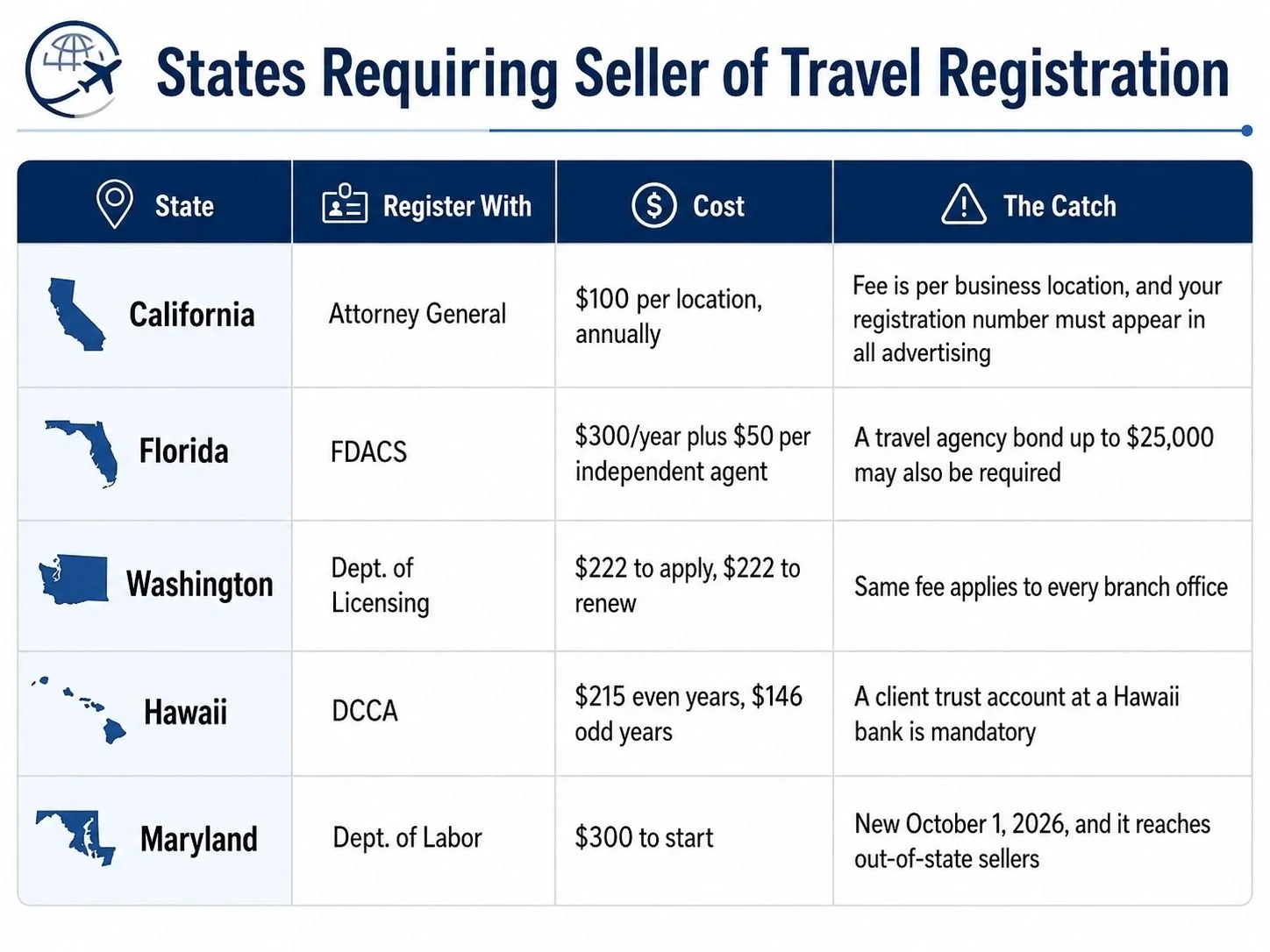
Seller of Travel States
If you heard that Iowa requires registration, that information is outdated. Iowa no longer requires it.
Keep in mind, these laws can depend on where your clients live, not just your own location. For example, if you are in Utah and book a family in California, you may need to follow California's rules. Some states like Illinois, Massachusetts, and New York have rules about disclosures and refunds but do not require registration. Delaware and Louisiana require you to have an occupational license.
Send your host agency a written list of questions: Which registrations do you maintain? Are independent contractors included? Which states are covered? Do I need to provide any specific disclosures? Am I allowed to collect client payments directly?
This guide gives general information and is not legal advice. If you are unsure about anything, speak with an attorney or contact your state's business office.
Business Structure
Most hosted agents begin as sole proprietors, which works well. Forming an LLC usually costs between $50 and $200, depending on your state, and is a good idea once you have steady income or start handling group business. You do not need an LLC right away, and it does not take the place of insurance or solid contracts.
Certification: Optional, Not Required
Travel advisor certification is not required anywhere in the U.S. It is voluntary and up to each person. Credentials from The Travel Institute's CTA, ASTA's programs, and CLIA can help you build credibility and knowledge, but none of them are required to work as a travel advisor.
CLIA's Individual Agent Membership costs $139 per year. CLIA suggests you have $5,000 in cruise commissions from the past 12 months to qualify, but some host agencies can waive this requirement in your first year. You should get this membership when cruises become a significant part of your business, not before.

Step 6: Set Up Your Business for Almost Nothing
You probably need less technology than you expect.
Start with a professional email. A simple Gmail address is fine at first. When you’re ready to get more serious, a domain-based address looks more professional.
For video calls, use the free versions of Zoom or Google Meet. Video consultations usually work better than email, especially for complex trips or new clients.
Documents. Google Docs, Sheets, and Forms handle client intake, planning checklists, and supplier training records.
Canva’s free version is enough for creating social graphics, quote covers, and simple lead magnets.
CRM is where free options become limiting quickly. You’ll need to track contacts, preferences, quotes, deadlines, payments, and commissions. A spreadsheet is fine for your first few clients, but it won’t keep up as you grow. MainStreet membership includes a CRM, which is a big reason for the $99 fee.
Social profiles. Business accounts on Facebook and Instagram at minimum. Both are free.
If you’re eligible, claim your Google Business Profile. Make sure your business name, phone number, service area, and website are exactly the same everywhere online. Inconsistencies can confuse Google and AI assistants.
Here’s a quick security reminder: never keep client credit card numbers in a spreadsheet, text message, or your Notes app. Always use your agency’s approved process.

Step 7: Register With Suppliers
When you join a host agency, you won't get access to every supplier right away. Here’s what you need to do:
Complete your host agency’s onboarding training.
Find out your host agency’s rules for registering with suppliers.
Ask for access to the suppliers that fit your specialty.
Set up your own advisor account with each supplier.
Finish any training each supplier requires.
Learn their booking portal
Review their commission, deposit, and cancellation policies.
Save their 24-hour agent support number somewhere you can find it fast
It usually takes a few days to four weeks to get approved by each supplier.
Start with just a few suppliers. Many new agents sign up with thirty in a week, but then forget their passwords or the rules. Choose five or six that fit your specialty.
For example, if you want to specialize in Disney, you could start with Disney Destinations, Universal, a travel insurance company, and a transportation partner in Orlando. If you focus on cruises, you might begin with three major cruise lines, an insurance provider, and a hotel partner for pre-cruise stays. You can add more suppliers as you go.
Always use your own login. Using someone else’s can quickly get your credentials revoked and damage your agency’s relationship with the supplier.

Step 8: Get Your First Clients Without Spending a Dollar
About 71% of travel advisors say social media is their main way to market themselves, and for good reason. It only takes consistency, not money.
Start With People Who Already Trust You
Let your friends and family know three things: what you focus on, how you work, and how they can contact you. Don’t try to sell or push them. Make it simple for someone to say, "hey, my sister is planning a cruise."
Experienced advisors will tell you that friends and family are good for your first clients, but they can’t be your whole business. They often want discounts, mix business with personal, and eventually you’ll run out of them. Use these early clients to practice while you work on real marketing.
Post Content That Teaches
People won’t follow an account that just says "book with me." Share posts that help solve small problems:
The difference between a Disney value, moderate, and deluxe resort — and who each is actually for
Why you should fly into your cruise port a day early
What "all-inclusive" leaves out
When travel insurance is worth it and when it isn't
Three mistakes families make booking Universal tickets
What to do the moment your flight cancels
Educational content builds the trust that turns into inquiries. Sales content harvests trust you already built. You need both, in that order.
Use Where You Live
Most new agents overlook the value of their own zip code. Local Facebook groups, school and church communities, sports teams, and neighborhood business groups are full of people who prefer booking with someone they can meet in person.
Make sure you show up in local searches too. For example, "Disney travel agent in (your city)" has much less competition than just "Disney travel agent," and people searching locally are usually ready to talk.
Consider hosting a free travel night at your local library or in the back room of a coffee shop. Having twenty people in a room is better than getting two thousand online impressions.
Build Referral Partnerships
Wedding planners often need help with honeymoons. Photographers work at destination weddings. Corporate event planners need group hotel blocks. Fitness instructors have clients interested in adventure trips. Youth sports organizations are always traveling.
Always offer real value first. Before you offer any referral rewards, make sure to check your host agreement and state laws.

How Travel Agents Get Paid
We have two main revenue streams: supplier commissions and client fees.
Commissions
After an eligible booking, suppliers pay our agency a percentage. Then, the agency pays you your share. Here are the rates for 2026:
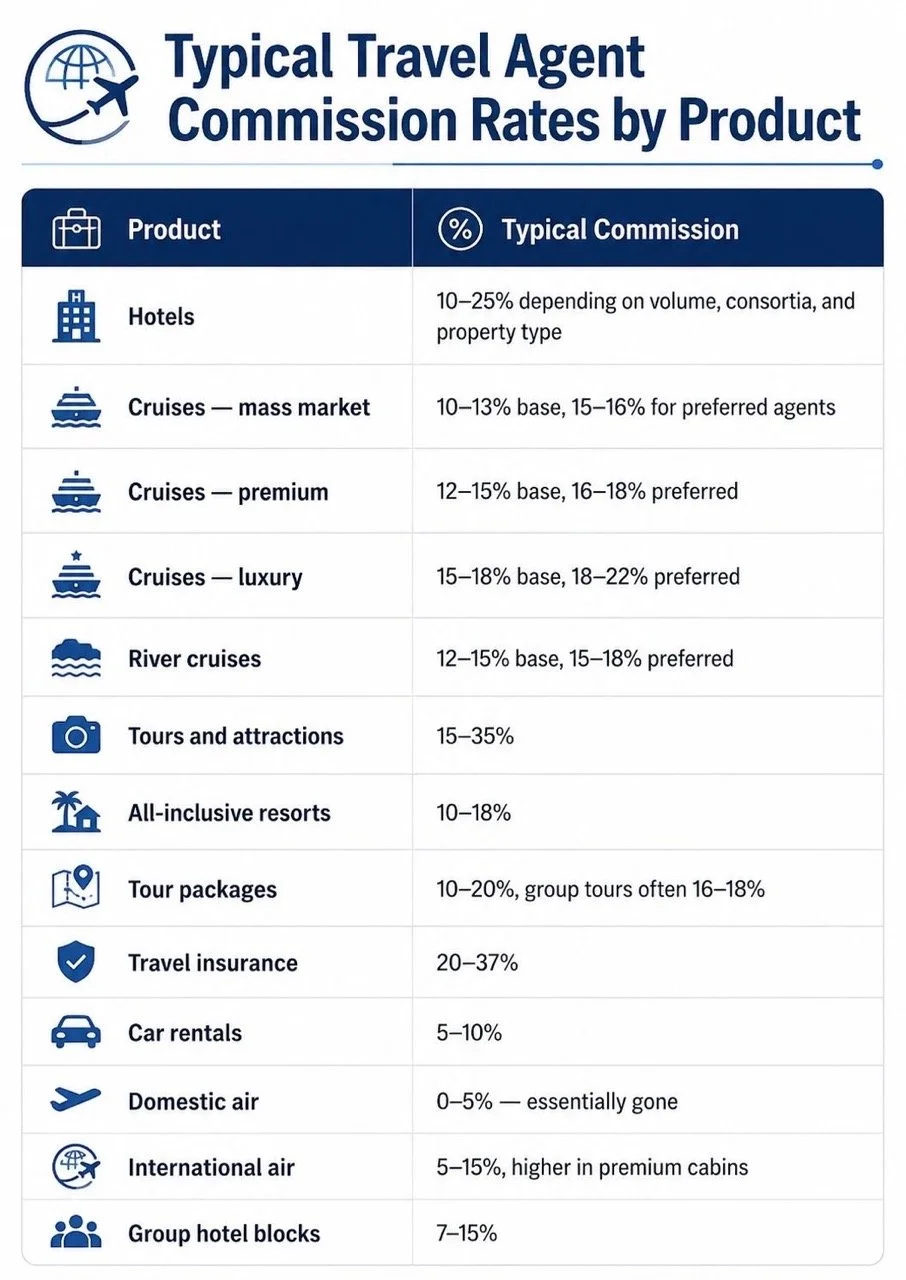
It's important to understand what happened with airline commissions. Selling flights is a service you offer your clients, but it's not something you can build a business around.
The Timing Nobody Warns You About
You don't get paid at the time of booking. Usually, you receive your payment about 30 days after your client has completed their trip.
For example, if you book a cruise in September for the following June, you probably won't get paid until July. That's a ten-month wait. Make sure to plan your finances with this in mind, and don't leave your current job just because you've booked a large trip.
Planning Fees
Some advisors charge a fee for their time in addition to earning commission. Fora, for example, shares fee guidelines showing that service fees average about $350 for a week of trip planning. Fees can range from $50 for a simple weekend hotel stay to over $2,000 for complicated multi-country trips.
Charging fees is reasonable for complex custom itineraries, trips with a lot of flights, or clients who want research but may not book. For simple cruise or resort bookings that already pay good commissions, fees might not be necessary. Check your host agreement, since not all hosts allow fees, and always make sure to disclose any fees in writing before you begin working.

How Much Do Travel Agents Actually Make?
According to the BLS, the median yearly pay for travel agents is $50,160 as of May 2025, which works out to $24.11 per hour. Half of travel agents earn between $41,950 and $63,060, while the top 10% make over $76,660.
Data from independent advisors gives a clearer picture for newcomers. Host Agency Reviews found that full-time advisors in their first three to five years made an average of $44,127. Those with more experience earned between $66,000 and $79,000. Top earners with a strong niche or luxury clients can make over $100,000.
Part-time agents earn much less, making about half as much as full-time agents, according to the same data.
To be honest, those numbers reflect agents who already have steady clients. Your first year will be very different. With the time it takes to find clients, make bookings, and wait for payments, many new agents earn only a few hundred dollars in their first year and a few thousand in their second. The agents who succeed are the ones who treat it as a real business, not just a hobby for discounts.
Job growth for travel agents is expected to stay about the same through 2035, but there are still 5,900 to 7,100 job openings each year as people retire or change careers. The industry as a whole is growing, with that $45.3 billion number rising by 9.4% each year since 2021. Most of this growth is happening with independent advisors and host agencies, not traditional storefronts. That’s the area you would be joining.

FAM Trips: What They Are and How to Get One
A familiarization trip, or FAM trip, is an educational trip hosted by a tourism board, hotel, cruise line, or tour operator. It lets advisors experience a product firsthand.
What They're Not
They're not free vacations. FAM trips have busy schedules, with several hotel site inspections in a day, supplier presentations, planned meals, and ship tours. Also, "free" usually isn't literal. Advisors often pay for airfare, tips, insurance, and other expenses, even if the land portion is covered.
Some trips are truly complimentary, but most are offered at a significant discount for advisors.
How to Get Picked
Suppliers choose FAM participants based on:
Sales performance. High producers get first call.
Experience level. Brand-new agents are lower priority. Build credibility first.
Relationships count. Connect with supplier reps on social media, join their webinars, and respond to their emails.
Complete their training. Finishing a supplier’s certification shows you’re committed.
Pick trips that fit your niche. Apply for the ones that match what you really sell.
Some host agencies let any agent come on certain FAM trips through out the year, take advantage them as much as possible!
Keep your LinkedIn and agency profiles professional, share client testimonials, and show real enthusiasm when you apply. Suppliers want to invest in someone who will sell their product later.
Questions to Ask Before You Accept
What's included and what isn't?
Can I bring a guest?
Are there sales requirements before or after?
Is attendance mandatory at every activity?
What are the cancellation penalties?
Making It Pay Off
Set clear goals before you go, like which room types you want to see or what questions you need answered. Take detailed notes and photos for your marketing. Network with other agents, since those connections can last long after the trip. Afterward, send thank-you notes to your hosts and connect with sales reps on LinkedIn. These relationships can help you get client upgrades in the future.

Common Mistakes New Agents Make
Treating it like a discount club. The benefits are real. For example, Disney agent rates on Walt Disney World resort hotels are about 50% off, and MainStreet agents get a free 1-Day Park Hopper ticket each year. But these perks are for active professionals, and suppliers do check. Join to build a business first. The perks will come after.
Not choosing a niche. If you try to sell everything to everyone, you end up blending in. Most experienced agents say this is the biggest mistake new agents make.
Relying only on friends and family. They might be your first clients, but they are not your main market.
Signing up with suppliers before joining a host agency. You need an accreditation number to access agent portals, so always join a host first.
Rushing through training. The certificate is not what matters most; it is the knowledge you gain. Clients can tell right away if you are not prepared.
Skipping the contract. Make sure you understand the fees, commission splits, client ownership, non-compete clauses, and what happens to pending commissions if you leave. Read every part of the contract.
Expecting to get paid commission at the time of booking. Commissions usually arrive about 30 days after the client finishes their trip. Plan your budget for this delay.
Selling products that pay no commission and expecting to earn money. For example, single-day, single-park theme park tickets pay nothing. Offer these as a courtesy, but do not rely on them for your business.
Mishandling client money. Always follow your agency's process exactly. Never put client funds into your personal account.
Giving quotes before checking the cancellation policy. Make sure you know the deposit, final payment, change, and refund rules before you offer any options to clients.
Mixing up geography or dates. Double-check airport codes, time zones, and passport expiration. It's embarrassing and it's expensive.
Believing social media rumors instead of checking official sources. Always use supplier portals and government websites for anything that could affect a client's trip.
Not communicating. If you are running late on an itinerary, let your client know and give them a realistic update. Staying silent breaks trust faster than any delay.
Not documenting decisions. Save quotes, policy disclosures, insurance declines, approvals, and payment confirmations. This is what protects you.
Copying content from other agents. Writing original content based on your own experience is what builds trust. It is also what search engines and AI assistants reward.

Marketing Yourself in the Age of AI Search
This topic is more important now than it was last year. People no longer rely only on Google. They also use ChatGPT, Perplexity, and Google's AI Overviews to find answers.
Give a direct answer right away, then explain further. Begin each page or post by answering the main question clearly. AI tools look for clear, stand-alone answers. If you hide your answer deep in the text, it probably won't get picked up.
Be specific instead of general. For example, a broad topic like "Tips for visiting Orlando" is often overlooked. But a focused question such as "How to get from Orlando International to Universal's Epic Universe in 2026" is more likely to be cited.
Create an FAQ page using questions in the same words people use when searching. After each question, give a clear answer in 40 to 60 words.
Make sure your business details are exactly the same everywhere. Use the same name, phone number, and description on your website, Google Business Profile, and social media. If your information is inconsistent, AI tools may be less likely to trust or cite you.
Share your credentials. Mention any certifications you have, how much experience you bring, and which destinations you have visited yourself. Showing your credibility helps build trust.
Always include real numbers and cite your sources. Statistics without sources are often ignored. For example, saying "According to BLS data from May 2025" makes your information more likely to be used.

Frequently Asked Questions
Can you become a travel agent for free?
Yes, in the ways that matter most. Training, supplier certifications, your accreditation number, and marketing are all free. However, you may still need to pay for things like host agency membership, Seller of Travel registration in five states, and optional credentials.
Do you need a license to be a travel agent?
There is no federal or national travel agent license. However, five states require Seller of Travel registration: California, Florida, Hawaii, Washington, and Maryland (starting October 1, 2026). Your host agency usually takes care of this compliance.
Is travel agent training free?
Yes. Host agency onboarding is usually part of your membership, and supplier programs from Disney, Universal, Royal Caribbean, tourism boards, and many others are free and self-paced. Only independent certifications from The Travel Institute and similar organizations require tuition.
How much do travel agents make?
According to the BLS, the median annual income is $50,160 as of May 2025. Independent full-time advisors usually earn about $44,127 in their first three to five years, and this can rise to $66,000 to $79,000 with experience. Top specialists in niche and luxury travel can make over $100,000.
Do travel agents cost the client money?
Usually, clients pay nothing extra. Suppliers pay agents a commission that is already included in the standard price, so clients often pay the same or even less than booking directly. Some advisors may charge planning fees for complex custom trips, but these are always disclosed upfront.
Do you need experience to become a travel agent?
No. The BLS says you do not need any prior related work experience, just moderate on-the-job training. A high school diploma is usually enough to get started. Skills in sales, customer service, and organization are more important than having a travel background.
How long does it take to start booking?
You can join a host agency in just a few minutes and finish basic onboarding in a few days. Supplier approvals usually take anywhere from a few days to four weeks. Most new agents make their first booking within one to two months, often for their own trip.
How do travel agents get paid?
Suppliers pay commission to your host agency, which then splits it with you according to your agreement. You usually receive payment about 30 days after your client finishes their trip, not when they book.
Can I be a part-time travel agent?
Yes, and most people begin part-time. As an independent contractor, you set your own hours and can take on as many or as few clients as you like. Try to find a host agency with no minimum booking requirements.
Do I need an LLC to be a travel agent?
You do not need an LLC to start. Most hosted agents begin as sole proprietors. Forming an LLC costs $50 to $200 depending on your state, and it makes sense once you are earning regularly or handling group business.
What is a host agency?
A host agency provides independent advisors with an industry accreditation number, supplier relationships, commission processing, training, technology, and support. In exchange, the host takes a share of your commission or charges membership fees.
What's a good commission split for a new agent?
Splits range from 50/50 for beginners at some hosts up to 90/10 for high-volume veterans. A 70/30 split with no volume requirement is strong for a new agent. Always weigh the split against the fees — a great split with heavy monthly dues can net you less.
Can I become a Disney travel agent for free?
The College of Disney Knowledge training is completely free. You need to be affiliated with an agency to access the Disney Travel Agents portal, and reputable agencies never charge extra for Disney portal access.
What is a CLIA card and do I need one?
A CLIA card is a professional ID for the cruise industry. Individual Agent Membership costs $139 per year, and CLIA recommends earning $5,000 in cruise commissions in the previous 12 months. You do not need a CLIA card to start selling cruises.
Do travel agents get free trips?
Not usually. Agents can get discounted industry rates and FAM trips at lower costs. Some FAM land portions are free, but airfare, taxes, and other expenses usually are not. If someone promises free travel just for signing up, they are not being honest.
Are free host agencies legitimate?
Some free host agencies are legitimate. However, many free programs make up the cost through lower commission splits, fees that start after a trial period, paid training upgrades, or recruiting-based models. Always ask what you will have paid in total after three years, and read the full contract carefully.
Is $99 enough to start a travel business?
$99 covers your entry, including training, accreditation, supplier access, CRM, and support. You should budget separately for anything your state requires, as well as a domain and marketing tools once you start earning income.
Is being a travel agent worth it in 2026?
It's worth it if you like research, sales, problem-solving, and running a small business. Demand is real — 60% of Gen Z and Millennial travelers say they want an advisor, and agencies now capture $1 of every $4 spent on travel. It's not worth it if you expect fast money or free vacations.

Your Journey Starts Today!
You can really start becoming a travel agent online for free. Training, certifications, accreditation, and marketing all cost nothing except your time and focus. The main choice is which host agency to join, and that decision matters more than just the price.
MainStreet Travel makes it easy with a one-time $99 fee. There are no monthly fees, no annual dues, no minimum bookings, and you get a 70/30 commission split. We also include online training, a free CRM, and a support team that responds. If you are already an agent with another company, our Transfer Agent membership lets you switch for free.
After three years, you will still have only paid us $99. That’s it!
Become a Travel Professional for Only $99
Turn your love of travel into extra income from home!
Join Now