
Viator Travel Agent: How It Works, Commission Rates & Sign-Up Guide
The Viator travel agent program pays you 8% for tours, tickets, transfers, and excursions you book or recommend. Joining is free and setup takes about twenty minutes. So yes, it works. But what really matters isn’t just the 8%. It’s when you actually get paid, and a rule change in late 2025 tripled the time you have to earn commissions.
Most guides leave both of these points out. I won’t.
I'll show you how the platform works on a typical Tuesday, what your commission looks like after your host takes their share, the step-by-step sign-up process, and three tips that most guides skip or don't explain well.
Grab a coffee. I’m going to explain everything you need to know.
Viator Travel Agent Program at a Glance
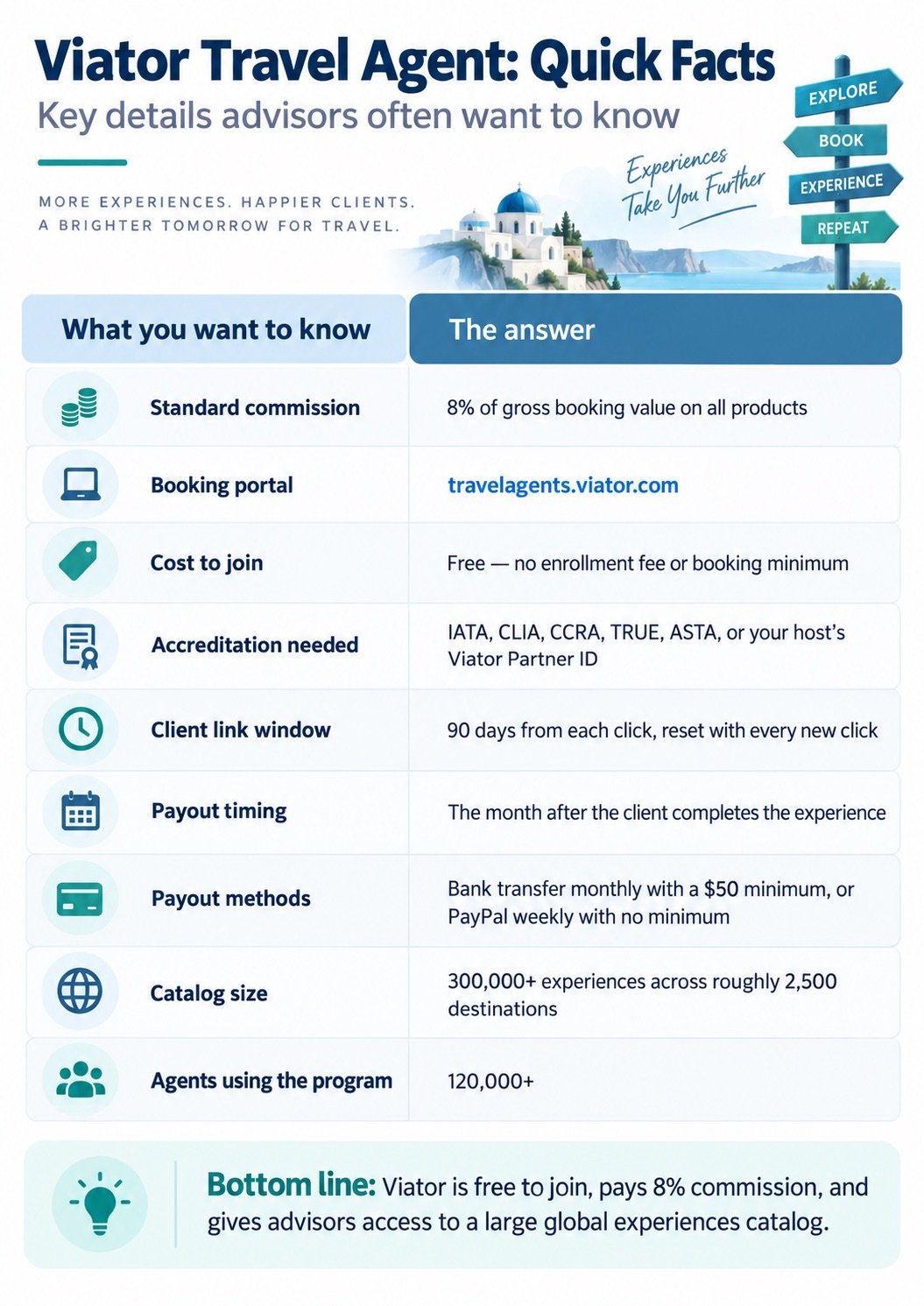
Viator at a glance
Save that table for reference. Now, let's go over the sections that need more explanation.
What the Viator Travel Agent Program Actually Is
The Viator Travel Agent Program is a booking platform made for travel advisors. It uses the same marketplace that clients use to find activities, tickets, food tours, transfers, and excursions.
Viator is owned by Tripadvisor, which is more important than it might seem. Most clients know the Tripadvisor name, so you don’t have to spend extra time convincing them the site is trustworthy.
Viator does not run every tour itself. Local operators handle the tours, while Viator takes care of payment, vouchers, customer support, and tracking commissions. Your expertise is knowing which experiences are truly worth booking.
Inside the advisor portal, you can:
Search and filter more than 300,000 experiences by destination, category, or cruise line.
Book directly for a client.
Generate trackable Share with Client links.
Hold eligible spots with Reserve Now & Pay Later.
Build Curated Lists to share multiple recommendations in one place.
Manage or cancel eligible bookings.
Pull booking and commission reports.
Invite advisors and set agency payout details if you are the account admin.
A quick note: the number of listings can be different on Viator’s agent pages compared to what clients see. Since inventory changes all the time, it’s best not to give clients an exact product count.

Viator Travel Agent vs. Affiliate Program
Viator runs two separate programs. They look similar from the outside, but they are designed for different kinds of businesses.
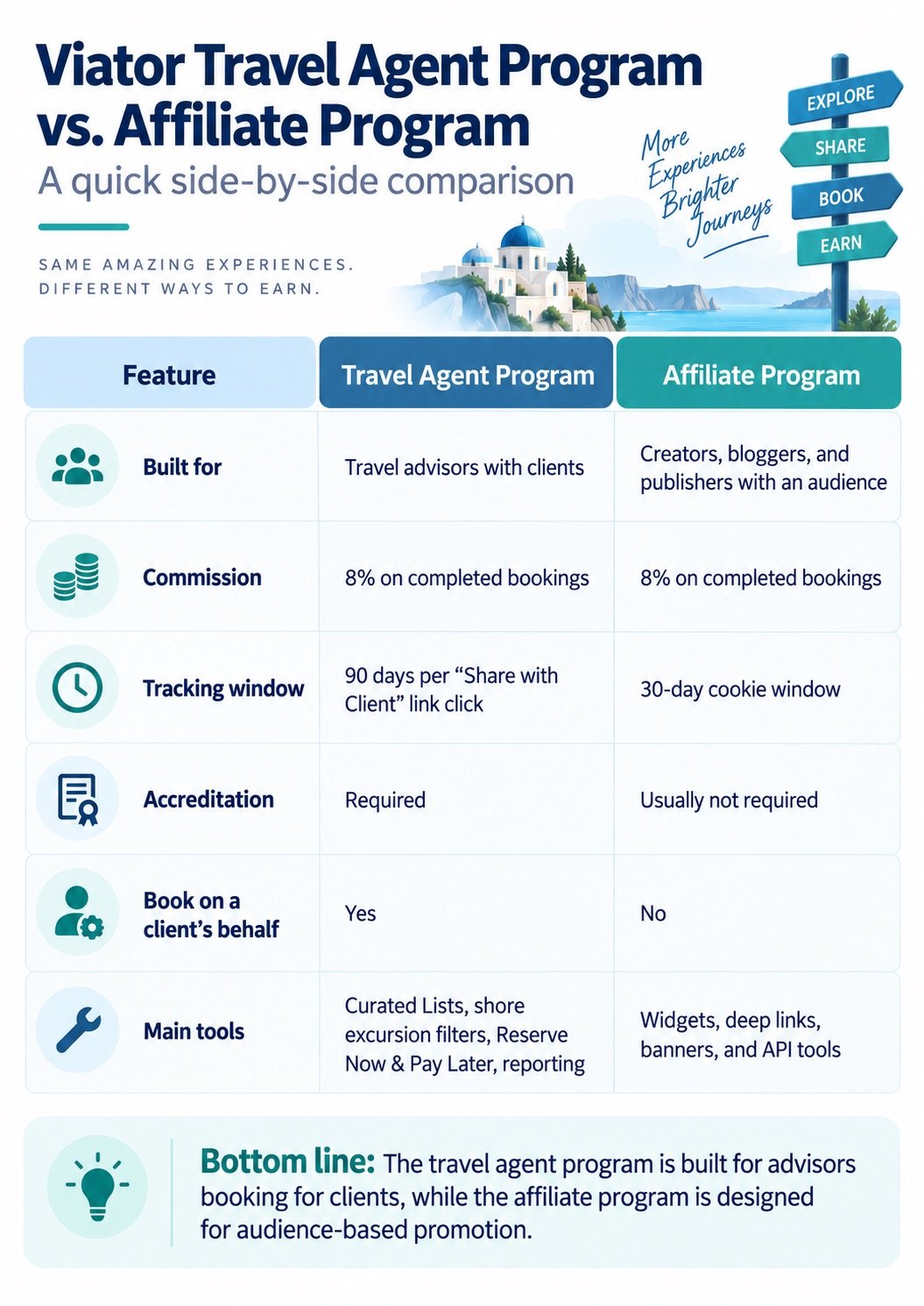
Viator V Affiliate
Here’s an easy rule: If you work directly with travelers, choose the travel agent program. If your audience is readers, viewers, or followers, go with the affiliate program.
If you do both, the travel agent program is usually better. It lets you book for clients, send them links, and use tools made for advisors.
If you picked the affiliate option by mistake but needed the agent program, don’t worry. Just contact Viator’s travel agent support team and ask them to update your account.
How a Viator Travel Agent Earns
You can earn money through the Viator Travel Agent Program in three main ways.
Book Experiences Yourself
Log in to the travel agent portal, search the destination, pick the experience, enter traveler details, and complete the booking. The voucher is issued under your agency record, which gives you more control over communications and changes.
This method is best for more complicated bookings, like:
A cruise excursion with a tight return time.
A family with multiple ages and needs.
A traveler who needs accessibility support.
A private tour with special pickup details.
A client who wants you to handle everything.
Before confirming, double-check the local start time, traveler ages, meeting point, pickup area, tour language, duration, what’s included, cancellation deadline, and any needed documents.
Most booking problems are small details that can turn into big issues if someone ends up in the wrong place abroad. For example, being at the wrong pier, the wrong hotel pickup spot, or booking a tour that clashes with dinner plans.
The One Rule That Can Cost You Commission
Make sure you always book through the travel agent portal. If you book on the public Viator website instead of the agent portal, your booking might not be linked to your account. This could mean you miss out on your commission.
Check the website address before entering payment details. It might seem obvious, but it’s an easy mistake to make if you have lots of tabs open.
Send a Share with Client Link
This is where you’ll find a lot of opportunities.
In the agent portal, click Share with Client on any page. Pick your language, copy the unique link, and send it by email, text, WhatsApp, social media, or your itinerary tool. Your client can browse and pay Viator directly. You’ll still earn the same commission as long as the booking is linked to your unique link.
You can share:
The Viator homepage for travelers who are early in the planning stage.
A destination page for clients browsing a city or region.
A category page, such as food tours, airport transfers, or family activities.
A specific experience when you already know the best fit.
The 90-Day Tracking Rule
In late 2025, Viator changed the Share with Client attribution period from 30 days to 90 days.
Here’s why this change is important:
Your unique link never expires.
When a client clicks your link, the 90-day tracking period starts.
If your client books an eligible experience within those 90 days, you’ll get credit for the booking.
They don’t have to book the exact experience you shared with them.
If they click your link again, a new 90-day window will start.
This is a major advantage over the standard affiliate program.
Don’t just send the link once and forget about it. Make it part of your regular client process:
Send it in the deposit confirmation email.
Include it in the planning-stage itinerary.
Re-send it during the 90-day travel check-in.
Add it to the final itinerary email.
Include it in a one-week-before-departure text.
Send it in a welcome-home message for future trips.
Each time a client clicks your link, you get another chance for attribution. This makes your usual client service even more valuable.
Can You Manage Client Self-Bookings?
Yes, when clients book through your Share with Client link, those bookings appear in your Manage Bookings area as indirect bookings.
You can request access to manage an indirect booking or contact support using the booking reference number when your client needs help. This lets clients pay on their own without fully giving up your ability to assist them later.
Add a Widget to Your Website
Viator’s widget tools let you highlight a destination, category, or specific products on your website. Just pick the language and currency, copy the code, and add it to the right page. You’ll earn the same commission rate as you would for bookings made directly through the agent platform.m.
What matters most is relevance. Avoid adding a generic activity widget to every blog post. If someone is reading a guide about one day in Rome, show a few carefully chosen Colosseum tours or food experiences. Focused recommendations feel helpful, while a random list of tours just looks cluttered.

Viator Travel Agent Commission Rates
Viator usually pays travel agents a commission of 8% of the total booking amount. This rate covers most tours, activities, shore excursions, transfers, and group bookings.
Here are some examples:
A $200 food tour earns about $16.
An $80 airport transfer earns about $6.40.
A $500 private Colosseum tour earns about $40.
A $1,200 private boat charter earns about $96.
Five $1,200 boat charters can generate about $480 in gross commission.
It’s important to focus on the term gross commission.
The 20% Commission Myth
Some sources claim Viator pays travel agents about 20%, but that is not accurate. The 20% to 30% figure often refers to the commission Viator charges tour operators and suppliers to list and sell their products. This is not the rate paid to travel agents.
Most travel advisors receive the standard 8% commission rate.
Can You Earn More Than 8%?
In some cases, certain host agencies, consortia, or large travel organizations have arranged higher commission rates with Viator.
Examples that have appeared in agency materials include:
10% for some Nexion members.
12% for some FROSCH-affiliated advisors.
10% for certain Travel Planners International advisors.
These are not guaranteed rates that every advisor receives. Your actual commission depends on your agency relationship, host agreement, and the rate displayed in your account.
For the most accurate information, always check your dashboard instead of relying on blog posts, even this one.
Gross Commission vs. What You Keep
If you work with a host agency, Viator usually pays your host first. Your host will then pay you based on your commission split and payout schedule. An 8% commission from Viator does not always mean you will receive the full 8%.
For example, if your gross commission is $80:
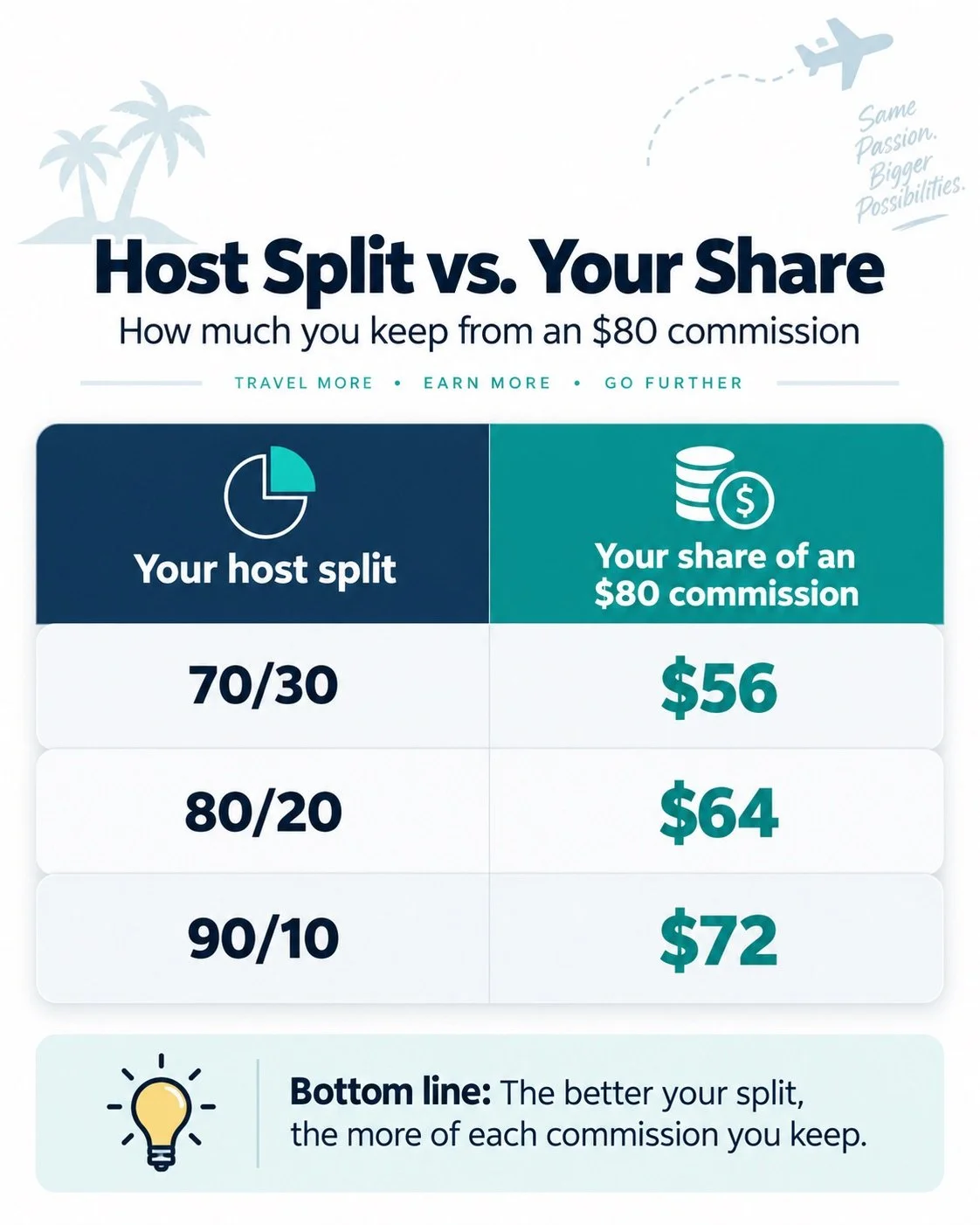
Host Split V Your Share Graph
Before booking any client experience, make sure to ask your host these questions:
What percentage of supplier commission do I keep?
When are activity commissions paid to me?
Are transaction, processing, or admin fees deducted?
Your actual earnings are what you receive in your account after commissions and fees are deducted.
Can you increase Viator prices for your clients?
Usually, you cannot. In the standard Viator Travel Agent Program, Viator acts as the merchant of record. Your client pays the regular price, and you receive your commission after the experience is finished.
This setup is different from a traditional net-rate system, where you buy at wholesale and set your own retail price. Some advanced merchant API options work differently, but they also mean you take on more responsibility for payments and customer support.

When Viator Pays Commission
Viator pays your commission only after the traveler has completed the experience, not when the booking is made.
For example:
You book a food tour in February.
Your client travels in July.
The tour is completed in July.
Your commission is typically processed in August.
Many new agents overlook this important cash-flow rule.
Payout Schedule
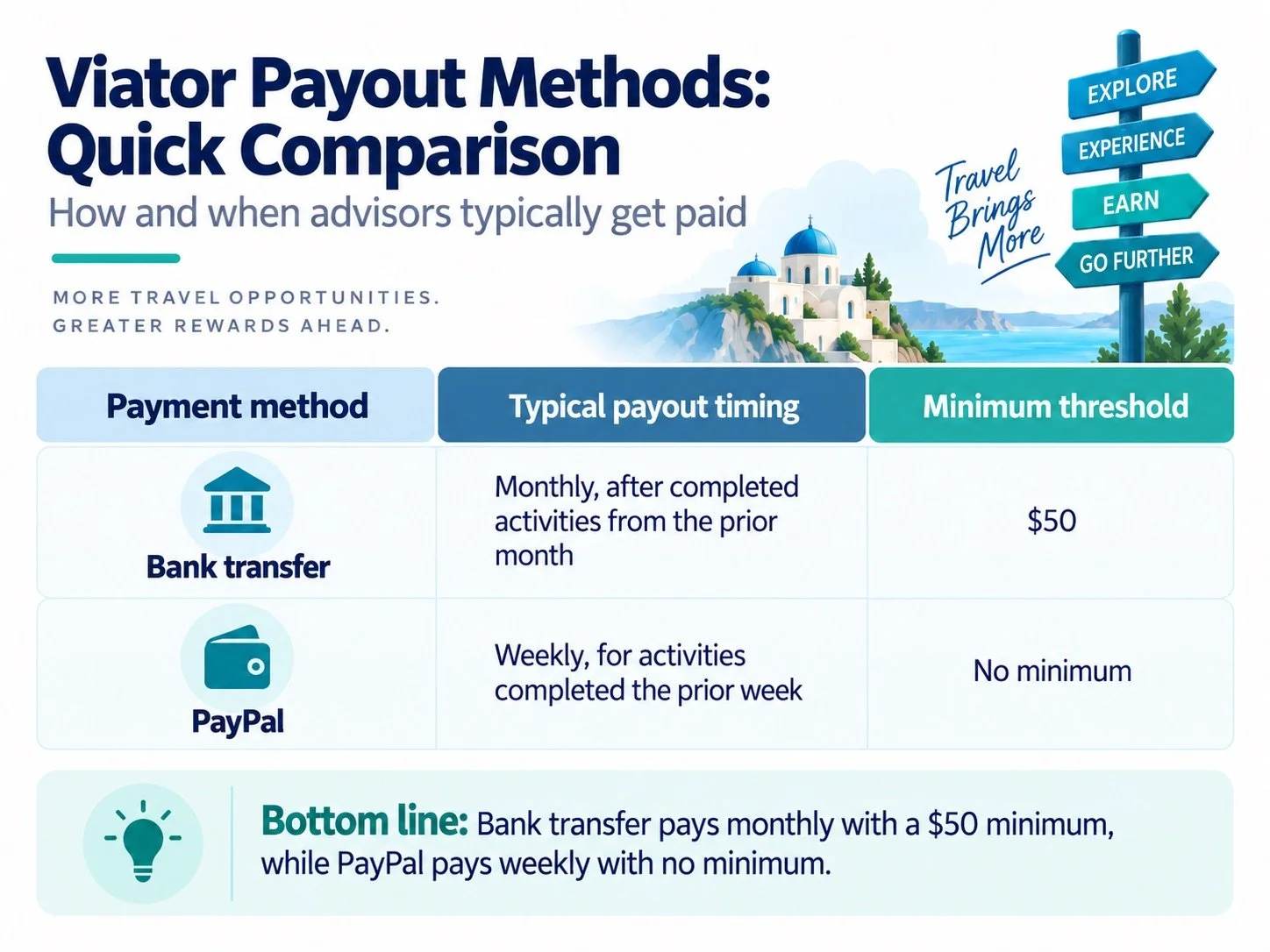
Viator Payout Methods
If your commission balance from bank transfers is less than $50, it usually carries over to the next month. Your commission will not expire as long as your account is active and your payout information is up to date.
Why Payout Timing Matters
For example, if you sell twelve summer tours in February, you will not receive payment in March just because the bookings are confirmed. You might have to wait until July, August, or even later, depending on when the tours take place.
This does not mean there is a problem with the program. It just means you should plan your cash flow based on when travel is completed, not on the number of bookings.
Canceled bookings usually do not earn commission. However, if a guest does not show up and the booking was not officially canceled, you might still earn commission depending on the booking terms and final outcome.

Accreditation and Licensing Are Different Things
This part can get confusing, so let’s clear it up.
What Viator Requires
To join the Viator Travel Agent Program, you usually need a recognized industry credential or membership in an agency association. Here are some common options:
A Viator Partner ID through your host agency.
IATA or IATAN accreditation.
CLIA membership or credentials.
CCRA, TRUE, or ASTA numbers.
Another accepted host or agency accreditation.
If you work with a host agency, you will often use the host’s credential instead of getting your own.
What the Law Requires
Having professional credentials is different from registering your business legally.
There is no single federal travel agent license in the United States. Some states, like California, Florida, Hawaii, and Washington, have Seller of Travel rules or other registration requirements. Iowa also requires travel sellers to register. Other states might have rules about disclosures, business licenses, taxes, or consumer protection.
Look up the rules for both where your business is based and where you sell travel. If you use a host agency, ask them in writing if their registration includes you.
Don’t assume an IATA or CLIA credential handles state-level legal requirements. It doesn’t.

How to Sign Up as a Viator Travel Agent
Step 1: Choose Your Business Path
First, decide whether you will:
Join a host agency.
Work as an independent travel advisor.
Create your own agency account.
Join an existing agency as an employee or independent contractor.
A host agency can make things easier by offering accreditation, handling commissions, providing training, connecting you with suppliers, and sometimes helping with insurance.
If you work independently, you have more control, but you are also responsible for compliance, accounting, taxes, and possibly paying other advisors.
Step 2: Gather Your Information
Make sure you have these items ready before you begin:
A professional email address you plan to keep long-term.
Your legal name and phone number.
Your agency name and business address.
Your host’s Partner ID or another accreditation number, if you have one.
Tax details.
Bank account information or PayPal account details.
Preferred payout currency.
If you already have a Tripadvisor account, use that same email address. The Viator agent platform uses Tripadvisor login details, so using a different email could create a second account you don’t need.
Step 3: Use the Correct Portal
Make sure you use the Viator travel agent portal, not the regular booking website for customers.
When you set up your account, choose the travel agent option. Only pick the affiliate option if you work as a publisher or content creator, not if you advise clients directly.
Step 4: Join a Host or Create an Agency
If you work with a host agency, you can join in one of these ways:
A custom signup link from the host.
An emailed invitation from the agency administrator.
Independent registration followed by a search for your host’s Viator Partner ID or accreditation number.
Check the exact identification number with your host. Agencies with similar names can cause confusion, and using the wrong number might send your commission to the wrong place.
If you’re starting a new independent agency, select the new agency account option. You can add multiple accreditation IDs, which helps future advisors find and join your agency.
Step 5: Know the Difference Between Admin and Agent Roles
The person who creates the agency account becomes the admin.
Admins can:
Add or update payout methods.
Invite advisors.
View agency-wide booking reports.
View client details and commission information across the agency.
Manage account settings.
Standard agents can generally:
Make bookings.
Create Share with Client links.
View their own bookings and reports.
Manage their own client activity.
Standard agents usually can’t add payout details or see another advisor’s client information.
If you can’t add banking details, you’re probably a member agent, not an admin. Your agency owner or host will need to handle that step.
Step 6: Finish Payout and Tax Details
After you create a login, keep going with the next steps.
The account admin needs to add a payout method in the Finance section. What you need to provide depends on your country and payment method. You may be asked for:
Account-holder name.
Billing address.
Bank name.
Routing number, SWIFT code, or IBAN.
Account number.
Payment currency.
Tax information.
PayPal account details, if applicable.
If your finance information is incomplete, your commissions might not be paid out correctly.
Step 7: Test the Platform
Take a few minutes to test your setup before you have a client waiting for a response.
Confirm your agency name is correct.
Verify the commission rate shown in your account.
Check that your payout details are marked as complete.
Generate a Share with Client link.
Open the link in a private browser window.
Confirm your name appears where it should.
Find the Reports tab.
Find the Manage Bookings tab.
Search a destination you know well.
Doing this quick test now can save you a lot of stress later.

Tools That Can Increase Your Earnings
Reserve Now & Pay Later
With Reserve Now & Pay Later, clients or agents can book eligible experiences without paying right away. The client’s card is typically charged closer to the travel date, based on the experience and its terms.
Why it helps:
Clients can secure popular experiences before they sell out.
Travelers have more flexibility while planning.
You can finalize bookings without requiring clients to pay right away.
You will still earn your usual commission once the experience is completed.
Try using a simple closing line like this:
Let’s reserve the sunrise balloon ride now so it doesn’t sell out. You will not be charged until closer to travel, and we can review the cancellation terms before you commit.
Be sure to check the payment deadline. If the payment method does not go through, the reservation could be canceled and might need to be rebooked.
Travefy Integration
If you use Travefy, you can link your Viator account and add products straight into your digital itineraries.
This is helpful because your Share with Client link becomes part of the itinerary you already send. Clients get useful product details and booking access, while you enjoy a smoother workflow and more chances to earn attribution.
Each itinerary can work as a commission tool, not just another document you send and forget.
Shore Excursion Planning
Shore excursions are among the best opportunities in the Viator Travel Agent Program.
Cruise clients often worry most about missing the ship.
Use your advisor role to confirm:
Port arrival time.
Actual disembarkation timing.
Meeting point distance from the ship.
Tour duration.
Return time before all-aboard.
Pickup details.
Traffic or weather risks.
Operator cancellation policies.
When you clearly explain the timeline, you are offering more than just an excursion. You are providing peace of mind.

Track Your Experience Attachment Rate
Many agents focus on total bookings or total commission. These numbers are important, but they do not reveal if you have a process you can repeat.
Instead, pay attention to your experience attachment rate:
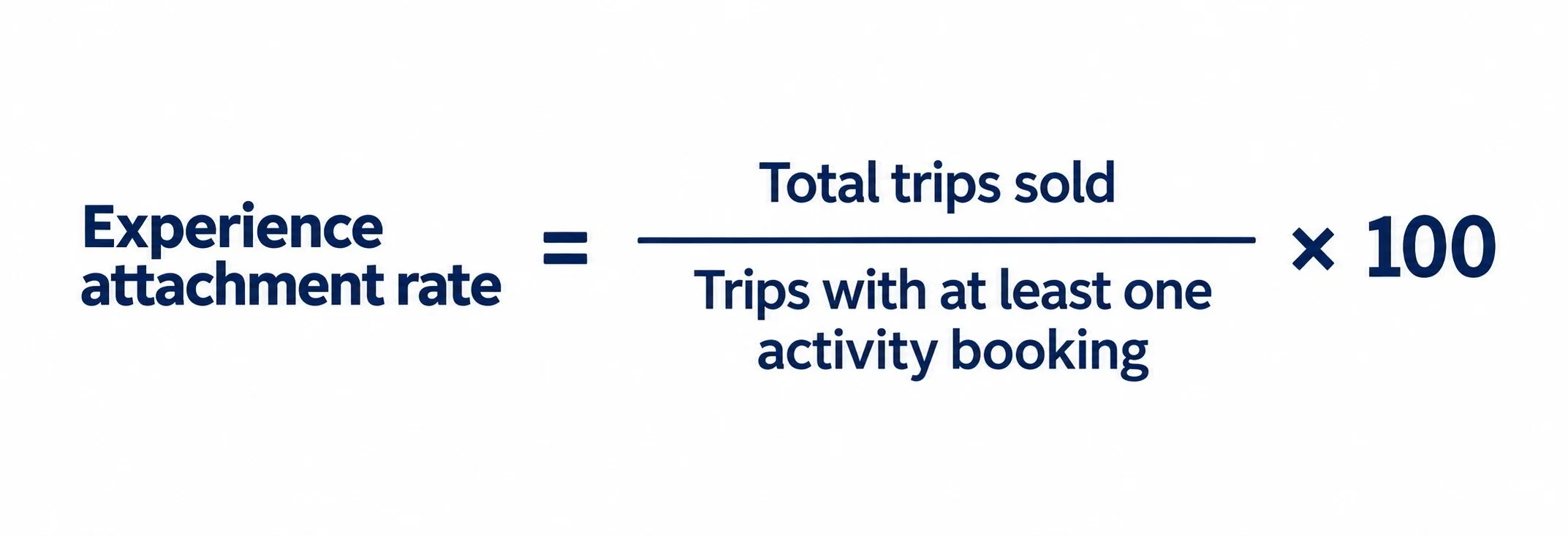
Experience Attachment Rate
For example, if you sell 20 trips and eight of them include at least one booked experience, your attachment rate is 40%.
This number is helpful because it is usually easier to increase than your total number of clients.
Raising your attachment rate from 40% to 70% does not mean you need new leads, ads, or a new website. Instead, build a simple habit: ask every client what they want to experience, not just where they want to stay.
Track these numbers each month:
Total trips sold.
Trips with at least one activity booking.
Experience attachment rate.
Gross commission earned.
Net commission after host split.
Average booking value.
Most-booked destination.
Best-performing email or link placement.
Cancellation rate.

Sell the Recovery Day, Not Just the Main Attraction
Here’s one way to help you stand out.
Everyone sells the famous attraction. Orlando means theme parks. Las Vegas means the Strip. Nashville means Broadway. Rome means the Colosseum.
After three days of crowds, walking, and busy schedules, most people want a break. This is a great chance to suggest something they might not expect.
For an Orlando family, the recovery-day recommendation might be:
An airboat ride through marsh grass at sunset.
A bioluminescent kayak tour.
A clear-bottom kayak experience near Florida springs.
A Kennedy Space Center day trip with transportation.
An airport transfer that saves them from a brutal rental-car line.
For Las Vegas, it might be Red Rock Canyon, a Grand Canyon flight, or a food tour away from casino noise.
For Nashville, it might be a whiskey trail, garden visit, food experience, or day trip outside downtown.
Start with the main attraction, then look for a relaxing option nearby. Clients remember the agent who suggests something they have not already found online.

How to Choose Experiences Clients Will Book
A five-star rating alone is not enough.
Match the Experience to the Traveler
Consider:
Traveler ages.
Mobility needs.
Budget.
Energy level.
Dietary needs.
Comfort with crowds.
Interest in private versus group experiences.
Desire for adventure, culture, food, or relaxation.
Available time.
Hotel location.
A sunrise hike might be a highlight for one client but not enjoyable for someone else.
Read Reviews for Patterns
Do not obsess over one negative review from years ago. Look for patterns in recent feedback.
Pay attention when multiple people mention:
Confusing meeting points.
Late pickups.
A rushed itinerary.
Bad transportation.
Poor guide communication.
Unclear accessibility information.
Hidden costs.
Large crowds.
A mismatch between the listing and reality.
Check the Exact Product Option
One listing can include several options:
Tour only.
Tour with transportation.
Morning or evening departure.
Small-group upgrade.
Private experience.
Audio guide.
Hotel pickup.
Different ticket levels.
Make sure the product in the cart is the product you told the client about.
Read the Cancellation Terms Every Time
Many Viator experiences offer free cancellation up to 24 hours before the activity, but not every product follows that rule.
Some products use stricter deadlines. Others may have special weather, refund, no-show, or minimum-participant policies.
Always send the client the exact cancellation deadline in writing, including the local time zone.
Build in Buffer Time
Leave room between:
Landing and the first activity.
Cruise docking and an excursion.
One tour and the next reservation.
A long day trip and dinner.
A private transfer and a ticketed experience.
A perfect itinerary on paper can turn into a stressful mess when it has no breathing room.

Common Mistakes Viator Travel Agents Make
Booking through the consumer website instead of using the agent portal.
Sending a regular browser link instead of a Share with Client link.
Sending a client link only once and not refreshing the 90-day attribution window.
Expecting to receive commission at the time of booking instead of after the client has traveled.
Creating a new agency account when you should join an existing one.
Signing up for the affiliate program when you actually need the agent tools.
Not knowing how your host agency splits commission.
Recommending too many tours instead of focusing on three strong options.
Forgetting to consider time zones for meetings and cancellation deadlines.
Promising hotel pickup or free cancellation without first checking the listing details.
Not checking supplier messages after making a booking.
Not disclosing commission information when sharing links publicly.
Assuming every traveler wants the same type of itinerary.

What to Do in Your First 30 Days as a Viator Travel Agent
Week One: Getting Set Up
Decide if you want to join a host agency or work on your own.
Check which business and Seller of Travel rules apply to you.
Set up the right Viator travel agent account.
Fill in your payout and tax information.
Double-check your commission split.
Bookmark the agent portal for easy access.
Week Two: Learning the Platform
Look up five destinations you already sell.
Try out the filters and explore different product categories.
Make a few test Share with Client links.
Locate the Manage Bookings and Reports tabs.
Read through a few cancellation policies.
Watch the training webinars that are available.
Week Three: Building Your Process
Make a short activity questionnaire for your clients.
Write a draft email recommending experiences.
Write a draft text to remind clients before they depart.
Create curated lists for your top destinations.
Include an activities section in every itinerary.
Set up a spreadsheet to track bookings, expected commissions, and payout dates.
Week Four: Start Selling to Clients
Send two or three personalized options to your active clients.
Add relevant activities to your current itineraries.
Add destination-specific widgets to your best website pages.
Include a destination-level link in your next email to clients.
Keep track of clicks, questions, and bookings.
Focus on improving what gets the best response from your clients.
The goal is not to spam links everywhere. The goal is to create a reliable habit that makes your client feel better prepared!

Frequently Asked Questions
Is the Viator Travel Agent Program Free?
Yes, joining the Viator travel agent program is free. There are no enrollment fees or monthly subscriptions. However, you might have other expenses, such as fees for a host agency, business registration, insurance, marketing, training, or professional credentials.
How Much Commission Do Viator Travel Agents Earn?
The usual commission is 8% of the total booking value for eligible completed bookings. Some host agencies or consortia may have higher rates, but your actual commission depends on your account dashboard and host agreement.
When Does Viator Pay Travel Agent Commission?
Viator usually pays commissions in the month after your client finishes their activity. Bank transfers are made monthly and may need at least a $50 balance. PayPal payments are usually sent weekly with no minimum amount required.
Do I Need an IATA Number to Become a Viator Travel Agent?
Not always. You might be able to use your host agency’s Viator Partner ID or another accepted credential, like CLIA, CCRA, TRUE, or ASTA. Independent agencies may need to get their own approved accreditation.
Can Anyone Become a Viator Travel Agent?
You must have a real travel business or work with an eligible host agency, and you need accepted credentials. There is no federal travel agent license in the U.S., but state and local rules may still apply.
How Long Does a Share with Client Link Last?
The link does not expire. When a client clicks it, a 90-day tracking period starts. If they click the link again, the 90 days restart.
Do I Earn Commission If My Client Cancels?
No, you usually do not earn commission on canceled bookings. However, if a client does not show up and the booking was not canceled, you might still get a commission depending on the terms.
Can My Client Pay for Their Own Viator Booking?
Yes. When you use Share with Client links, your clients can browse and pay Viator directly. You still earn commission on bookings that are correctly linked to you.
What Is the Difference Between Viator Affiliate and Travel Agent Programs?
Affiliates promote Viator to their audience and usually get a 30-day cookie window. Travel agents work directly with clients, can book for them, get a 90-day Share with Client window, and have access to tools like Curated Lists and Reserve Now & Pay Later.
Can I Switch From the Affiliate Program to the Agent Program?
Yes. Just reach out to Viator’s travel agent support team and ask them to change your account type.
Can I Mark Up Viator Prices?
No, not in the standard Travel Agent Program. Viator handles the payments, so your clients see the regular public price and you earn your commission after the booking is completed.

Final Thoughts
The Viator travel agent program is not a quick way to make money. Instead, it offers a large catalog, an easy booking system, a client link you can track, and commission payments that come later for work you might already be doing for free!
Advisors who succeed with this program focus on doing three simple things well:
They pick the travel agent program rather than the affiliate program.
They include experiences in every itinerary, not just as an afterthought.
They send their Share with Client links more than once during the planning process.
You have more influence than you might think. Each time a client clicks your link, the 90-day attribution period starts over. Reserve Now & Pay Later helps clients commit more easily. Travefy lets you add your link to every itinerary you create.
Begin with small steps. Sign up using the right portal and complete your payout details. Suggest one thoughtful experience to a real client, like a museum ticket, airport transfer, food tour, or sunset sail.
In a few months, when you see your first commission in your report, you’ll be glad you started even if you didn’t feel completely ready.
Go book something great!
Become a Travel Professional for Only $99
Turn your love of travel into extra income from home!
Join Now