How to Become a Viator Travel Agent in 2026 and Earn Commission
Becoming a Viator travel agent in 2026 is one of the fastest and most affordable ways to get started in the travel industry. You really can earn money by booking tours and activities you already enjoy recommending. Signing up is quick, quicker than grabbing a coffee. But what most people don’t tell you is when you’ll actually get paid, which of the two Viator programs is right for you, and the one tracking rule that quietly tripled how long you can earn commissions last year.
Stay with me, because that last point can make a huge difference!

Why Tours and Activities Are the Smartest Money in Travel Right Now
Here’s the thing about experiences. Flights are just commodities. Hotels get compared endlessly. But tours are different. Tours are where travelers get emotional, and when people feel that way, they don’t haggle.
Think about your last client. They probably booked their own flight, maybe even the hotel. Then they reached that awkward moment in planning, looking at a blank Tuesday and wondering, what shouldwe actually do?
That empty Tuesday is your opportunity to earn.
Viator offers more than 300,000 bookable experiences in about 2,500 destinations, and over 120,000 travel agents already use its agent program. Since it’s owned by Tripadvisor, your clients will recognize the name right away. From airport transfers and skip-the-line tickets to cooking classes, helicopter rides, swamp airboats, and shore excursions, everything is in one catalog.
You don’t need a storefront full of glossy brochures to sell any of this!

What a Travel Agent Does Nowadays
Let’s set the record straight. The job has changed, but many people haven’t noticed.
You’re no longer just someone who makes bookings. Software handles that now. Your real value is helping clients feel confident and sure about their plans.
You help a family of five enjoy the ocean breeze on a small-group catamaran instead of waiting in a long line. You notice when their hotel is just outside the pickup area. You suggest the 8 a.m. tour because the 10 a.m. one is crowded and the lighting isn’t greatfor photos.
Here’s what a modern travel advisor does each day:
Talking to clients and figuring out what they actually want
Researching destinations deeply instead of broadly
Vetting operators and reading recent reviews for patterns
Building itineraries that flow without dead air or panic gaps
Following up before, during, and after the trip
Marketing themselves online so new clients come inbound
Selling experiences fits that role perfectly. Helping clients choose the right experiences is a perfect fit for this role. It’s the part of the trip where people want the most guidance, and it’s also where they’re most likely to make mistakes if they go it alone.

Viator Travel Agent vs. Viator Affiliate: Pick Your Lane First
This is where most people get tripped up. Viator has two separate programs, and if you sign up for the wrong one, you could lose weeks.
The Affiliate Program
This program is for people who have an audience, not clients. Think bloggers, YouTubers, newsletter writers, or Instagram travel accounts.
Free signup with no traffic or follower minimums
8% commission on completed bookings
You get a 30-day cookie window. If someone clicks your link and books within a month, you earn a commission.
Links, widgets, banners, and an affiliate API if you're technical
You can get basic API access without pre-approval. For full access, you need Viator’s authorization and certification.
The Travel Agent Program
This program is for people who book trips for others. If you have clients, this is the right choice for you.
You earn 8% commission on every product, all the time. This includes shore excursions and group bookings.
Direct booking inside the agent portal on your client's behalf
You can share links with clients, and these have a longer attribution window. I’ll explain this in more detail soon.
Reserve Now & Pay Later, Curated Lists, shore excursion search, Travefy integration
Reporting dashboards built for advisors, not publishers
So Which One?
My recommendation is simple:
If you serve travelers, choose the Travel Agent Program. If you serve an audience, go with the Affiliate Program. If you do both, register as an agent and use your client links in your content.
If you choose the wrong program, don’t worry. Just email tapsales@viator.com and Viator will reset your account type so you can sign up for the right one.

Do You Need Accreditation or a License to Join?
These are actually two separate questions, but people often mix them up.
Viator's Requirement
When you sign up for the agent program, you’ll need to provide an accreditation credential. This could be your host agency’s Viator Partner ID, or an IATA, CLIA, CCRA, TRUE, or ASTA number. Accreditation is simply a unique number that shows suppliers you’re a legitimate travel business.
Your realistic options:
IATA/IATAN: This is the industry credential recognized worldwide for travel professionals.
CLIA: Recognized by cruise lines and partner suppliers, and offers an individual agent membership for hosted agents.
ARC or VTC — ARC suits U.S. agencies ticketing air through the GDS; VTC fits agencies ticketing through a host or consolidator
Your host agency’s number: Hosted agents use their host’s accreditation, so they don’t need their own.
If your ID is rejected during signup, don’t worry. Viator’s help center explains that this usually means your agency isn’t in their system yet, not that you’re disqualified. Their Travel Agent Program sales team can help at 866-654-1438.
If you’re just starting out, joining a host agency is the quickest and most reliable way in. Getting your own IATA number usually takes years of sales, business checks, and bonding. With a host, you get a usable credential right away.
The Legal Requirement (Separate Thing)
There’s no federal travel agent license in the U.S. However, four states (California, Florida, Hawaii, and Washington) have Seller of Travel registration rules. These apply if your agency is based in those states or if you sell to residents there. Iowa also has a registration, and some states like Illinois, Massachusetts, New York, Delaware, and Louisiana have disclosure or occupational license rules.
Before you start selling, check your state’s business requirements, your clients’ states, local licensing, tax registration, and whether your host’s registration covers you. Always ask for confirmation in writing. Don’t just assume you’re covered.

How to Become a Viator Travel Agent: The Full Walkthrough
Registering usually takes about twenty minutes, but getting everything set up the right way needs a bit more attention. Let's go over it step by step.
Step 1: Decide How You'll Operate
You have two options for how to get started.
One way is to join through a host agency. The host gives you accreditation, training, booking systems, help with commissions, marketing tools, a community, and sometimes insurance options. This is usually easier for beginners since the structure is already in place.
Before you sign up with any host, make sure to ask about startup and monthly fees, how commissions are split, contract length, cancellation rules, who owns your client list, how often you get paid, sales minimums, and what kind of compliance support they offer.
The other option is to set up your own agency. You’ll create the account, become the administrator, and can add up to five accreditation IDs so your advisors can find you when they sign up. This gives you more control, but you’ll be responsible for compliance, accounting, and paying your advisors.
Step 2: Gather Everything Before You Open the Form
To avoid searching through tabs later, gather these details now:
Business email you'll control long-term
Full legal name and phone number
Agency name and business address
Host Partner ID or accreditation number
Tax information
Bank details or PayPal account
Preferred payout currency
If you already have a Tripadvisor account, use the same email address. Viator’s agent platform uses Tripadvisor’s single sign-on, and if you use a new email, it will automatically create a Tripadvisor account for you!
Step 3: Go to the Right Portal
Go to travelagents.viator.com and bookmark it now so you can find it easily later.
DON’T use viator.com. I’ll explain later why this is so important.
Set up your login using your email, password, name, and phone number. When you’re asked which program you want, choose, "Get Started" in the travel agents section, NOT the affiliates section.
Step 4: Connect To Your Host Agency
There are three ways in:
Register using your host’s custom signup link, which will automatically link your account.
Accept a direct invitation sent to your email from your host or admin.
Sign up on your own, then select "Yes, I work through a host agency" and search for their Partner ID or accreditation number.
Confirm that Partner ID with your host directly. Picking an agency because the name looks familiar is how commissions end up in a stranger's account.

Step 5: Or Create Your Own Agency Account
If you’re starting from scratch, select "No, I'm setting up a new agency account," fill in your agency details, and add your accreditation IDs.
The person who creates the account becomes the admin, and that’s an important role. Admins can invite advisors, manage users, add payout details, and see agency-level reports. Member agents can book and view their own commission reports, but they can’t add payout details or invite others.
This difference is the main reason for many, "why haven't I been paid?" support tickets. If you’re a member agent, your admin needs to finish the banking setup.
Step 6: Complete Payment and Tax Details
Just creating a login doesn’t complete your setup. This next step is what finishes it.
The admin should go to the Finance section, click, "Add a new payout method," and enter the country, currency, billing address, account holder name, bank name, routing/SWIFT/IBAN, and account number. If you prefer, you can use PayPal instead. You can also add up to ten email addresses to get payment notifications.
If your account or payout details are incomplete, Viator won’t be able to process your commission at all. It won’t just be delayed, it simply can’t be paid out.
On taxes: as a U.S. partner, you may receive a 1099 if you earn over $600 USD in commission in a calendar year. If you're paid via PayPal, you pull that form from PayPal. If you submitted tax details through the finance tab before January 1, it goes to the address you provided. Talk to an actual tax pro, I'm just a travel guy, not an accountant.
Step 7: Activate, Then Test Everything
Once you activate your account, take five minutes to check these things. It can save you a lot of trouble later:
Log in and confirm your agency name is right
Verify the commission percentage displayed
Confirm payout details show as complete
Generate a test Share with Client link
Open that link in a private browser window
Check that your name appears at the top
Find the Reports and Manage Bookings tabs
Re-bookmark the correct portal
After that, watch a webinar. Viator offers live and on-demand sessions about getting started, using Share with Client links, Reserve Now & Pay Later, and the Travefy integration. Agents who skip training often use the link tools incorrectly and miss out on money they’ve already earned.

The Three Ways You Actually Earn
Method 1: Book Directly for Your Client
Log in, search for the destination, choose the experience, enter the traveler’s details, and finish the booking. This method works best if your client wants full service, has a tight schedule, or the product is complex.
Before confirming, double-check the date and local time, traveler ages, meeting point, pickup eligibility, tour language, duration, accessibility, what’s included, what’s not, the cancellation deadline, and any required documents.
Most booking problems are not dramatic. They’re usually small things like the wrong pier, the wrong language, a hotel outside the pickup area, or a start time that overlaps with dinner. Catching these details is the main part of the job.
The Rule That Costs Agents the Most Money
Say it with me: you must book on travelagents.viator.com.
If you book on viator.com, Viator cannot link that commission to your account. There is no appeal, no fix, and being registered does not change this. Always check the URL before entering a card number!
Method 2: Send a Share with Client Link
This is where the smart money lives.
Log into the agent platform and click, "Share with client" in the upper-right corner of any page, or share an experience from a Curated List. Choose your display language and copy your unique link. You can send it by email, text, DM, or any method you already use.
Your client will see your name at the top of their screen, which reassures them they are booking through their trusted advisor. You also earn the same commission rate as with a direct booking.
You can share the Viator homepage for clients who are just starting to plan, a destination or category page for those browsing, or a specific experience for a targeted recommendation.
The 90-Day Rule Nobody Is Exploiting
Here's the update that matters most in 2026.
Starting November 3, 2025, Viator will extend the attribution window on Share with Client links from 30 days to 90 days. This gives you three times as long for your clients to book.
How it works:
You generate your link
When the client clicks, a 90-day tracking window opens.
They book any experience on Viator inside that window, and it's attributed to you
If the client clicks again, anew 90-day window starts right away.
The link itself never expires
Read step four again.
Here’s the tactic: get in the habit of re-sending your link. Send it with the deposit confirmation email, the ninety-day check-in, the, "one week to go!" text, the final itinerary, and the post-trip thank-you.
Every click resets your tracking window. If you do this regularly, you will almost never lose attribution with an active client. I have not seen any top-ranking guide explain this clearly.
And if a link booking somehow doesn't get credited to you, send Viator the booking or itinerary reference number plus your client's email address, and their team will review whether they can attribute it manually. Save those confirmation emails.
Method 3: Put a Widget on Your Website
With Viator's widget builder, you can highlight a destination, a category, or specific tours (up to 30 products) in your preferred language and currency. Just copy the code and add it to your site's HTML. The commission rate stays the same as if you booked directly.
Avoid adding a generic widget to every post footer. Instead, choose products that fit what your readers are looking for. For example, if someone is reading, "one day in Rome," they will appreciate two carefully selected Colosseum tours rather than a long list of unrelated Italian tours.

The Travefy Loop: How to Earn Passive Income Automatically
This feature gets its own section because it’s the program’s best-kept secret!
Viator has teamed up with Travefy, the itinerary and proposal tool that most advisors already use. With this integration, you can add full Viator product details to any itinerary, and your Share With Client Link is automatically included every time you build one.
Setup:
Book products normally on travelagents.viator.com
In Travefy, go to Account Settings → Linked Accounts → enable Viator → add your PID and UID → save
Find your PID and UID by hovering the dropdown in the upper-right corner of your Viator account
Grab a product code from the "Questions" section under the reviews, or from the end of the product URL after the hyphen
In Trip Builder: New Event → Tour → find Viator in the Tour Line list → paste the code → Get Itinerary
Export to PDF or send the Travefy link directly
Now, put it all together. Each itinerary you send includes your link. When someone clicks that link, it starts a new 90-day window. Your main job, building itineraries, turns into your attribution engine. This process keeps working for you, whether you’re at your desk or relaxing on a beach.

When You Really Get Paid (Read This Twice)
Many new agents feel discouraged and give up just before they start seeing results.
You receive your payment the month after your client finishes their experience, not when they make the booking. Your commission is based on the total booking amount.
Payout schedules:
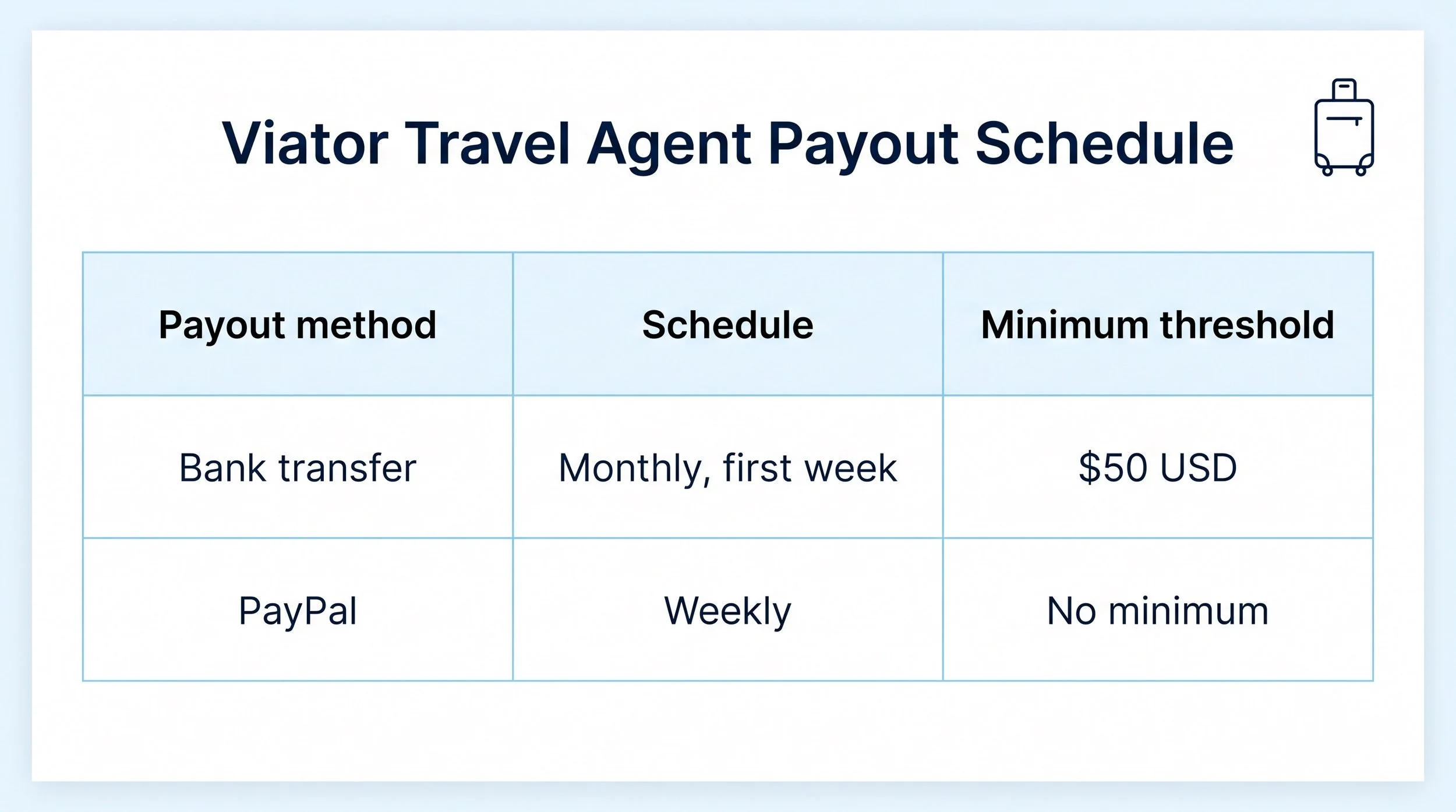
Viator Payout Schedule
Bank payments cover experiences finished in the previous calendar month, and if your balance is under $50, it carries over to the next month. PayPal payouts are sent weekly for experiences that happened the week before. You’ll usually get your commission on or before the seventh working day of the month.
Your commission will not expire as long as you stay registered, your banking details are up to date, and you book through the correct site.
Here’s how this affects your cash flow: if you book twelve summer experiences in February, you won’t see much income until July, when you’ll get two large payments in a row. Make sure to plan for this delay so it doesn’t catch you off guard.
You don’t earn anything from cancelled bookings, but you still get paid for no-shows if they weren’t cancelled. If you work with a host agency, Viator pays your host, and then your host pays you according to their own schedule and commission split.
Before you book anything, ask your host these three questions:
What percentage do I keep?
When will I get my activity commissions?
Are there any fees taken out?
An advertised 10% supplier commission doesn't mean a hosted advisor pockets the full 10%.

Let’s Clear Up the 20% Myth
You might come across articles saying Viator pays travel agents, "around 20%." That’s not accurate, and I want you to have the right information so you’re not caught off guard with a client.
Viator’s official program materials and launch announcement both list an 8% commission. The 20-25% number you may have heard is actually the booking fee Viator charges tour operators. That fee applies to suppliers, not agents.
To put 8% in perspective, GetYourGuide’s agent program offers up to 16% for your first 60 days, then drops to an 8% base. So 8% is the standard in the industry, and the higher introductory rate is just a way to attract new agents.
Here’s my advice, don’t stick to just one platform. Use Viator as your main option for its wide selection, exclusive deals, and how it works with Travefy. For bigger bookings, it’s worth comparing options.

Reserve Now & Pay Later: Your Best Closing Line
This feature doesn’t get enough attention, but it really helps boost bookings.
Clients can book most Viator experiences without paying upfront, even up to four months in advance, and they can cancel for free until just a few days before. Their card is charged automatically two days before the experience, or they can choose to pay earlier.
Viator sends reminders before any payment is taken. You can manage these reservations in your dashboard, where they appear as "Pending" commission until they are confirmed.
You’ll get your full commission for every Reserve Now & Pay Later booking, paid on the usual schedule after the experience is completed.
Viator's own data shows these products increase conversion and make travelers more likely to book high-ticket items.
Here's the pitch that closes: "Let's lock in the sunrise balloon ride now so it doesn't sell out. You won't be charged until two days before, and you can cancel for free."
It’s hard for clients to say no to that offer!

How to Pick Experiences Clients Will Actually Book
Offering more options doesn’t always lead to more sales. Too many choices can overwhelm clients, but suggesting three well-chosen tours often helps them decide.
Start by matching the experience to the traveler. Consider their age, mobility, children’s ages, budget, interests, energy level, dietary needs, fears, and preferred group size. A sunrise hike might be amazing, but it won’t suit everyone.
Look at recent reviews for patterns instead of just focusing on scores. A single bad review might not mean much, but if several people mention the same issue, like meeting-point confusion or a no-show driver, take it seriously.
Always check the cancellation terms. Most Viator products let you cancel for free if you do it at least 24 hours ahead, but each product can be different. Make sure tosend your client the exact deadline in writing. “Free cancellation” isn’t helpful if no one knows which time zone applies.
Keep the schedule flexible. Allow extra time between a flight’s arrival and the first activity, between when a ship docks and a tour starts, between tours, and between a day trip and dinner. For cruise clients, remember that “ship arrival,” “disembarkation time,” and “all-aboard” are all different times.
Don’t just pick the cheapest option. More expensive tours might include hotel pickup, admission, smaller groups, or better departure times. Explain these differences to your client instead of just choosing the lowest price.
Shore Excursions Deserve Special Attention
With Viator, you can filter shore excursions by your client’s cruise line, make sure the timing fits the ship’s schedule, confirm they’ll return on time, and check if port pickup is available.
This is a big advantage! Cruise passengers often pay extra for ship-sponsored tours because they worry about missing the boat. If you can find a better independent excursion and clearly show how the timing works, you’re giving your client real value on one of their biggest concerns.

Using Your Location: The Orlando Playbook
This is a strategy I use in my own area, but you can apply the same approach wherever you work.
Orlando is known for its theme parks, and millions of visitors come for them. Most agents focus only on the parks. But after a few days, families are tired. Their feet hurt, and the kids are done with waiting in lines. They start looking for something new to do without leaving Florida.
This is your chance to earn extra commission!
Rather than sending them to another theme park, suggest these options:
An airboat ride skimming across gator-filled marsh grass at golden hour
A bioluminescent kayak tour where every paddle stroke lights up blue
A clear-bottom kayak trip through spring water so transparent you watch manatees glide underneath
A Kennedy Space Center day with transportation handled
Airport transfers, which nobody thinks about until the rental car line ruins their morning
You earn 8% commission on each of these, and your client will appreciate that you suggested something they hadn’t seen online.
You can use this approach anywhere. Start by finding your city’s main tourist attraction, then look for relaxing experiences within an hour or so from there. For example, Las Vegas has Red Rock and Grand Canyon flights, Nashville offers whiskey trails and Cheekwood, and Salt Lake City has Antelope Island and slot canyon trips.
Every place has something extra to offer, and the agents who know about these hidden gems are the ones clients come back to!

Why FAM Trips Matter
Familiarization trips, or FAM trips, are steeply discounted trips that let agents experience a destination in person. They’re one of the best perks in this industry, and they also help you build expertise and trust.
You can sell a destination without having physically been there, but when you do visit the place you pick up on tips that help you stand out from others. Plus the content you get (photos, video, merchandise) is really helpful for posts!
When you go on a FAM, try booking a few local tours through your agent portal. Test how the booking process works. See how the operator manages vouchers. Check how the meeting point works in real life.
When you get home, you’re not just repeating a product description. You can tell a client, "take the small-group version. The big bus stops at four places and you’ll spend an hour on the coach." That kind of detail helps you close sales and get referrals.

Common Mistakes To Avoid
Booking on viator.com instead of travelagents.viator.com is a costly mistake for agents.
If you send a regular browser URL instead of your Share with Client link, you won’t get credit or commission.
Don’t expect quick earnings. Commissions are paid the month after your client travels, so plan ahead.
If you don’t re-share your link, you miss out on extra 90-day commission windows each week.
Don’t create a new agency account if your colleague already set one up. Join the existing account instead.
Signing up as an affiliate when you needed the agent program. Fixable via tapsales@viator.com, but it burns time.
Make sure you know your host’s commission split before you make your first booking, not after you get paid.
Don’t try to sell everything to everyone. Focus on a niche, like culinary tours in Italy, accessible travel, or cruise excursions, and become the go-to expert.
Always follow up. Check in with clients a week before their trip to confirm vouchers, and send a welcome-home note afterward. This helps turn one client into five.
Pay attention to time zones. Both the tour time and cancellation deadline use the local time at the destination.
Save all your documentation, including confirmation numbers, client approvals, cancellation terms, operator messages, and commission reports.
Be transparent about your financial relationship. If you post links online, clearly state near the links that you may earn a commission. Don’t hide this in a footer policy.

Your First 30 Days
Week 1: Get set up. Decide if you want to work with a host agency or independently. Check your state's Seller of Travel and business requirements. Create your account on the correct portal. Fill in your payout and tax details. Make sure you know your commission terms.
Week 2: Learn the platform. Look up five destinations you sell often. Try using the filters. Make some test links. Find out where to manage cancellations and reports. Watch two Viator webinars.
Week 3: Build your system. Write an activity questionnaire. Draft three client email templates. Build Curated Lists for your top destinations. Add an "experiences" checkpoint to your planning workflow. Set follow-up reminders.
Week 4: Start selling. Send personalized options to your active clients. Update your website content. Add widgets to your most popular destination posts. Publish a detailed destination guide. After that, check your clicks, bookings, and questions, then make changes as needed.
The goal is not to share links everywhere. Instead, focus on creating a repeatable process that truly helps people make better choices.

Frequently Asked Questions
Is the Viator travel agent program free to join?
Yes, it’s free to join. You won’t pay any enrollment fees, monthly subscriptions, or have to meet booking minimums to keep your account. The main costs you’ll have are for your host agency, accreditation, insurance, and marketing.
How much commission do Viator travel agents earn?
You earn 8% commission on every Viator product you book through your agent account, including shore excursions and group bookings. If you work with a host agency, they receive the commission first and then pay you your share.
When does Viator pay commission?
You get paid the month after your client finishes their experience. Bank transfers are sent out monthly if you have at least $50, while PayPal payments go out weekly with no minimum amount.
Do I need an IATA number to become a Viator travel agent?
You don’t always need your own IATA number. You can sign up using your host agency’s Viator Partner ID or an IATA, CLIA, CCRA, TRUE, or ASTA number. Most new agents use their host’s information.
Can anyone become a Viator travel agent?
You’ll need to be accredited and have a legitimate travel business. There’s no federal license required in the U.S., but Seller of Travel laws do apply in California, Florida, Hawaii, and Washington.
How long does my Share with Client link last?
The link does not expire. When a client clicks it, they have 90 days to book, and each new click resets the 90-day window.
What's the difference between the affiliate and agent programs?
Affiliates share Viator with their audience and get a 30-day cookie, with no need for accreditation. Agents book trips for clients, have a 90-day window for earning commission, and get access to features like Reserve Now & Pay Later, Curated Lists, and shore excursion tools.
Can I switch from affiliate to travel agent?
Yes, you can. Just email tapsales@viator.com and they will update your account type for you.
Do I earn commission if my client cancels?
No, you don’t earn commission on canceled bookings. However, if a client doesn’t cancel but doesn’t show up, you still get paid.
Can my client book without giving me their credit card?
Absolutely. That’s the main benefit of Share with Client links. Your client pays Viator directly, and you still earn your commission.
Can I share links on social media?
Yes, you can, and Viator encourages sharing links on social media to help you attract new clients. Just make sure to follow each platform’s rules and let people know you earn a commission.
Can I book my own tours and earn commission?
Many agents use Viator for their own travel, but whether you can earn commission depends on the current program rules and your host agency’s policy. Check both before booking for yourself.
Will I get a 1099 from Viator?
You might. Viator will send you a 1099 if you earn more than $600 in commission in a year. If you use PayPal, you’ll get your 1099 from them. Otherwise, Viator will mail it to the address they have on file, as long as you submitted your tax details before January 1.
Why can't I add my payout details?
You’re likely a member agent, not an admin. Only admins can add payout details and invite new users, so your agency host will need to take care of this for you.
Can I mark up Viator prices?
You can’t mark up prices in the standard agent or affiliate setup because Viator is the merchant of record. If you use the Merchant API, you can set your own prices, but you’ll also be responsible for customer service.

Wrapping It Up
Signing up to be a Viator travel agent is actually pretty simple. It just takes an afternoon to fill out some forms and save a link!
Agents who make real money from this focus on three basic things. First, they choose the right program from the start. Second, they use their client link over and over, not just once. Third, they stay patient during the payout wait while their bookings add up.
You already have some big advantages. Every time someone clicks your link, the 90-day window starts over. The Reserve Now & Pay Later option helps clients say yes. Travefy adds your link to every itinerary for you. Put these together and you can earn money even while you sleep.
So do this today. Get your credentials sorted, sign up on the right portal, finish your payout info, and book a small experience for someone you know. It could be a museum ticket, an airport transfer, or something else simple. Share that link. In six months, you'll pull up a commission report and be genuinely glad you started this morning instead of someday.
Go book something great!
Become a Travel Professional for Only $99
Turn your love of travel into extra income from home!
Join Now