
Expedia TAAP: The Smart Complete Guide for Travel Agents in 2026
Expedia TAAP is a free booking platform for accredited travel agents. It gives you access to Expedia’s worldwide inventory and lets you earn commission on bookings. That’s the standard explanation. But here’s what most people miss: there’s a timing trick in the commission tiers that can secure you a higher payout rate for over a year, and most agents don’t even notice it.
I’ll explain that in a moment. First, let’s clear up some confusion. TAAP in 2026 is not the same platform people complained about two years ago. It’s much stronger now. You can set your own fee in the booking, hold a hotel for a year without paying anything, and change dates without losing the rate you worked hard to get.
Grab a coffee. You’ll want to read this to the end!

What Is Expedia TAAP, Really?
TAAP means Travel Agent Affiliate Program. Imagine the regular Expedia site you know well, but now it's set up for work.
You still get the same search box, filters, and photo galleries, but the system behind it is different.
Here’s what it looks like in practice:
You use your client’s card to book, so you don’t have to pay upfront or manage a merchant account.
You earn commission on the full booking amount, including any taxes and fees paid at the time of booking.
Joining is free. There’s no signup fee, no subscription, and no sales quota.
It works in about 34 markets, so you can manage clients from Lisbon to Tokyo all in one dashboard.
You get access to tools just for agents, like property quotes, white-label vouchers, booking management, and reporting.
The inventory is huge, with over 3.5 million places to stay in more than 200 countries, 570 airlines, 110 car rental companies, and over 200,000 tours and activities. Expedia reports that more than 41,000 agencies use the platform, and it handles over 35 million searches each month.
It’s very easy to learn. If you’ve ever booked a flight on Expedia, you already know how to use it. This is intentional, and it’s why many new advisors make their first commissionable sale here instead of struggling with older systems.

Why Travel Agents Reach for It
It's a good question: why would a professional choose a big retail site over a wholesaler?
Sometimes, your usual suppliers just don't have what your client is looking for.
Imagine this, your client wants to stay at a small nine-room guesthouse in a Cotswolds village. You check your bed banks, nothing. You look on your consortium portal, still nothing. You ask your UK DMC, but they don't know it either.
Then you log into TAAP and find it right away. You can book it, get instant confirmation, and earn commission.
That's the everyday magic. You keep the sale, your client stays with you, and you avoid sending them off to book on their own. That's often how clients quietly stop being clients.
It's also a great backup for last-minute needs. Expedia says you can often book a place to stay right up until the day of check-in. This has helped many advisors when a family gets stranded overnight because of a canceled flight.

Who Can Join Expedia TAAP?
This is where many people get confused.
TAAP does not charge a fee, but it is not open to everyone. To register an agency, you need valid industry accreditation such as an IATA, ARC, CLIA, or TRUE number. Without these credentials, you cannot access the portal.
Honestly, this is a good thing. It ensures the platform is used by real travel professionals, not just anyone with a laptop and big ambitions.
Most independent advisors join through a host agency. The host agency provides the required accreditation. You set up your own TAAP login and connect it to the agency's credentials. This way, your bookings and clients are managed under your login, but use the host's accreditation number.
Before you choose a host agency, ask about their partner tier with Expedia. Top-tier partners have access to a dedicated support line, so you can reach a real person quickly if something goes wrong, even late at night. If you have ever waited a long time in a general queue during a busy period, you know how valuable this can be.
The Registration Walkthrough
Check with your host agency first. If they already have a TAAP account, creating a separate independent account can cause problems with commission tracking, ownership records, and pending payments if you ever decide to leave.
Always use the official portal. Avoid third-party websites that promise guaranteed approval or charge a fee. Expedia has warned partners about phishing sites, so carefully check the website address and never share your passwords or one-time passcodes with anyone who contacts you unexpectedly.
Appoint an agency manager. This person will be responsible for adding and removing agents, submitting tax documents, and receiving commission updates. Make sure to use an agency-controlled email address instead of a personal one.
Provide your business details, including your legal name, agency name, address, phone number, website, market, accreditation number, and tax information.
Wait for approval. Expedia says the platform should be ready to use within a few days, and you will receive an email with the next steps once you are approved.
Set up your account carefully. Add your approved users, review the commission settings, and learn where to find the cancellation and payment labels. Make a simple booking first before handling more complex itineraries.
I strongly recommend making that first practice booking. It helps you learn the workflow when there is less pressure.

Expedia TAAP Commission Rates in 2026
Let’s get straight to the point about money, since that’s what most people search for.
TAAP has a four-tier system based on your yearly gross booking value. The more you book, the better your rate. The concept is simple, but the details can get complicated.
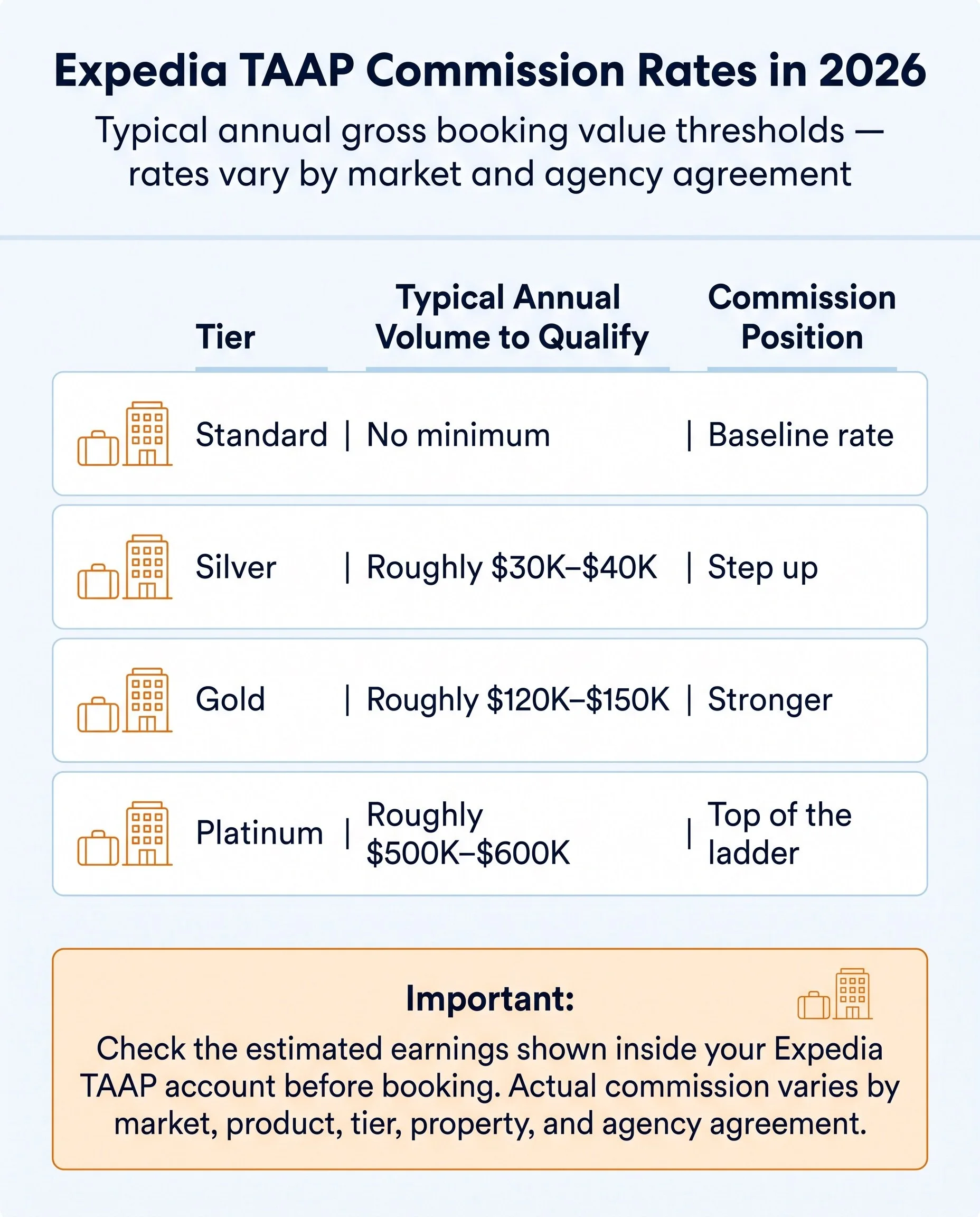
Expedia TAAP Commission Rates 2026
Let me be upfront with you, because I’d rather you know this now than find out the hard way. TAAP commission percentages vary a lot. Older reports showed top tiers from about 12% at standard up to 14% at platinum. More recent, market-specific rate cards start much lower, around 3% to 7%, and can go up to 11% to 14% at the highest levels. Both sets of numbers are accurate, they just come from different markets, years, and agency deals.
Here’s my advice, treat every percentage you see online, even in this guide, as just background info. The only number that really matters is the estimated earnings the portal shows you before you confirm a booking. That figure is live, linked to your account, and always accurate for your booking.
It’s also worth knowing, commission is calculated. It’s also important to know that commission is based on the total gross booking value, including taxes and fees paid at booking. This is a real advantage, since many suppliers only pay commission on the base rate. However, charges collected by the hotel at check-in, like resort fees, parking, or city tax, might be handled differently. Always check the estimate instead of guessing.s the insight I promised in the opening.
When you reach a new tier, you start earning at the higher rate from the next month, and it lasts through the end of the following calendar year.
Read that again, then do the math with me.
Imagine you’re just below a tier threshold in late November. If you make one big booking in December, your new rate starts in January and lasts through the end of the next year. That gives you about thirteen months at the higher commission rate.
But if you make that same booking in January, you’ll earn the old rate for most of the year before the higher rate kicks in.
It’s the same booking and the same client, but your income can change a lot just because of timing. Every November, check your year-to-date volume and see if it’s worth moving a booking up by a few weeks.
So, when do you actually get paid?
You get paid monthly, as long as you reach a minimum payout of about $25. Payments cover bookings that were completed in the previous month.
The word "completed" is important here. If you book a hotel in December for a February stay, you’ll see that commission in your March payment. Your income usually lags two to three months behind your sales.
This delay surprises many new advisors. Plan for it in your budget. And never spend commission before you actually receive it, since cancellations, refunds, or no-shows can wipe it out.

The Agency Service Charge: A Game Changer for 2026
If you read just one part, let it be this.
Expedia introduced the agency service charge, allowing you to add a fee of up to 30% of the total lodging booking value at checkout. This popular feature is now available in more places, including Canada, Australia, and New Zealand.
Why this matters:
No more separate transactions. Before, you had to invoice your planning fee outside the platform, which meant awkward conversations and extra payment links. Now, the fee is included in the same checkout your client already trusts.
You keep the full amount. When this launched in New Zealand, Expedia confirmed there are no processing fees.
You can choose a flat fee or a percentage, up to 30%. Set a fixed dollar amount or pick a percentage, it's up to you.
It's easy to track. Agency managers can see all service charges for the team on the monthly statement.
There are two limitations you should know about:
Right now, it only applies to lodging, including standalone hotel and package rates. It does not apply to flights.
Agents who have tried it found that you can't add the charge to itineraries that include flights, since flights are not commissionable. Expedia has said that flights and packages may be included in the future.
Here's a real example: You book a five-night Orlando resort stay for $2,400. Your usual commission is in the low hundreds. If you add an 8% service charge, you earn about $190 more for the same work.
Most advisors haven't tried this feature yet. You can be the one who does.

Book Now, Pay Later: Deferred Payments
The second hidden feature is the one your clients will really notice.
With deferred payment, you can secure a hotel booking now and pay later. In 2025, the advance booking window increased to 365 days, up from 280. Over 16,000 agencies had already started using this feature when Expedia last reported, and it has expanded to most TAAP markets since its 2021 launch.
Here’s why this matters for you:
You can secure early-bird pricing for clients booking a year in advance, without needing them to pay $4,000 upfront in February.
The Hard Change feature now lets you change dates, occupancy, or room type on a deferred booking directly in the portal. This means you no longer have to cancel and rebook, risking the rate you secured.
Bank transfer is now an available payment option, starting in some European markets.
Keep in mind that some accounts may have shorter deferral periods than the advertised 365 days. Always check your account’s terms before making promises to clients.
Also, remember that deferral means your client pays later, not in monthly installments. If they need a payment plan, a tour operator is usually a better choice.

The Real Story on Booking Flights
You can book flights alone in TAAP. There’s no need to add a hotel, and you’ll see live fares from many airlines. Just use your client’s card in the portal.
But if you book only flights, you won’t earn any commission.
Here’s why, airlines cut agency commissions in the late 1990s, so now there’s almost no profit on a single ticket for anyone. You’d face the same issue booking directly or through another portal. Expedia isn’t holding back anything other companies offer.
So what’s the best approach?
Bundle the flight with a hotel. When you sell air with a hotel, it becomes a commissionable booking. Even better, TAAP package rates are usually about 20% lower than what clients see on consumer sites for over 350,000 properties. This way, you’re giving your client a better deal, not charging them extra just so you can earn.
Ask one simple question. If a client says, "I just need flights," find out where they’re staying. If they haven’t booked a hotel yet, you have a chance to make the trip commissionable. If they already have a room, at least you know your options.
Consider charging a flat fee for booking flights only. This is a fair and common practice, and it helps avoid doing unpaid work.
Sometimes it’s best to send clients directly to the airline. If the itinerary is likely to change, booking with the carrier makes it easier for your client to manage changes themselves. Since you’re not earning commission, you don’t need to handle extra work.
One more tip to avoid most flight issues, the airline’s fare rules, not Expedia’s, control the ticket. Change fees, cancellation policies, and refunds are all set by the airline. Basic economy tickets are very restrictive. Make sure your client understands these rules before they pay. Spending a couple of minutes explaining now can save hours of trouble later.
How Package Rates Really Work
You get package pricing when you combine eligible lodging with a transportation option like a flight, rental car, train, or cruise. Sometimes, the transportation doesn’t have to be booked in the same TAAP transaction, but the discount only applies if it’s a real package. Don’t try to pass off a hotel-only booking as a package.
What to do if your client already booked flights somewhere else:
Make a note of their transportation details
Search eligible package pricing
Compare these rates with regular TAAP, direct bookings, and preferred supplier prices
Review the cancellation and payment terms for each option
Show your client the best overallvalue, not just the lowest price
Sometimes the package is cheaper, but a preferred hotel program might offer extras like breakfast, resort credits, or upgrades. Always compare the full offer.

TAAP Rewards: The Points Program Many Agents Overlook
TAAP Rewards is different from your commission. It gives you points for eligible lodging bookings, and you can redeem those points for digital gift cards from places like Amazon and Starbucks!
The program is easy to follow. You earn one point for every dollar, Canadian dollar, or Mexican peso you spend on eligible bookings. Points are pending until the traveler finishes their stay, then they become active and ready to use.
TAAP Rewards started in the US in 2022, then expanded to Canada and Mexico. Now, it’s also available in the UK, Germany, Spain, Australia, and New Zealand, each with its own local gift card options.
Before you start using TAAP Rewards, check these three things:
See if your market is included and which products are eligible.
Check if bundled package bookings are included.
Find out if your host agency allows you to enroll on your own.
TAAP Rewards won’t make you rich, but it’s extra money on top of your commission. You do need to opt in. If you’re already a TAAP advisor, just enroll with your TAAP email. Many agents miss out on their points simply because they haven’t checked the rewards dashboard.

Retail Rates vs. Net Rates: What You Need to Know
It’s important to know how TAAP is set up differently from a wholesaler or DMC, since this affects how you use each one.
With a wholesaler, you get a confidential net rate. For example, the room costs you $1,000, but the retail price is $1,400. You charge your client $1,400, pay $1,000, and keep the $400 difference right away. You set the markup, your client can’t compare prices, and you get paid immediately.
With TAAP, you work with retail pricing. Your client sees the $1,400 price online, and you book it at that rate. Your commission comes after the client travels. Since your pricing is visible, the new service charge feature is important. It gives you a clear way to get paid for your expertise when rates are transparent.
Neither model is better than the other. They are just different tools. Wholesalers are best for higher margins and better cash flow. TAAP is great for a wider selection, instant confirmation, and being familiar to clients. The most successful advisors use both options.

When TAAP Works Best—and When It Doesn’t
Use TAAP in these situations:
You want access to a huge selection of hotels worldwide in a single search
Your usual suppliers are sold out or don’t offer the property you need
Your client needs a last-minute room for tonight
You can save money by booking a package rate that includes both air and hotel
You’re putting together a custom trip with activities and transfers
The trip is 6 to 12 months away and deferred payment helps with budgeting
You want to include a service charge without sending a separate invoice
Look elsewhere when:
You’re booking a cruise, an escorted tour, or an all-inclusive where you have a strong supplier relationship
Your client wants to pay in true monthly installments
You’re booking only air with no hotel, since you wouldn’t earn commission
The trip has complicated multi-city ground arrangements, and a regional DMC can offer better pricing and service than an aggregator
Loyalty program benefits are very important to your traveler
It’s important to know this, travelers shouldn’t expect to earn hotel loyalty points, elite night credits, or status perks when booking through a third party. Each brand and rate type has different rules. Always check what’s included before booking to avoid surprises at check-in.

What's New in 2026: Back-Office Tools
In June 2026, Expedia TAAP shared that it is now more than just a booking platform. They introduced a back-office API and let you add your own internal reference codes to bookings.
With reference codes, you can tag a reservation with things like client IDs, trip files, advisor names, branch locations, group numbers, accounting categories, or marketing campaigns. For example, SMITH-ORLANDO-0326 links a hotel booking to your CRM and bookkeeping at the same time.
The API is especially useful for larger agencies. It links your booking data with your existing systems, which helps you avoid entering the same information twice and makes it much easier to match up TAAP with your accounting. Since access and technical needs can differ, check if you qualify before planning to set it up.
If you work on your own, just using the reference code is a simple but valuable benefit. Start using it right away, and your monthly reconciliation will be much easier.

A Workflow That Really Works
This is how I handle a typical hotel request from start to finish.
Before you start searching, gather the exact dates, number of travelers and their ages, budget range, preferred neighborhood, bed setup, any accessibility needs, must-have amenities, loyalty program preferences, and how flexible the cancellation policy needs to be.
When researching, compare at least three channels: TAAP, a preferred supplier or consortium portal, and the hotel directly. For each option, note the total price, included benefits, estimated commission, payment schedule, and cancellation deadline.
Before booking, send a brief written proposal with just three options, not a long list. Choose the best value, best location, and best overall experience, and include one sentence for each explaining your choice. Ask for written approval. List your service charge or planning fee separately to make its value clear.
After booking, save the itinerary number, supplier confirmation, payment receipt, and the cancellation deadline with the correct time zone. Add the reference code to your CRM. Set a calendar reminder before the cancellation window closes. Send well-prepared documents along with a note that explains where to check in, which confirmation to show, what might need to be paid locally, and who to contact if any issues come up.
The vouchers TAAP generates are good. Vouchers plus your instructions feel like a professional service.

Common Mistakes New Agents Make
Booking on the public Expedia site is a common mistake. It happens every week. An agent moves quickly, ends up on the consumer homepage, makes a booking, and earns nothing. Always check the URL before you submit.
Chasing flight commissions is rarely worth it. You can spend hours handling schedule changes for a payout that barely covers lunch. Instead, focus on lodging, packages, and activities.
Ignoring local charges can cause problems. Resort fees, city taxes, parking, and deposits often surprise clients at check-in. Make sure to disclose these in writing.
Not recording cancellation deadlines is risky. Policies usually follow the property's local time. Always save the exact date, time, and time zone.
Promising unconfirmed requests can lead to disappointment. Connecting rooms, high floors, early check-in, and views are only requests unless the supplier confirms them on the reservation.
Skipping the rewards dashboard means missing out. Remember, points will not redeem themselves.
Sharing one login across a team causes problems. It reduces accountability and creates security risks. Make sure each authorized user has their own login. Forgetting to reconcile can cost you. Booking is only half the job. Audit completed trips on the same day each month and compare the portal's reports with your own records. Expedia usually pays reliably, but you are the best person to watch your money as you do.

Worried about a price drop? Here’s what to do
Clients often check prices after booking. It’s normal. If they see a flash sale online and call you, there’s a simple solution.
If you booked a refundable rate, you can usually cancel and rebook at the lower price. This saves your client money and shows the value of choosing refundable rates over non-refundable ones for small discounts.
Set TAAP’s filters to show refundable options first. Non-refundable rates may seem appealing to clients but can cause problems for you.

Frequently Asked Questions
Is Expedia TAAP free for travel agents?
Yes, it’s free. There’s no signup fee, no subscription, and no minimum sales requirement. The main thing you need is valid agency accreditation. If you work with a host agency, they might have their own membership fees or commission splits, but that’s separate from Expedia TAAP.
How much commission does Expedia TAAP pay?
Commission rates depend on the product, market, your tier, and your agency agreement. Published rates start in the low single digits and can go up to about 14% at the highest tier. Always check the estimated earnings shown in the portal before you confirm a booking. That’s the number that applies to your account.
Do I need an IATA number to join?
Your agency must be accredited with IATA, ARC, CLIA, or TRUE. If you’re signing up under a host agency that already has accreditation, you don’t need your own.
Can I join without a host agency?
You can only join without a host agency if you have your own accreditation. Because getting accredited is tough for new independent advisors, most agents use a host agency to access TAAP.
When do I get paid?
You get paid monthly, as long as you reach about a $25 minimum. Payments cover bookings that finished in the previous month. For example, if you book in December for a February stay, you’ll get paid in March.
Does commission include taxes and fees?
Yes, commission is paid on the total gross booking value, including taxes and fees paid at the time of booking. However, charges collected locally by the property might be handled differently.
Do Expedia TAAP flights earn commission?
Standalone flights do not earn commission. If you sell flights as part of a package that includes lodging, then the booking is commissionable.
Can I add my own fee to a booking?
Yes, you can. The agency service charge lets you add up to 30% of the total lodging booking value at checkout, either as a flat amount or a percentage. Right now, this applies only to lodging, but flights and packages may be added in the future.

Finishing Up
Expedia TAAP in 2026 is truly different from what it was two years ago. While most people focus on the commission ladder, the real change is in the stack: tiered commission, a service charge you set, deferred payment for up to a year, rewards points, and in-platform changes that keep your secured rate intact.
When you add all these features together, bookings that once seemed less profitable now bring in real earnings. Your clients get better cash flow, and you have less administrative work.
Here’s what I’ve noticed. Advisors who get the least from this platform use it only as a discount hotel search. The successful ones treat it as a business tool. They create packages instead of just selling flights. They charge for their expertise, join the Rewards program, and know when to use other booking options.
This week, focus on three steps. First, log in and review your current rate card. Next, activate TAAP Rewards. Finally, on your next hotel booking, add an agency service charge, even if it’s just 5%, to see how simple it is.
You already have access to one of the world’s largest travel inventories. Make sure you’re earning what you deserve for using it well!
Become a Travel Professional for Only $99
Turn your love of travel into extra income from home!
Join Now