
How to Become a Travel Agent in Madison, WI
There’s a two-billion-dollar visitor economy in Madison, Wisconsin ready for anyone who dares to take it! Here, you can put together commissionable travel for actual clients in a matter of days rather than months. Add to that the university population and what goes on at Capitol Square, not to mention the unpretentious way business is done in Wisconsin, and you have a college town where it’s no great expense or trouble to start a career in travel from your laptop. In many ways, it’s among the most accessible places in the country to become a travel agent. Let’s go through the steps together on how to become a travel agent in Madison, Wisconsin.

What Do Travel Agents Do These Days?
First, let’s put one thing to rest. The days of a travel agent sitting at a desk and issuing paper airline tickets are long gone. These days most prefer the term of, “travel advisor”, for good reason; they do far more than simply put in a reservation.
Their job is to put together an itinerary that suits a client’s style, requirements and budget. This means they’ll be on hand to:
Select a destination
Put hotels and resorts head to head
Locate a suitable cruise ship
Map out tours and activities
Draw up a plan for each day
Make the bookings for flights, cars and transfers
Keep tabs on deposits and final payments
Lay out the cancellation policy or any passport rules you should know
Step in if plans go awry
See to it that all the details are in order
Advisors arrange business and leisure travel, size up what the client wants, run the numbers on fares and schedules, and sort out new arrangements when necessary. We also handle the documentation.
That last bit is no small thing. There’s plenty of value in an advisor when a client presents you with something like this: “There’s six of us, we need three rooms, there are two with food allergies and one in a wheelchair, and under no circumstances will Grandma get on a plane before 10am in the morning.”
You can click a button to book a hotel yourself. But now you have a puzzle on your hands and that’s where a capable advisor makes their mark.
It’s a mix of planning, sales and problem-solving. You’ll be talking to clients, doing research, following up and running the books. An independent agent has to run a small business as well, which entails marketing, social media, invoicing and tracking commissions. It’s not something to be put off by; you do not have to master it all on day one. You pick up the skills in time.
As for whether anyone still employs a travel agent, the answer is yes! For a single person going on a short trip an online site might be fine. But almost anything outside of that a travel agent will make things so much easier, they’ll do all the heavy lifting which is a huge draw for most people. The desire for advisors is continually growing, so there’s no shortage of clients.
You might book a single night in a hotel on your own. But a honeymoon, a theme park holiday or a family excursion across three countries is a whole other matter. Those have more moving parts than a baggage claim in spring break.

Why Madison Is a Great Place to Start
For a new travel agent, Madison presents an uncommon combination of advantages: a solid local clientele, minimal overhead and a state government that doesn’t stand in the way. There’s no shortage of deep buying power for group or leisure travel in Dane County; tourism spending in excess of two billion in a recent year has put more than 21,650 jobs on the books.
Then there’s the University of Wisconsin-Madison which, by virtue of its alumni, visiting academics, sports fans and families, creates a steady stream of travel demand. A new agent can count on this as a warm market even before running an advertisement.
The appeal of Madison extends to the fact that it’s in a state with few bureaucratic impediments for the would-be travel entrepreneur. Unlike some of their counterparts in more restrictive states who are still tied up with paperwork, a driven resident here can be making bookings right away.
Wisconsin requires no exam or mandatory certification and does not issue a travel agent license at all. Add to that a $130 fee to file an LLC online and the state’s low cost of living, and you’ll find Madison to be among the most financially open markets in the Midwest for an advisor in their first year!

Does Wisconsin Require a License or Registration?
In Wisconsin, you can sell travel without the need for a Seller of Travel license, state travel agent certification or any particular educational background. That’s not the case in Florida, California, Hawaii and Washington; those states have Seller of Travel laws on the books and will not allow anyone to do business with their residents without proper registration.
For a Wisconsin agent looking to serve clients in any of those four jurisdictions, the strict rules mean it is necessary to work out of a host agency that has an existing Seller of Travel license. The individual licensing process in those states is too costly and involved to be practical.
But don’t mistake the absence of a state license for an absence of paperwork. There are three registration matters you need to do, each different depending on the route you take.
First, a local business license may be needed by some Wisconsin municipalities for self-employed individuals running a home office. A phone call to the clerk’s office to put in the word about remote work can prevent zoning headaches before you start accepting clients.
Second, there’s the matter of forming an LLC or corporation, which requires filing with the Wisconsin Department of Financial Institutions (DFI) regardless of city licenses.
And third, while Malinda’s Law covers traveling sales crews that do door-to-door group sales overnight, it’s of no consequence to the ordinary home-based or remote advisor.

Getting Set Up Through a Host Agency
The Host Agency Route
This is by and large the most popular method for a Wisconsin travel advisor to begin operating legally, not to mention the quickest and least expensive! It also has the advantage of avoiding the registration hassles outlined above.
To make it work, you’ll need to do some legwork to compare host agencies on a number of things, like their commission structure, fees, the caliber of training and supplier ties they offer.
Once you’ve made your choice, fill out the host’s application or click their join button; expect to put a signature on an independent contractor agreement at some point in the process.
After finishing the required training (a matter of a few hours if you work hard), you’ll be able to book under the host’s IATA and CLIA numbers and E&O insurance rather than having to secure those on your own!
In most cases, approval and the ability to start booking comes in 1-5 days, depending on how much time you put into it.
The Fully Independent Agent
For those inclined to go it alone, the path is more involved and costly, including a direct application for IATA/IATAN accreditation.
First, put in the paperwork with the Wisconsin DFI to register a legal entity; an LLC can be filed online for $130.
Then there’s the matter of credentials, provide documentation of two years in travel sales or get recommendation letters from a certified professional or accredited agency.
Errors & Omissions insurance is also a must unless your experience prevents the need for it.
The application goes in through the IATA/IATAN portal along with proof of financial stability and banking details. A solo advisor should budget for the $110 application and annual fee, then allow 4-6 weeks for the review to be completed.
Registered Business Owner (Agency)
Opening an actual agency is a step up from being a solo contractor and calls for a more rigorous version of the independent process.
Start by filing Articles of Organization with the Wisconsin DFI for an LLC or corporation ($130 if done online, $170 by mail).
A Wisconsin registered agent needs to be put in place and an EIN obtained from the IRS at no charge.
Registration with the state Department of Revenue for taxes is also required.
When it comes to IATAN accreditation at the agency level, the fees are steeper – about $280 to apply and $120 a year – and the bureau will want to see audited statements or bonding as evidence of financial standing. Don’t forget the $25 online fee for the mandatory annual report to the DFI to keep things in good order.

Training and Certifications Worth Pursuing
While Wisconsin doesn’t require formal training, there’s no mistaking the value of a top-tier certification when it comes to making an impression on suppliers and clients or getting noticed by FAM trip selection (if required).
The Travel Institute’s Certified Travel Associate (CTA) is the entry-level credential with the broadest recognition. It’s open to those with a year of industry experience or a good showing on the Travel Agent Proficiency exam. The price tag is in the $419-$599 range, depending on your payment plan and edition, with ten continuing education units needed each year for renewal.
For an agent looking to put in some more specialization once the CTA is accomplished, the institute offers the advanced Certified Travel Counselor (CTC).
Then there’s the CLIA Individual Agent Membership (IAM), which puts one’s cruise expertise front and centre for both the client and the supplier! Most agents will secure this through their host agency’s TAM plan at an annual cost of $69-$89, rather than foot the full $119-$139 bill.
And for a new advisor who hasn’t qualified for the CTA, there’s always the free route of destination-specific certifications from the likes of the Disney College of Knowledge, Sandals or various cruise line academies; they are an effective way to establish credibility in short order.

IATA and CLIA: Costs, Renewals, and How to Get Each
There’s a distinction between IATA and CLIA credentials, each with its own function. In Wisconsin, the majority of agents will find it more practical to obtain both via a host agency as opposed to making a solo application.
Here’s how the numbers break down for IATA/IATAN:
An independent advisor looking for his or her own accreditation can expect to pay roughly $110 to apply and another $110 on an annual basis. For a travel agency the figures are about $280 for the application and $120 per year; a corporate travel department faces higher costs in the range of $410 to $450 to apply and $184 to $210 annually.
If you choose to apply on your own, approval isn’t very quick. The process can run 4-6 weeks and requires documentation of E&O insurance, financial stability, business registration and at least two years of sales experience. A business owner would first put in the Wisconsin entity paperwork before submitting an agency-tier IATAN application with the requisite audited financials or bonding.
The alternative is to go through a host agency. Once onboarding is done, the agent has access under the host’s IATA number without any further fee, waiting period or separate application to worry about!
CLIA membership is structured like this:
A Travel Agency Member (TAM) runs $399 to $429 a year and comes with a complimentary Individual Agent Membership for the owner. On its own an IAM is $119 to $139 annually, but an agent under a host with a Premier or TAM affiliation will see a discount to somewhere in the $49 to $89 range. To maintain an active status, IAM holders have to clear the free State of the Industry course and quiz from CLIA when renewal time comes around in November.
For those operating as a business owner, the path is to register the agency for TAM on cruising.org and put in individual memberships for the staff. An agent working with a host can simply be added under the host’s membership at the lower rate.

Picking a Niche
There’s value in specializing. It allows a new advisor to position himself as the expert of choice rather than being drawn into a price war with every search engine out there. Niche agents will tell you they see better repeat business and more open doors for FAM trips from suppliers who know precisely who to look at.
And when you have a command of a particular lane, bookings are made in short times, supplier ties are stronger and pricing is at an all time high; after all, a client is paying for that expertise, not just a reservation!
In Madison, some niches present themselves as particularly worthy of attention:
University-linked travel. You can make the most of UW-Madison’s vast alumni and family network by handling graduation planning, Big Ten sports packages or the kind of travel alumni and parents undertake for weekend visits.
Group and conference travel. The likes of Monona Terrace and the Alliant Energy Center put on a steady parade of conventions, which in turn generates need for add-on leisure and group hotel blocks.
Midwest drive-market getaways. Before committing to something on an international scale, many in the Madison area like to book an easy side trip to the Dells, Chicago or Door County. Regional knowledge here is a good way to earn a client’s confidence.
Multigenerational and family reunion travel. Since what visitors do in Madison is largely dining, shopping and sightseeing, an agent can build on those interests with domestic or cruise packages that cater to the whole family on a larger level.

How Much Travel Agents Make (and How They Get Paid)
Before we get into how much travel agents make, no matter what the averages are you can always beat them by putting in the work! Just like most good things, the more you put in the more you’ll get out. You don’t have to be an, “average” travel agent!
The national median for a travel agent is put at $48,450 a year, but one would be hard pressed to find such uniformity on the ground. The actual numbers vary widely with the type of employment. A new hosted independent in his or her first year might see less than $15,000, whereas an old hand at full-time hosting will average between $60,000 and $67,000! Those who are fully independent with their own accreditation come in near $78,900. As for straight salary employees, they average $49,900; add in commission and the figure is closer to $62,000!
Wisconsin is no different in that regard. Here the median comes in at some $43,970, which is in keeping with the W-2 and small-agency make-up of a market like Madison. For host-affiliated or independent agents it’s the commission that drives earnings. Hotels run about 10%, tours and packages 10-20% and cruises 10-16%. Travel insurance offers the best margin at 15-35%, while domestic airfare is so unprofitable that agents have to put a flat planning fee of $25 to $75 on top of it.
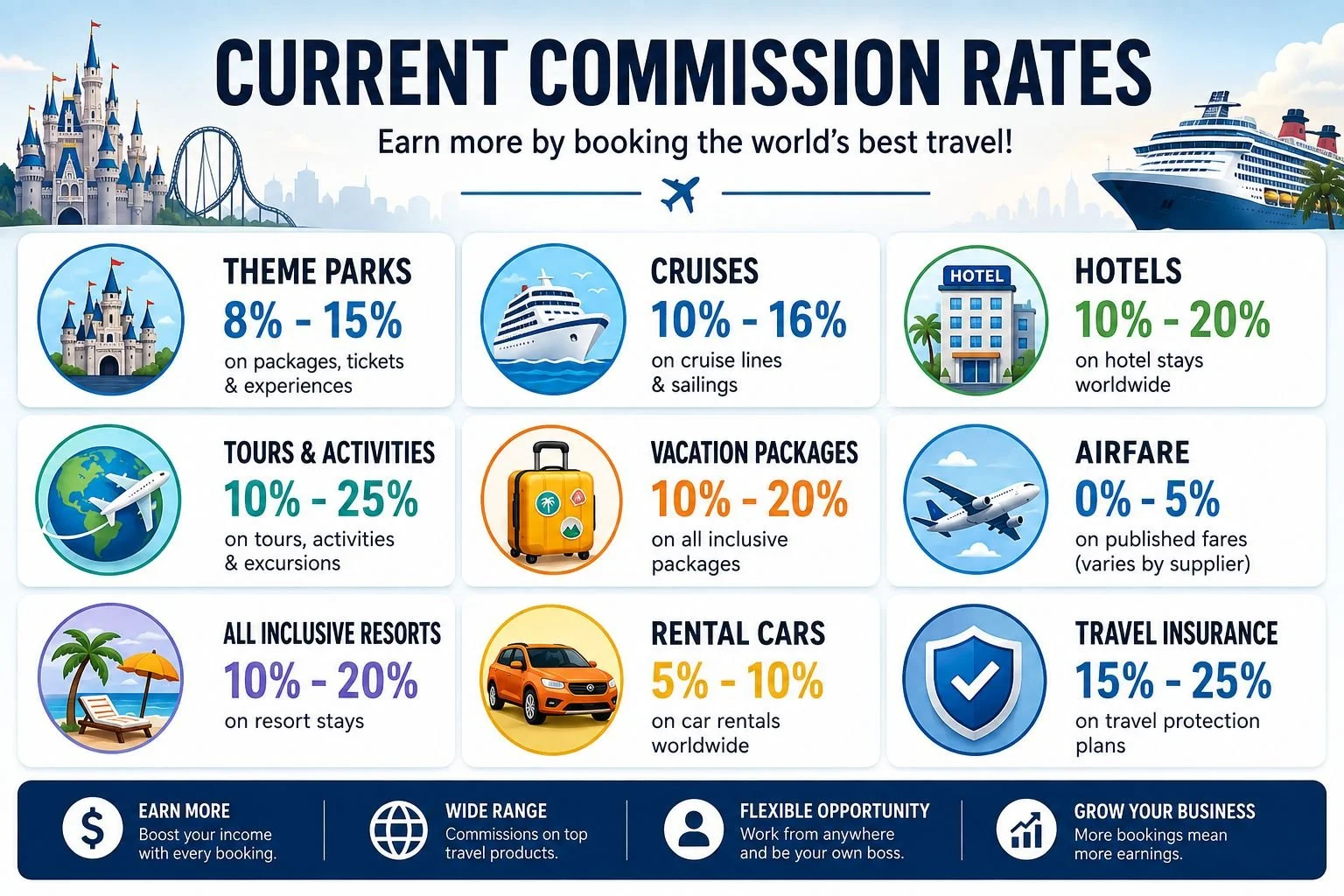
Commissions are subject to change*
Then there’s the matter of when the money arrives, something that can be a shock to the new agent. Do not expect to be paid as soon as a booking is made. The supplier will not put anything in the host’s or agency’s pocket until the client has made the journey. It’s common for 5-10 days to elapse after the return date before the payout clears any post-travel cancellations and supplier accounting. That’s how the industry works in every state; a Madison agent offloading a summer cruise will likely wait until autumn for the commission to show up.

Business Setup Basics
There’s a lot of value in getting the business side of things setup from the start; it’s a way to sidestep any legal or tax complications later on. Wisconsin, for the most part, makes that process straightforward and inexpensive!
Start by deciding on a structure. You can opt for a sole proprietorship with no state filing required, or form an LLC to put a protective barrier around personal assets. The latter will run $130 to file with the DFI online. If you choose an LLC, the Articles of Organization are submitted via the DFI portal. Processing usually takes between 1-7 business days, though there’s a $25 charge for same-day service.
A registered agent must be named. The owner can serve in this capacity at no expense, or a commercial service can be retained for an annual fee of $100 to $300.
An EIN is another matter to handle; the IRS website provides this free of charge for the purpose of opening a bank account and handling taxes. In fact, having a dedicated business account is the best way to ensure commission income does not get mixed up with personal funds.
If the business involves selling products or is of a certain type, registration with the Wisconsin Department of Revenue is needed. And even where the state does not mandate it, some municipalities do, so it is worth checking with the Madison city clerk to see if a local license is needed for a home-based operation.
For insurance, Errors & Omissions coverage should be put in place, whether through a host agency’s group plan or your own. To maintain good standing with the DFI, the $25 annual report is due every year.
Finally, a brief, one-page plan is advisable to set out the niche and 90-day marketing objectives for target clients; it helps keep the early momentum from becoming unfocused.

How to Find Clients
In my experience, the first and quickest clients will invariably be drawn from those closest to you rather than cold advertising. The most sensible way to begin is to put word of the new venture out to everyone within reach!
Make an announcement to friends, family, old travel companions and coworkers; a warm referral from someone known is much more likely to convert than a stranger.
Put in some time at the events on Madison’s crowded calendar to get face-to-face with prospects, be it a UW-Madison alumni function, a conference at Monona Terrace or one of the local Chamber of Commerce mixers.
There are also opportunities for cross-referrals by aligning with other local outfits in the travel sphere, like wedding planners, photographers or fitness studios that put on destination retreats.
And do not overlook the Facebook and Nextdoor groups in the area where locals are looking for travel advice!
For independent advisors, past and referred clients have always been the best source of new business in terms of cost and conversion. It pays to offer a modest incentive to former clients for making a referral!

How Long It Takes to Become a Travel Agent
It’s entirely feasible for a person of action to be up and running as a legal travel agent in Madison in as little as 1-5 days! The quickest way to do so without the need for a state license in Wisconsin is to go through a host agency. Here’s how the timeline would look:
Day 1: Put in an application or join with a host after a lot of research.
Days 1-3: Do all the onboarding and required training.
Days 2-4: Take care of the business end of things, such as putting together social media profiles, a landing page or website and a proper email address.
By day 3 or 5, onboarding should be complete. At that point you’ll have access to the booking tools and the host’s IATA/CLIA standing to make your first booking!
A different matter altogether is if the goal is to be fully independent with an LLC and IATAN accreditation. That route demands more from IATA in the way of review, insurance and paperwork, so it will run several weeks to a few months.

FAM Trips: What They Are and Why They Matter
Suppliers in the travel industry (cruise lines, hotels, resorts or tourism boards) put on what are known as FAM trips, or familiarization trips. The idea is to give agents an educational opportunity to see a product or destination with their own eyes before putting it on the table for a client!
Do not mistake them for a full on holiday. They’re working trips of a sort, designed for site inspections, training from the supplier and some networking with brand representatives and fellow advisors.
There’s value in making the time for a FAM trip. An agent who has been there can speak with the kind of confidence and detail that puts a client at ease and brings a sale home quicker than any amount of brochure recitation will. It’s also a chance to put in a good word with a supplier’s business development manager, which can open the door to better perks and first refusal on future invitations!
Agents looking to make the most of these excursions would do well to follow a few practices:
Make sure to have your sales record and social media in order. Suppliers want to know you will be moving inventory once you get back, and they tend to put those agents at the top of the list.
Specializing in a niche also helps; you’ll be paired with the right FAMs more quickly than if you’re a generalist.
Before you go, finish off any training the supplier has made a prerequisite, as hosts are apt to check on that before they send out an invite.
Once on the ground, take copious notes on the amenities, room types and the like, noting the pros and cons for your clientele. That material makes for good content and a tailored recommendation when you are back in the office.
And be sure to put in the work to network with the other agents and reps on hand; those are the sorts of connections that turn into joint marketing down the road.
Common Mistakes to Avoid
An agent in Wisconsin may forgo E&O insurance on the grounds that a state license is not mandatory, but this leaves you open to personal liability if a booking is mishandled.
There’s also the matter of FAM trips; viewing them as a free vacation instead of what they are, a working trip, will erode the trust of suppliers and put an end to any future invitations. That doesn’t mean you can’t have fun during classes, afterall you’re meant to test out the theme park, cruise ship, or hotel!
Some make the mistake of commingling business and personal funds when a separate account should have been put in place from the start. Or they attempt to be a generalist right out of the gate rather than establishing a niche, only to find that it complicates the building of supplier ties and marketing efforts.
Cash flow is another area where errors are made, such as failing to budget for the 30 to 90 day window after travel before commission payouts arrive.
And while Wisconsin does not call for a state license, an agent operating out of a home office might overlook the need for a local Madison business license.
Finally, one might be tempted to sign with a host agency for the sake of the top commission split, but without due diligence on the quality of training, support and access to suppliers, it’s a poor choice!

Frequently Asked Questions
Does Wisconsin require a license to become a travel agent?
No. Wisconsin has no state-level license or registration requirement for individuals selling travel, unlike states with Seller of Travel laws such as Florida, California, Hawaii, and Washington.
How fast can someone become a travel agent in Madison?
Applying through a host agency, someone can complete onboarding and start booking clients in as little as one to five days, since no state license or exam stands in the way.
Do travel agents need a college degree?
No degree is required in Wisconsin; a high school diploma or GED is the general baseline expected by most training programs, though it is not a legal requirement to sell travel.
How much does it cost to become a travel agent through a host agency?
Many host agencies charge little to no upfront fee and instead take a percentage of commission, commonly keeping 10-30% while the agent keeps the rest.
What is the difference between IATA and CLIA?
IATA/IATAN is the accreditation that lets an agency issue and earn commission on air travel and broader bookings, while CLIA is a cruise-industry-specific membership that provides training and supplier access focused on cruise sales.
How much do travel agents typically earn in their first year?
New hosted independent advisors often earn under $15,000 in year one, since building a client base and waiting for commission payouts both take time.
Why does it take so long to get paid after booking a trip?
Suppliers pay commission only after the client has actually traveled, and processing typically adds another 30 to 90 days on top of that, which is standard industry practice rather than a state-specific rule.
Is a niche really necessary, or can someone just sell everything?
A niche is not legally required, but it significantly improves marketing focus, supplier relationships, and FAM trip access, which is why most successful independent agents specialize within a year or two!
Wrapping It Up
For the new travel agent, Madison is hard to beat! The city has a thriving local visitor economy and a client base that will book on the spot when they see some genuine expertise. On top of that, there is hardly any red tape to contend with in this state. It doesn’t take much to get started; put in the work to find a niche and align with a host agency, and one can be putting commissionable travel in the books in a matter of days. In short, there has never been an easier time to make a business out of a passion for travel here!
Become a Travel Professional for Only $99
Turn your love of travel into extra income from home!
Join Now